3 French Mountain Villages Ideal For All Seasons
Property
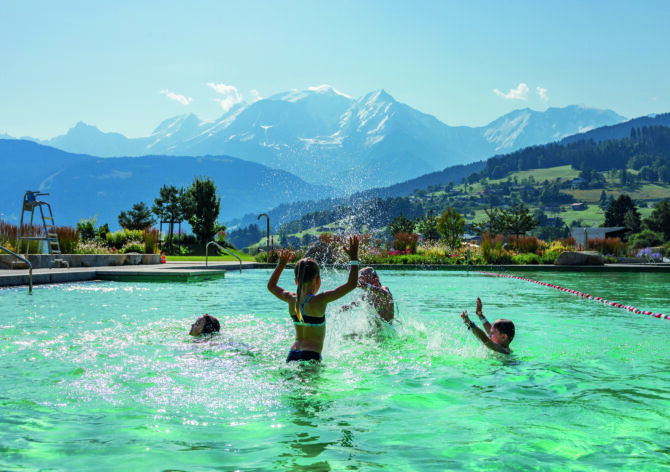
If you want to enjoy outdoor activities year round in France, head for the hills – Carolyn Reynier looks at three middle-mountain villages ideal for all seasons
Looking for a home for all seasons? Look no further. The French have always appreciated the joys of mountain holidays for snow sports, summer hiking or just a breath of fresh air – un bol d’air frais. Here are three stations-villages, authentic middle-mountain villages with ski resorts attached one in the Grand Est region, the other two in Auvergne-Rhône-Alpes.
Firstly, in Alsace in eastern France, Sondernach and the Schnepfenried ski resort are in the Haut-Rhin department in the Munster valley. We’re in the heart of the 2,947km² Parc Naturel Régional des Ballons des Vosges, 61% of which is forest. Picturesque prefecture Colmar has its famous Unterlinden Museum; cross the Rhine and you’re in Germany and the Black Forest.
Secondly, Mijoux is in the northeast corner of Ain in the Pays de Gex. You’re surrounded by the Jurassic mountains, forests and crystalline rivers of the 178,000 hectare Parc Naturel Régional du Haut-Jura. The Mijoux-La Faucille ski area offers panoramic views over shimmering Lake Geneva, Mont Blanc and the Alpine chain.
Thirdly, Combloux in Haute-Savoie has 13th-century origins, pine forests and is situated below Mont Blanc. Close to Savoie, it offers skiing for all levels in two distinct ski areas – Les Portes du Mont-Blanc and Evasion Mont-Blanc. Discover Savoyard flora, fauna, wines and local dishes like diots au vin blanc (pork sausages) and crozets, which are small square-shaped pieces of pasta.
MUNSTER MAJESTY
In the Munster valley, you’ll find fermes-auberges where you can enjoy local dishes like gratin des marcaires – local Munster cheese, potatoes, lardons, butter and onions. Marcaire is the name given to Munster-making Vosges massif dairy farmers. It comes from the Alsatian word malker, the person who milks the cows. For centuries, the marcaires and their herds have shaped these mountain landscapes.
Le Schnepf (1,100m) is one of the largest ski areas in Alsace and Vosges- plus it has a toboggan run for the under-sixes. Glwadys Gebele of Safti says in Le Schnepf you’ll generally find small 60m²-100m² chalets and a few apartments. Prices for chalets set back from neighbours are circa €3,500/m². There are more apartments at the tiny resort of Gaschney at nearby Muhlbach-sur-Munster. Here, small old residential buildings are right by the ski runs (au pied des pistes). Prices are cheaper because these holiday home apartments usually require renovation. Expect to pay around €2,000-€3,000/m² for one with no work required.
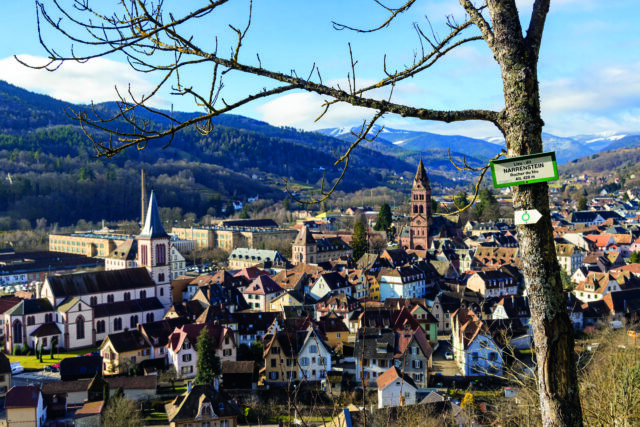
Many valley buildings were destroyed during World War I, so much property in Sondernach – awarded La Croix de Guerre after the war – dates from the 1920s. You typically find large old farmhouses originally occupied by parents and offspring living in two apartments, one on the ground floor, one above, with an adjoining barn for livestock. These rural properties make up much of the market here. Check out other villages such as Breitenbach, Stosswihr and Soultzeren. Expect to pay €2,000-€2,300/m² for a ferme needing no (or minor) work. Some owners sell just one apartment – usually cheaper at circa €1,800-€2,000/m².
Nearby Mittlach also has many small chalets. If you prefer an apartment in the centre of Munster – old ones with cachet may have wooden parquet floors and exposed beams – prices are around €2,100/m² for two bedrooms, depending on whether it has a terrace, garage or parking space.
In winter you can enjoy snow sports, and Christmas markets in Colmar and Germany. And the rest of the year, just appreciate the magnificent Vosges mountains, visit the ruins of the 7th-century Benedictine abbey in Munster on the River Fecht, marvel at rooftop-nesting storks, and hike and mountain bike.
There’s a train service from Metzeral to Colmar. From here you can travel north to Strasbourg or south to Mulhouse and Basel. “Folk often settle in the valley to be close to, but not actually in, Colmar,” says Glwadys. You have everything to hand. It’s a dynamic, beautiful and tranquil valley.
MARVELOUS MIJOUX
Stroll around Mijoux (1,000m) and admire houses decorated with frescoes depicting bygone trades and traditions. Gentle slopes make Mijoux an ideal resort for beginners, plus there are slopes for the more adept. The La Vattay-Valserine Nordic ski area extends from the Vattay plateau deep into the forests of the Swiss canton of Vaud and along the riverbanks of the Valserine valley. A piste damée (compacted snow path) takes you back down to Mijoux. Next July, the village celebrates its 50th Fête des Bûcherons, the oldest one in France, with wood sculptures by local artisans. And do taste the local Bleu de Gex cheese with a glass of Jura vin de paille (straw wine.)
“You can buy small 1990s apartments at the foot of the ski slopes,” says Sylvie Werbrouck at Monts Jura Immobilier. Expect to pay circa €60,000 for a T2 (one-bedroom place). You’ll also find large old stone fermes jurassiennes (Jura farmsteads), which have a certain cachet, she says.
The price range for a fully renovated property is €350,000-€450,000. Often the adjoining barn hasn’t been renovated so scope for a gîte. “Lélex in the Valserine valley, another small family resort, has similar property, inhabitants and prices,” she adds.
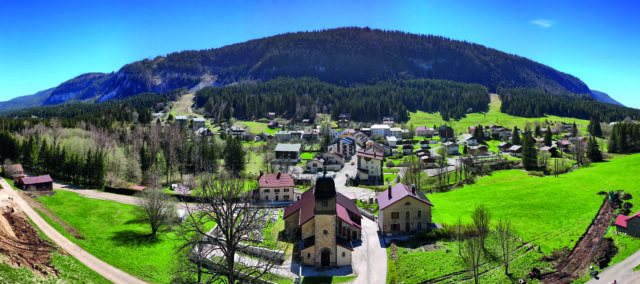
From Mijoux, climb the col and in 10 minutes you’re 200m higher at Lajoux in Jura, “the Nordic skiing paradise,” explains Sylvie. There are some small apartments but you’ll mainly find spacious old buildings and chalets. Prices are higher because you’re up in the Haut-Jura on a sunny plateau whereas Mijoux is in an enclosed valley.
Also, Lajoux is popular with border dwellers (frontaliers) who work in Switzerland. “That completely changes the property market,” says Sylvie.
They drive along to La Cure on the Franco-Swiss border then descend the col to the A1 motorway at Nyon on Lake Geneva (Lac Léman in French).
“From Mijoux this route is still quicker than taking the Col de la Faucille,” adds Sylvie.
A central 50m² one-bedroom apartment in subprefecture Gex will cost around €250,000. You’ll pay another €100,000 for something similar in the spa town of Divonne-les-Bains.
When the snow melts, walkers head for the Jura-Mediterranean GR9 hiking trail between Mijoux and Lélex and its vues époustouflantes – breathtaking views. Learn about local history and the link to precious stones at the Musée des Pierres et du Lapidaire.
Trout fishermen head for the Valserine, which marks the Jura-Ain border and is the first French river with the ‘Rivière Sauvage’ label. Rising above Mijoux at 1,200m, it joins the Rhône 48km later. It’s perfect for year-round living.
POPULAR COMBLOUX
“We’re at an altitude of 960m in the centre of the village, opposite Mont Blanc,” says Caroline Crozet of Agence AIC at Combloux. The ecological biotope lake is a preserved oasis attracting summertime swimmers. There are hiking paths and mountain biking (VTT) trails including the annual Combloux and Mégève MB Race (3-5 July 2026).
“Summer activities have been really well established now for several years,” says Caroline. Discover Haute-Savoie Baroque patrimony – churches, chapels, oratories – along the 20km Sentier du Baroque; check out the 210m pump track for BMX, VTT, scooter and rollerblade.
Enjoy Haute-Savoie Abondance and Reblochon cheeses, fondues and raclettes.
Property here is primarily timber-framed chalets, some of which are copropriétés of varying size containing apartments. The average price for an apartment in a new chalet is €8,000/m². For older unrenovated ones expect to pay €5,000-€6,000/m².
“Combloux housing stock is ageing,” Caroline says, but for the past few years there’s been a lot of enthusiasm for the mountains, especially since Covid. “Lots of apartments are being refurbished.” Individual chalets vary from around 150m² to 400m². It’s hard to find a small one that hasn’t yet been renovated for less than €1m, plus renovation costs, Caroline says. “You need a minimum of €1.5m to have something comfortable at Combloux.”
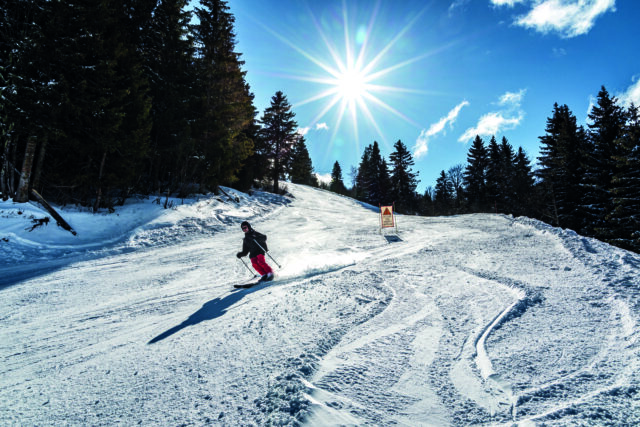
Look at nearby villages, such as the commune of Cordon between Sallanches and Combloux, Demi-Quartier on the Megève road, or Domancy on an Arve valley hillside. The architecture on the surrounding hillsides is the same chalet style – concrete foundations with timber framework above. There are a lot of second homes and good seasonal letting potential. Annual lets are more complicated. “Rents are relatively high for the amount of living space,” explains Caroline, “so buyers look further down the valley.”
Sallanches is the closest town and from the Mont Blanc roundabout you can access various ski resorts. “Geneva-Combloux is an hour on the A40 motorway and with Italy nearby, we also have an Italian clientele,” she adds. The main attraction is Mont Blanc, she laughs – plus fresh mountain air in summer. “Il y a toujours une multitude d’activités.” Looking for a home for all seasons? Take your pick.
3 REASONS TO BUY HERE
Three authentic middle-mountain ski villages with year-round appeal
Old stone farmsteads, timber-framed chalets, apartments in old farms and residential buildings ‘au pied des pistes’
Easy access, with airports at Basel for Munster valley and Geneva for Mijoux and Combloux
The unique mix of legal, financial and tax advice along with in-depth location guides, inspiring real life stories, the best properties on the market, entertaining regular pages and the latest property news and market reports makes French Property News magazine a must-buy publication for anyone serious about buying and owning a property in France.

Share to: Facebook Twitter LinkedIn Email
More in Alpine, french property, Mountain, villages
Related Articles

Leave a reply
Your email address will not be published. Required fields are marked *