How do Visa Health Insurance and State Healthcare work in France?
Paulette Booth explains how visa health insurance and state healthcare works…
Moving to France is an exciting adventure, but navigating the administrative and healthcare requirements can be daunting. Here we outline the steps you need to take before you leave, on arrival, and once you have settled into your new life in France.

PHASE 1: BEFORE YOUR MOVE-SETTING THE FOUNDATION
The preparation for a move to France begins months before you actually board your plane, boat or train. For UK citizens, the post-Brexit landscape means that moving to France now requires careful visa planning and a clear understanding of your healthcare rights. The priority during this phase is securing the legal right to stay and ensuring you have immediate health protection.
1) Secure visa-compliant health insurance: For most long-stay visa applications, providing visa applications, providing proof of health insurance is a non-negotiable requirement. It is essential to have this in place before you even submit your application to the French consulate. To be accepted, your insurance plan must meet specific criteria:
- Minimum coverage: It must provide at least €30,000 in medical coverage.
- Medical repatriation: The policy must include emergency repatriation.
- Duration: it must cover your entire stay.
Important note: One of the most common reasons a visa application is rejected is insufficient health insurance; for example, a standard annual travel insurance rather than a specialist long-stay policy.
While an annual policy might seem convenient, it fails to meet a fundamental requirement for French consulates: providing continuous cover for the entire duration of your stay. Most standard travel insurance policies are designed for holidaymakers and are strictly limited to a maximum stay of 30 to 90 days per individual trip.
Because they do not offer uninterrupted protection for a full 365 days, they do not satisfy the essential criteria for visa-approved insurance. To ensure your application is successful, you must secure a plan that guarantees comprehensive medical coverage and repatriation for every single day you are in the country.
At Lonemi we ensure your plan is fully compliant, avoiding delays or potential visa rejections.
2) Understanding the S1 form (for eligible EU/UK citizens):
If you are relocating from the UK and have reached state pension age or receive certain exportable benefits, you may be eligible for an S1 form. The St is a European health entitlement form that enables individuals who have paid social security in the UK to access healthcare in France. It is issued by the NHS Overseas Healthcare Services in the UK.
Important note: In France, the healthcare system generally operates on a reimbursement basis where the state (social security) covers a percentage of the costs, and you or your top-up insurance (mutuelle) -covers the rest. If you are hospitalised with an S1 but have not yet received your French social security number, here is how the financial responsibility works:
- Liability for the difference: Even with an S1, you would typically be liable for the ‘co-payment’ or the difference not covered by social security.
In France, the social security system usually refunds an average of 70% of set medical fees. Without a mutuelle (top-up insurance) in place, you are personally responsible for the remaining balance, known as the ticket modérateur. - Reimbursement delays: Obtaining a social security number can take several months. During this ‘gap’, you must pay for medical services upfront and collect paper receipts called feuilles de soins, commonly known as the ‘brown form’. You can only claim your 70% refund once your social security number is finally issued.
- Importance of private insurance: Because of these potential gaps in coverage and the long administrative wait times, it is strongly advised to maintain temporary private health insurance during the application process. It provides:
- Comprehensive protection: Coverage for the areas not fully protected by the social security or an S1.
- Accident and emergency cover: Specialist plans are specifically designed to bridge this exact gap until you are fully integrated and can switch to a mutuelle top-up.
3) Submit your visa application: Once your insurance is in place, you can finalise your visa application.
PHASE 2: ARRIVAL AND INITIAL SETTLEMENT
The first few months in France involve significant administrative tasks as you transition into the local system.
4) Manage initial administrative tasks: Upon arrival, your first priority is validating your visa (if required) and handling immediate logistics like housing and banking. While Lonemi focuses on your health, we work with a specialist partner who can assist with broader administrative requirements during the initial move, including banking and home and car insurance.
5) Bridging the healthcare gap: Access to the French healthcare system, known as l’Assurance Maladie, is not immediate. While many individuals must wait until they have been residents for three months before applying for a social security number, in some cases, you may be able to apply right away. If you are arriving for work, are self-employed, or have an S1 form, you may be eligible to apply for a social security number immediately upon arrival.
Important note: Regardless of when you apply, the administrative process can take several months. During this time, it’s essential to maintain your private health insurance, which offers a strong safety net and quicker access to medical services.
PHASE 3: SETTLING IN-JOINING THE FRENCH HEALTH SYSTEM
6) Apply for a French social security number: This is a critical step that can take several months to complete.
- The process: You submit your application when you arrive or after three months of legal residence in France, depending on your circumstances.
- Keep your records: During the waiting period, keep all feuilles de soins (the brown forms given by doctors). Once you receive your social security number, you can add it to these forms and send them to your local CPAM (Caisse Primaire d’Assurance Maladie) for reimbursement.
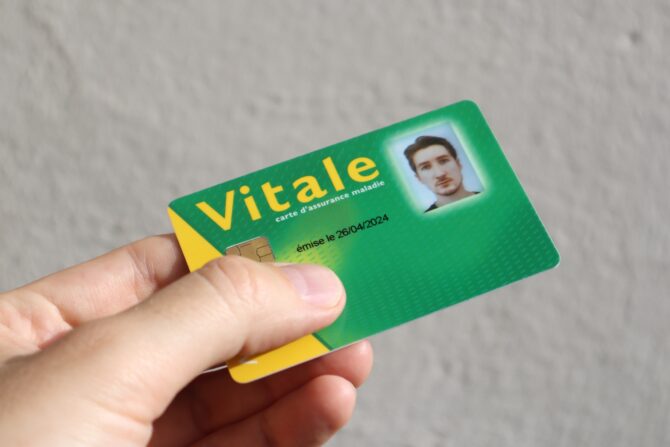
- The ‘carte vitale’: Eventually, you will receive a request for a photo to produce your carte vitale, the green card that confirms your social security status and streamlines medical payments.
7) Secure a ‘mutuelle’ (top-up insurance)
Once you have your social security number, you can officially switch from your international private insurance to a mutuelle top-up policy, completing your integration into the French health system. The mutuelle is then automatically linked to your social security account to make reimbursements seamless.
- Coverage gaps: Social security sets a fee for each procedure and typically refunds a percentage – the average is around 70% – of this amount.
- The role of a ‘mutuelle’: A mutuelle policy covers the difference between the actual cost and the social security refund.
- Enhanced benefits: A mutuelle can also provide coverage for private hospital rooms, complementary treatments, and higher-tier dental or optical care. It often includes additional services such as home help, pet care and study support.
Important note: It is important to understand that the French social security system does not cover 100% of healthcare costs. Relocating to France is a life-changing journey, and while the administrative path may have its twists and turns, you don’t have to navigate it alone. By ticking off these milestones and ensuring your healthcare is secured at every stage, you can focus on what really matters: enjoying the vibrant culture, stunning landscapes, and incomparable lifestyle of your new home.
Your new life starts here!
Paulette Booth is the Manager at Lonemi, which provides tailored insurance solutions, paving the way to a seamless visa application lonemi.fr
Lonemi will be at The French Property Exhibition in Birmingham on the 16th & 17th of May, which is a ‘must attend’ for anyone who wants to buy a property in France.

Want more help with your France property journey? Join Membership, search our Property Portal, subscribe to French Property News, and follow our YouTube channel for the latest advice and updates. Join us at the French Property Exhibition for expert advice and property inspiration.

Lead photo credit : Shutterstock
Share to: Facebook Twitter LinkedIn Email
More in Healthcare in France, state healthcare, Visa healthcare in France
Related Articles



Leave a reply
Your email address will not be published. Required fields are marked *