
5 Steps to Buying a Swimming Pool in France
Essential Reading

When summer rolls around, many French homeowners’ thoughts turn to the pros and cons of installing a swimming pool and you’re not alone. The Fédération des Professionnels de la Piscine et du Spa claims that France now has approximately one pool per 20 people. But what do you need to know about buying a swimming pool in France? Here are the five most important steps.
1. Planning Permission For Your Swimming Pool in France
Permission is required from your local mairie (mayor’s office) to install a swimming pool and you should apply at least one month, preferably more, before the scheduled delivery. The type of permission you need depends on the size of your pool: pools under 10m² generally require no declaration, pools between 10m² and 100m² require a déclaration préalable de travaux (prior works declaration), and pools over 100m² require a full permis de construire (planning permission). There are a set of standard forms to fill in, running to about 12–15 pages. The forms comprise a typical CERFA document (an acronym for any official form for carrying out an administrative procedure in France).
You can ask for assistance to fill out the paperwork, often through your pool company, for a fee of approximately 40 – 50 euros. Or, if you know a local building designer who is accustomed to dealing with the mairie, it may be worth employing him or her as your liaison person. If the mairie doesn’t reject your application within one month, it’s accepted that you can go ahead with the pool.
Sometimes, there will be a series of additional questions that need answering before your application is approved. For example, does the pool take up less than 50 per cent of constructible area after you take out the size of your house and any other structures on the property? You may also be asked to ensure that the edge of your pool is at least five metres from any public road or footpath. These requirements are governed by your local Plan Local d’Urbanisme (PLU) and can vary from one mairie to another, but assuming that the land where you wish to install the pool is designated for building, it is unusual for permission to be denied if the correct procedures are followed.
2. Choosing Your Swimming Pool
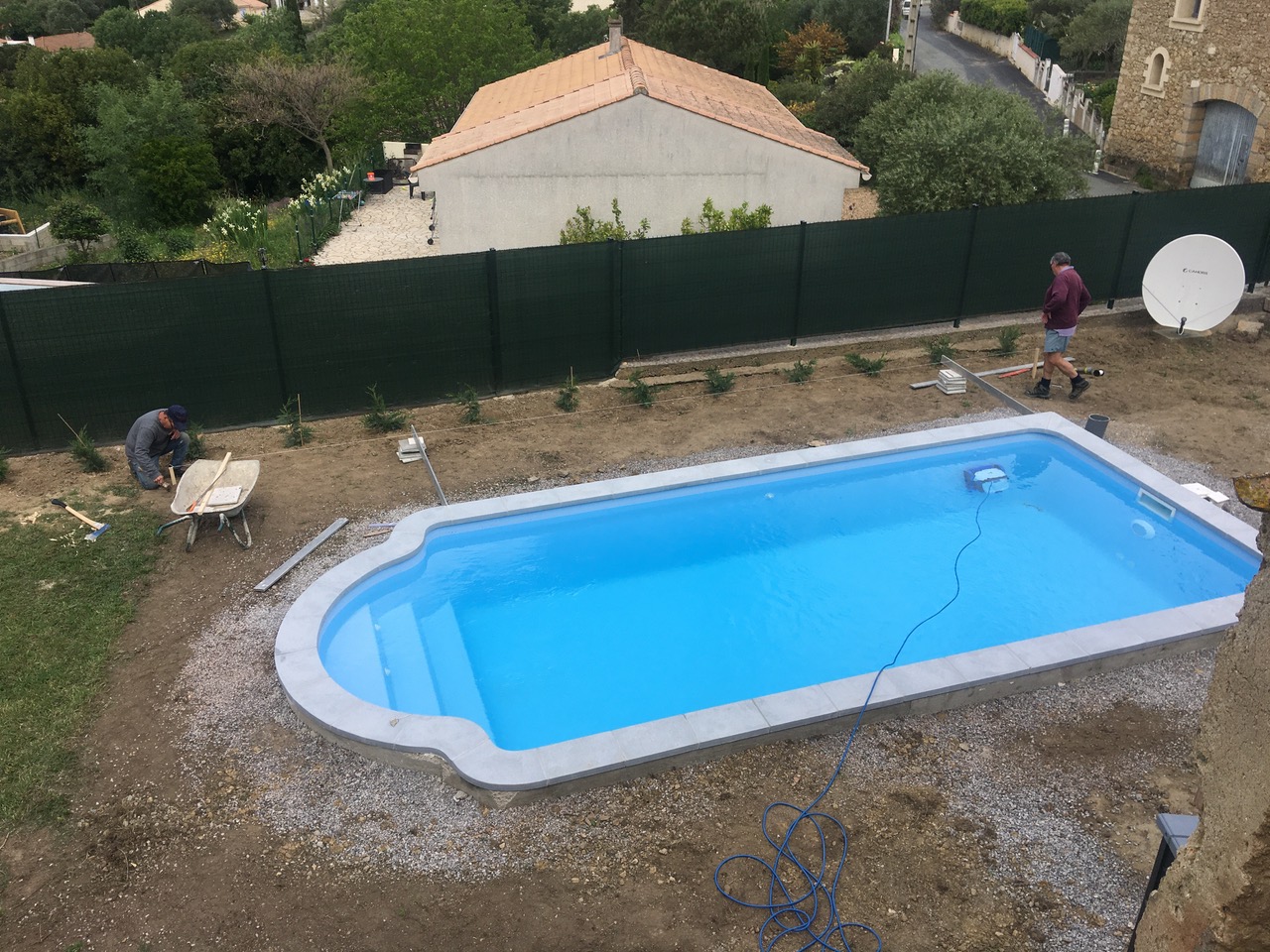
Swimming pools are most often made off-site in France and then delivered directly to your property. The most popular types are glass fibre shells (known as a ‘coque‘ or polyester monoblock) or those made of ready-made concrete or composite panels. With the latter, the shape will be marked out and then the concrete will be poured into place, ready for your own interior tiling or liner. Once the pool is in place, the decking or tiling around it is up to the individual and is usually not counted in the overall price. However, the margelle, or coping tile around the edge, should be available from your pool company but at an extra cost.
How Much Does a Swimming Pool in France Cost?
As a rough guide a 7 m x 3 m in-ground pool will often come in at around €17,000 to €30,000 supplied and installed, depending on the build type, site access, and how much excavation and groundwork your plot needs. The headline price typically includes the pool structure plus the core filtration set-up (pump and filter), but it rarely covers everything that makes the pool “finished” and easy to live with, so it is worth checking exactly what is included in each quote.
Common extras include a robotic cleaner (roughly €400 to €1,500), a safety solution (alarm, barrier, certified safety cover, or shelter), and practical items like a storage or technical space for the pump and filter. For a pool this size, a basic bar safety cover is often about €800 to €1,200, while more automated covers and shutters can start in the low thousands and rise quickly with specification. Margelles (coping stones) are usually priced separately and costs vary by material and labour, but even a modest per-metre price adds up once you account for the full perimeter and installation.
Paying for your swimming pool
Most pool companies ask for a third of the price as a down-payment, with the rest to be paid on delivery. If you have a smooth process, you can have a pool installed and ready to use around three months after deciding to buy one.
3. Installing Your Swimming Pool
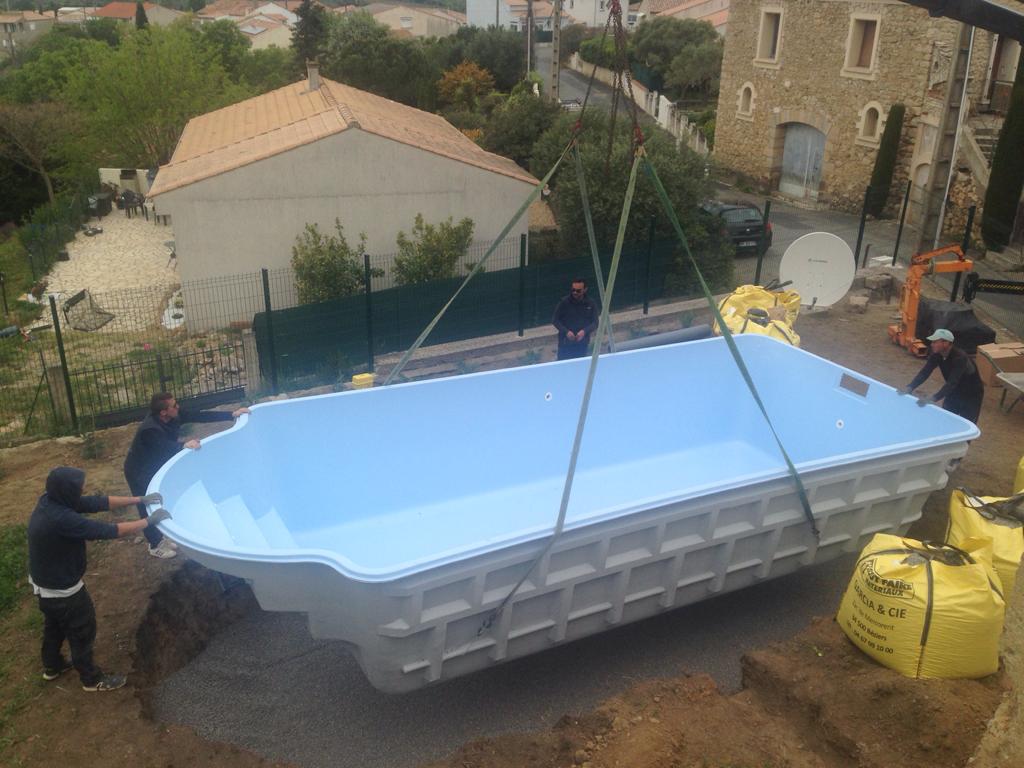
If you’re purchasing a pre-made pool, the time from decision to purchase and delivery should typically be around eight to ten weeks. The pool company should visit before the installation and mark out the area in preparation for earth removal. If you can find somewhere close, within five to ten kilometres, for the earth to be dumped, the company will often take it there free of charge. If you can’t, and are reliant on them to find a suitable place, there will be added charges according to the volume of earth to be removed.
The shell should then be delivered shortly after your earth removal. Most companies are adept at manoeuvring the shell into place, be it over your fence, or down your driveway, or across land. Be prepared for curious neighbours to watch, particularly in a small village, so everyone will soon know you have a pool!
4. Securing Your French Swimming Pool
By law, all private enterrée (in-ground) pools, whether for family use or shared use in a private residence, must be fitted with one of the following four security devices:
- A barrière de protection (safety barrier) — which must prevent a child under five from gaining access without adult help, and comply with norm NF P90-306.
- An alarme (alarm) — whose controls cannot be operated by a child under five, with detection systems that trigger a siren on any unauthorised entry, complying with norm NF P90-307.
- A couverture de sécurité (safety cover) — which must prevent the involuntary immersion of a child under five and withstand the weight of an adult, complying with norm NF P90-308.
- An abri (pool enclosure) — which, when closed, must make the pool inaccessible to a child under five, complying with norm NF P90-309.
The seller or installer of any of these devices must provide the owner with a technical information note covering the characteristics, operating conditions, maintenance requirements, and general recommendations for drowning prevention.
Failure to install a compliant security device can result in a fine of up to €45,000.
It is also recommended to keep a pole, a lifebuoy, and a telephone near the pool to alert emergency services quickly if needed. When it comes to everyday safety, there is never any substitute for the vigilance of an adult supervisor.
5. Initial Maintenance of Your Swimming Pool
You will either have chosen a salt or a chlorine pool and after you have filled it with water, the pool company should add the right amount needed to ensure it’s safe for swimming. Most pools automatically adjust amounts required to maintain water cleanliness but it’s then advisable to continue testing the water, usually around once a week. pH kits are available at pool shops for a cost of around 15 euros for 50 strips.

Want more help with your France property journey? Join Membership, search our Property Portal, subscribe to French Property News, and follow our YouTube channel for the latest advice and updates. Join us at the French Property Exhibition for expert advice and property inspiration.

Share to: Facebook Twitter LinkedIn Email
Related Articles