A Guide to Belle Époque Architecture in France
Some periods of history stand out as being special – Joanna Leggett looks back enviously at the Belle Époque, when life was full of optimism, fun and energy
Think of the Swinging Sixties – noted in France for moody songs and yé-yé singers – when imported Tamla Motown and mini-skirts ruled. Before that, after World War One, flappers and flaneurs celebrated the Roaring Twenties (les années folles in French, the American Jazz Age). More recently, there were the excesses of the Eighties when big shoulder pads and even bigger hair, loaded with copious amounts of hairspray, ruled.
However, the era that arguably beat them all was way back in the 19th century: la Belle Époque. It lasted the longest and was a time when art and architecture, fashion and folly joined in a glorious fusion of joie de vivre; a time when new ideas, optimism and creativity abounded.
It started in 1871, fresh off the back of the Franco-Prussian War. Napoleon III had lost his throne, was exiled and the Third Republic took power. The Belle Époque continued until August 1914 when, with the start of the First World War, everything changed forever.
LIFE IS GOOD
The Belle Époque was a period characterised by optimism, regional peace, technological innovation with railways opening up France, colonial expansion and a period of stability. French Imperialism was in its prime, and the 1889 World Fair in Paris was a highlight – marking the centenary of the French Revolution. It stimulated the economy and created Paris’s most recognised landmark, the Eiffel Tower – originally designed to be temporary.
The Impressionists painted and industrialists made money, creating a new social class: the nouveau riche. Haussmann’s renovations had already changed housing, creating walkable neighbourhoods in Paris, so new entertainment was required – the Palais Garnier flourished, as did the Casino de Paris, then the Moulin Rouge entered the fray, providing risqué shows. In addition restaurants and brasseries with bars flourished – with going out and travel becoming the norm – and culture never looked back.
Then there was fashion. Newly minted ambitious American mamas brought their daughters to Paris to be outfitted by Worth and other haute couture designers, spending fortunes on wardrobes in their quest to find titled husbands for their daughters. Many succeeded in propping up dukes, earls and other gentry’s estates on both sides of the Channel.
In any period of prosperity, innovation in architecture and design naturally follows, and throughout France there are buildings, châteaux, cities and towns brimming with beautiful buildings dating from the golden age of the Belle Époque.
Art Nouveau dominated design with its curved lines drawing inspiration from nature – just think of the ironwork that makes Paris’ metro stations so immediately distinctive. The style spread from Paris throughout France, and was adopted in Brussels, Vienna and Prague across the Continent and even further.
With new technology, styles of building could be expanded and changed, and glasshouses created to grow exotic fruits in winter. These advances meant more glass could be used in construction.
Most notably, perhaps, is the architectural icon which is Galeries Lafayette’s fabled store in Paris. Art Nouveau grandeur combined with the latest in modern design innovation was highlighted in its central glass dome, rising 43 metres above the roof in a Neo-Byzantine style that encapsulated the ambition of Belle Époque architecture. Its interior was further enhanced by gilded ironwork on balconies, marble galleries surmounted by delicate filigree – even today it’s fascinating to visit this beautiful light-filled mecca and just look – you could be forgiven for forgetting to actually buy anything!’
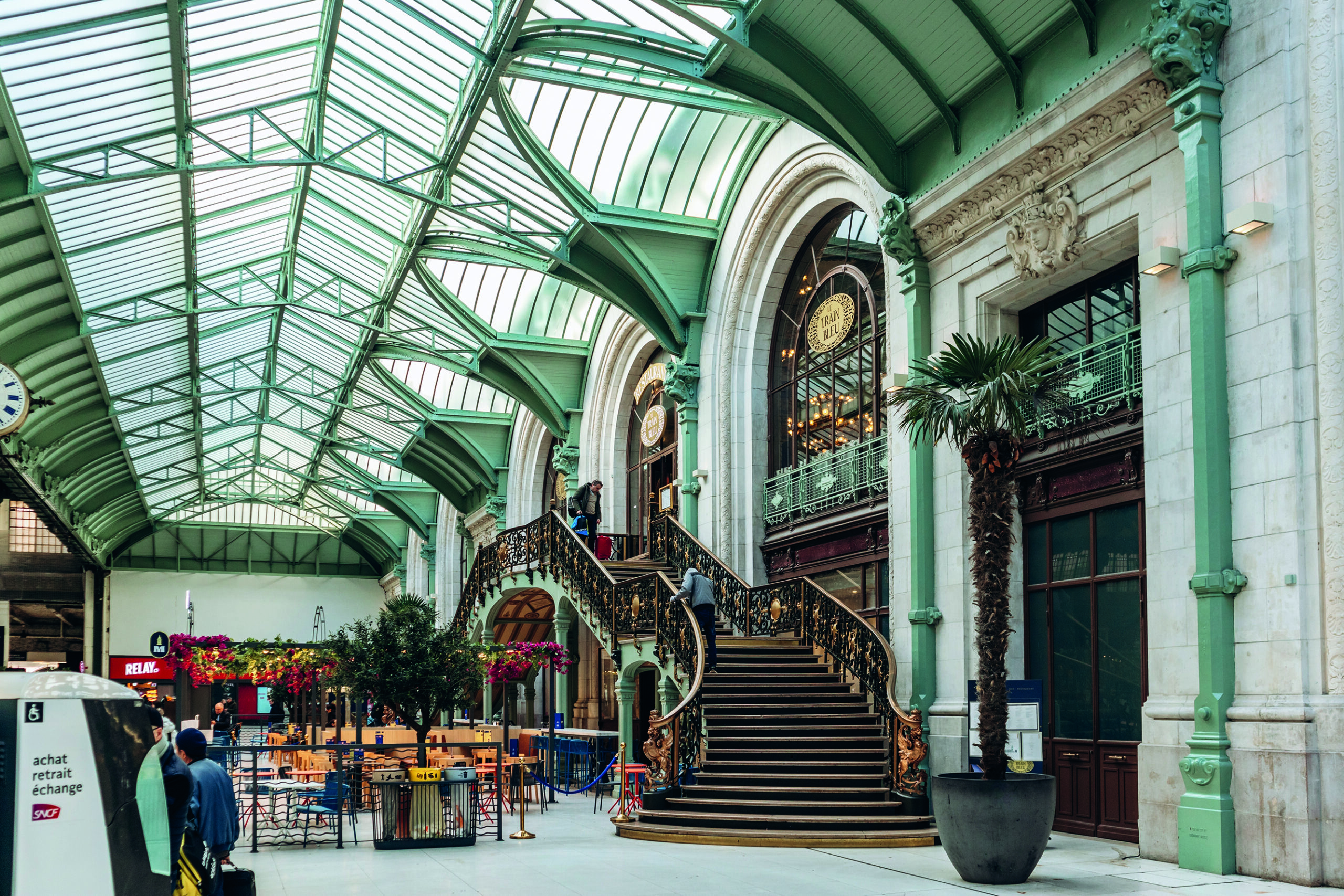
Le Train Bleu restaurant at Gare de Lyon, Paris, with its Belle Époque staircase
GLITTERATI HOTSPOT
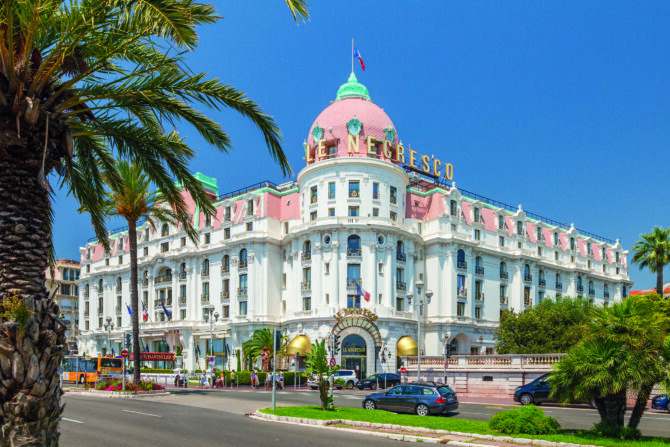
Nice has always been one of the most popular towns on the French Riviera. With its wonderful weather and sun-baked Mediterranean beaches, it became the tourist hotspot winter destination for the social glitterati during this period. Belle Époque architecture still rules in some quarters such as Cimiez, and then there’s the Promenade des Anglais and Quartier des Musiciens – just look upwards as you promenade through the streets and the curved lines, decorative glass and beautiful balconies are hard to miss – especially in the flamboyant design of the houses of 19th-century winter visitors known locally as les hivernants.
Along the Riviera, Beaulieu-sur-Mer is charming, remaining exclusive (read expensive) and steeped in the elegance of the time. Aristocracy and the monied who came here to enjoy mild winters wanted the latest style for their winter homes – exquisite facades, intricate moulding, sculpted pediments with long balconies (enhancing the Haussmann design ethic) reflect the elegance of the period. Large windows created light-filled interiors, and premium materials were, of course, prerequisite.
While many of these properties were originally designed as palaces or grand hotels, some buildings have been reconfigured as luxury apartments with glorious views over the gardens and terraces that line the coast here – with prices to match. Thanks to expanding rail networks, tourism evolved during this period and the ancient Alpine town of Annecy also became a place to see and be seen, thanks to its glorious setting, hospitality and spas, where visitors could (and still can) benefit from ‘treatments’. Its Casino Impérial is considered emblematic of the Art Nouveau building style.
Not for nothing is Biarritz called ‘the Pearl of the Atlantic’. Belle Époque was at the heart of design of this and many other elegant resorts, already made popular by visiting royalty including Napoleon III, his Spanish wife Eugenie and Queen Victoria, no less. In Biarritz, the imposing grandeur and façades of hotels constructed during this time, facing the ever-changing Atlantic seascape, make stunning visual impact. Many traditional Art Nouveau villas (albeit with somewhat Basque overtones) still line the coast here and are also dotted around the countryside.
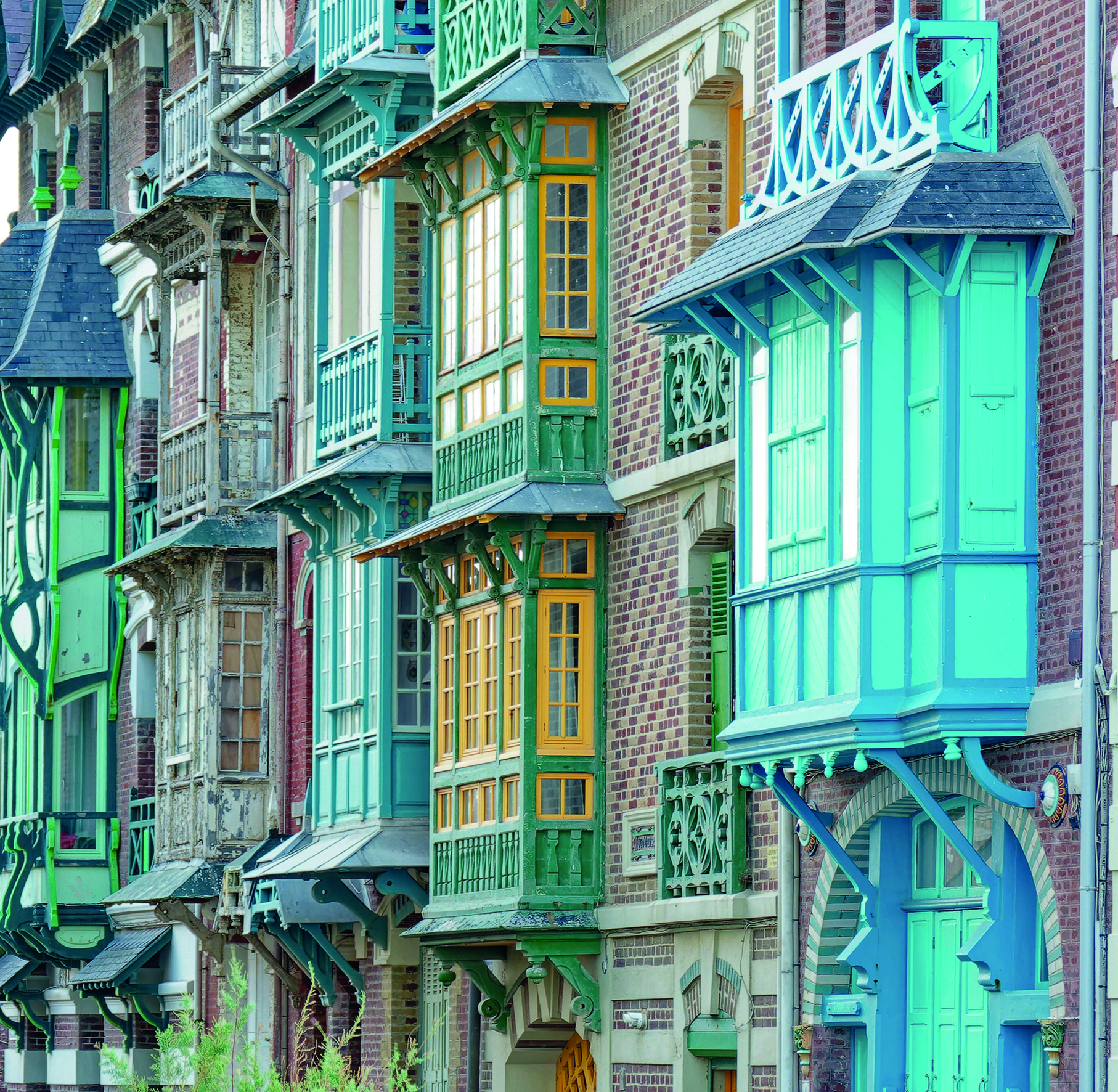
Belle Époque townhouse facades can be seen in Mers-les-Bains, Normandy
Inland, Pau also became a sought-after resort during this period, when ‘the Pearl of the Pyrénées’ as it became known became a meeting place for artists, international aristocracy (especially English and wealthy Americans) who recognised the therapeutic benefits of its climate and revelled in the grandiose palaces and activities. The city grew and the foreign colony left a lasting mark on its landscape, still appreciated today.
In Paris, and around France, the train stations picked up and ran with Art Nouveau architecture too. The Musée d’Orsay on the Left Bank, now rammed full of Impressionist masterpieces (and my absolute favourite museum of all time), started its life as a station, opening in 1900, designed to transport visitors to the expositions in central Paris. Light-filled and with massive glass roofs, it’s truly a masterpiece in itself.
AN INSPIRATIONAL TIME
The Belle Époque was the inspiration for many an architectural treasure. While capturing the beauty of the era, the charming film Gigi epitomises its elegance and charm. With luscious costumes, settings and music, it showed the era and Paris to its best advantage, the characters enjoying visits to the Bois de Boulogne and daily excursions, promenading in their carriages.
It also highlighted two other seaside resorts which flowered during this time – Deauville and Trouville on the Normandy coast – which continue to retain the elegance and charm of yesteryear, thankfully today coupled with the conveniences of the 21st century.
Lead photo credit : © SHUTTERSTOCK