
A Long-Stay Visa Guide: French Visas and Residency Explained
Arthur Cutler offers an essential relocation guide to visas and residency
While no visa is required for Brits holidaying in France, if you wish to stay longer than 90 days in any 180 (in the EU), you must apply for a long-stay visa. This application forms the start of the process of relocating.
For the purposes of this article, we’ll look at the two main types of visa affecting people moving to France on a permanent basis: non-working, and working as a self-employed individual in one capacity or another (visas for people on French employment contracts are dealt with by the employer).
NON-WORKING VISA
There are three main requirements for a successful outcome to your 12-month, long-term, non-working visa application – ultimately leading to residency (VLS-TS visa):
1. Financial resources. An individual will need a minimum of about €1,800 gross per month in income (€22,000 for the year). Alternatively, if you have no regular income, you’ll need savings, investments etc equal to the annual requirement.
You can also achieve compliance with a combination of both income and savings can be taken into account, including pensions, shareholdings, ISAs and so on. For a couple, married or otherwise, the monthly requirement is €2,500 per month gross, or equivalent in savings (or a combination of both). Note that one person can financially provide for all the others in a group; it isn’t necessary for each member to comply with individual financial requirements.
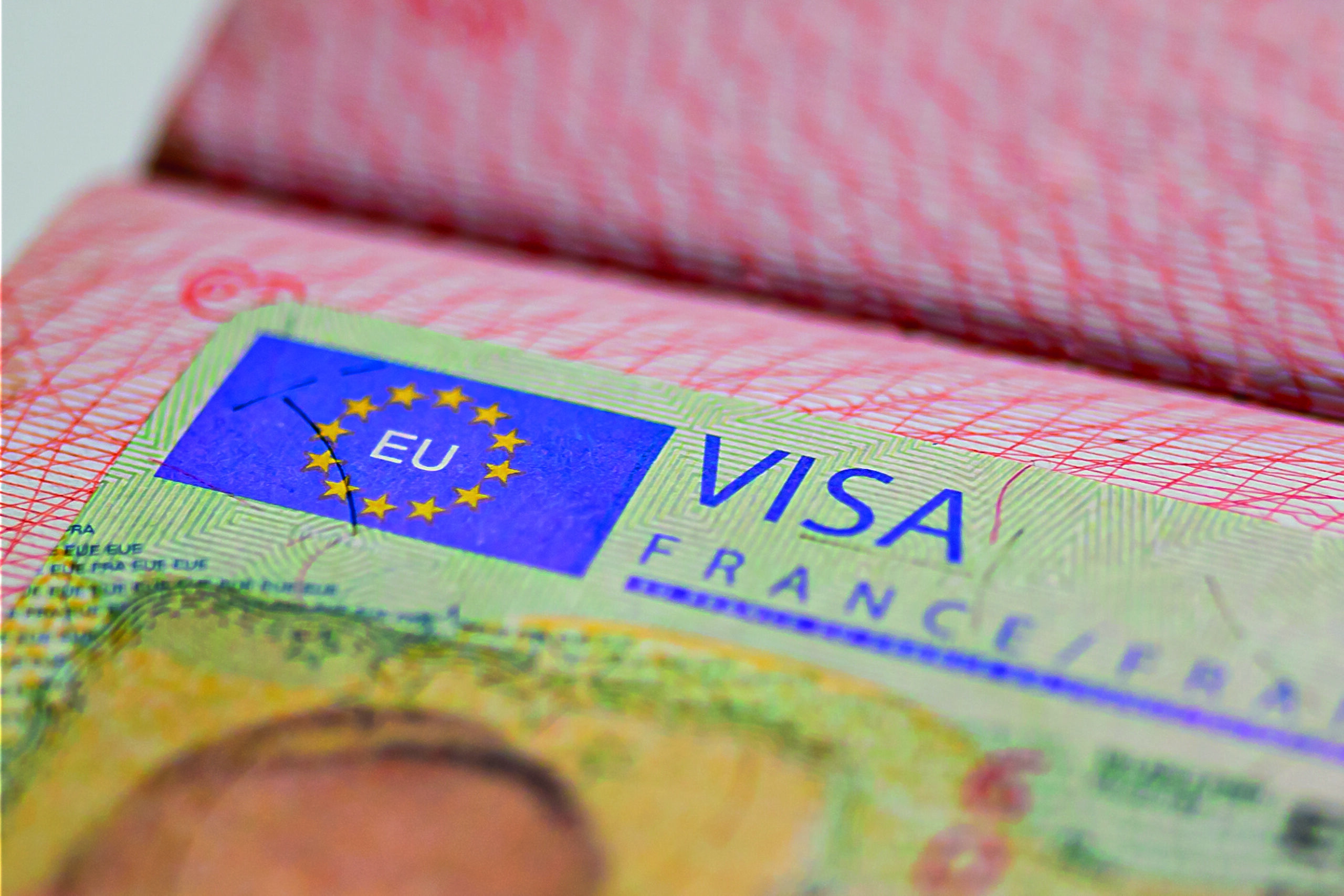
Closeup France Schengen visa in the passport. closed border of EC
2. Private health insurance
Your Schengen-compliant health insurance must tie in exactly with the full 12-month duration of your visa. It’s important to note that this is not an annual travel insurance policy, it must be Schengen specific.
3. A verified address in France for the full 12 months
This can be a property you own, rent, or where you are staying with family or friends, providing there is written confirmation issued, countersigned by the local town hall (mairie).
Potentially, you could have two addresses from consecutive six-month rentals; however, a series of Airbnb stays is unlikely to be accepted. There are various ways to achieve a 12-month rental contract if you don’t own or are not immediately buying a property.
The main stages of the visa application process:
1. First of all, you will need to complete an online application, filling in forms about you and any members of your group (whether family or others) who will be travelling and staying together.
2. In the UK, the independent organisation TLScontact has been appointed by the French Consulate to deal with the initial physical application process. As part of this, you’ll need to make an appointment to visit one of its three UK o ces (London, Manchester or Edinburgh). For a fee, it is also possible to elect for an ‘apply anywhere’ option, meaning TLScontact will come to your home or meet with you at a convenient location.
Note, TLScontact does not decide whether your application is successful or not, it is just a handling agency.
3. Following your appointment, TLScontact will send your dossier and passport to the French Consulate in London for a decision to be made, and your visa will be issued if your application is successful.
You cannot go direct to the Consulate to make an application; it can only be dealt with via TLScontact.

L’ISLE-SUR-LA-SORGUE, FRANCE, JUNE 24, 2017:Narrow street in L’Isle sur la sorgue village in France
4. A complete visa application dossier depends to some degree on your personal circumstances. Errors or omissions will mean a rejection of your application, often without you being given the actual reason for the refusal. For example, you may receive a refusal on the grounds that ‘your application was missing one or more documents’, with no further details given. It’s advisable to employ a specialist to assist you with the process, as it can be complex and daunting. Many service providers offer re-submission for free in the event of a refusal.
5. Once your application has been processed by the French Consulate, your passport and visa will be returned to TLScontact for collection, or you can pay for a courier return service to save you having to visit again.
WORKING VISA
Essentially, the process of applying for a 12-month self-employed working visa leading to residency (VLS-TS entrepreneur/profession liberal visa) is the same as for a working visa, but there are extra steps to take in advance:
1. You must prepare and submit a viable business plan to show that your work will provide the minimum financial requirements to support yourself, and others in your group if relevant.
The plan must cover income and trading projections for a minimum of three years. Some occupations are regulated and in those cases evidence of relevant quali fications and/or experience must be provided as part of the plan. A recent police check (ACRO) is also required. The plan and other documents must be in French, with translations by a French court-appointed translator.
The plan must be sufficiently detailed for the independent assessor to be able to verify its feasibility. This does not mean it should be 100 pages long. Typically, the main points can be presented in a four/five-page document.
Note, the plan must be based on a speci fic address from which the business will operate, it cannot be a vague ‘somewhere in France’, even if it is remote work. You will need to have an address in France of some kind – owned, rented etc – but you must have this for your visa application, whether you intend to work or not.
2. Once your plan has been approved, and not before, you can apply for your working visa. On top of the non-working visa requirements above, there are additional documents and registration forms needed for this visa type.

Border between France and Luxembourg – Road sign indicating the border of a European Union country
NEXT STEPS
There are several things you need to do to ensure your ongoing stay and life in France is kept on track:
Validate your visas. This must be done while you are physically in France, and within three months of your arrival date (sooner for a working visa). Don’t wait until the last minute – get it done as soon as possible.
Join the healthcare system. The first step in joining the French healthcare system is to apply to OFII (Office Français de l’Immigration et de l’Intégration) for a health certi ficate. This will involve having a medical with a local doctor appointed for the process. They will issue you with a certi fcate.
Apply to your local CPAM. The next step is to apply to your local CPAM office (caisses primaires d’assurance maladie). This is the regional public administrative body and is responsible for managing mandatory health insurance. It will require a copy of your medical certi cate. You will be issued with a French social security number and medical card (carte vitale), meaning you are entitled to full healthcare.
Working visas. Your business must be registered as soon as you enter France, which will automatically kickstart entry into the French healthcare system without making a separate application. Note, the process for holders of an S1 certi cate (a UK healthcare form entitling you and your dependants to state-provided medical care in the EU (and beyond) is different.
Titre de séjour. To extend your long-stay visa for the next 12 months, you will need to apply for a residency card. This is initially an online procedure, followed by a visit to the prefecture. You’ll need many of the documents you used to apply for your visa. Residency can be renewed for additional yearly periods, and at the end of five years, a multi-year card can be obtained.
Lead photo credit : Close up of British passports.