
Family Heirlooms and French/UK Inheritance Tax: What happens to my grandmother’s jewellery?
Sponsored Content


Karine Chevalier-Watts is a bilingual French/English paralegal and the in-house certified translator of Stone King’s International and Cross-Border Team. As part of her day-to-day functions, she deals with new enquiries received from British individuals regarding various French matters. Here, Karine discusses how jewellery is assessed for inheritance tax in the UK and in France.
When a loved one passes away, few items stir as much emotion, and confusion, as family jewellery. Whether it is a diamond engagement ring, a pearl necklace, or a gold heirloom bracelet, these objects often carry both sentimental and financial weight. If you inherit a piece of family jewellery, you may be wondering if it needs to be declared for tax purposes.
The French position: everything counts, unless it is a “customary gift”
Under French inheritance law, when a person dies resident in France, all of their property must be declared to the tax authorities, including jewellery, which is treated as part of the “estate assets.” This means that valuable personal items, like rings or necklaces, are subject to inheritance tax, just like real estate or bank accounts.
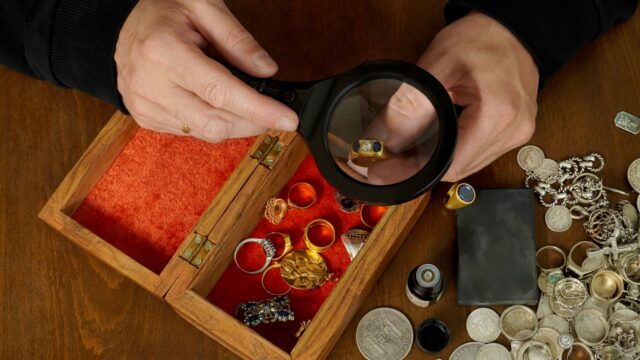
The notary overseeing the succession in France should ensure that every asset is properly valued. If the jewellery is insured, its declared insured value is typically used. Otherwise, an expert such as an auctioneer may be called in to assess its worth. In the absence of a detailed inventory, French law presumes that the deceased’s movable property, including jewellery, represents at least 5% of the total estate’s value.
However, there is one significant exception: the “présent d’usage”, or “customary gift.”
The “customary gift” exception
Customary gifts made on special occasions, such as birthdays, engagements, or weddings, where the value of the gift is modest and in keeping with the donor’s wealth and social circumstances are known as présent d’usage.
Because of the présent d’usage concept jewellery given as a wedding gift, or a watch presented at a graduation, may not need to be declared to the French authorities as a gift, provided it meets the following criteria:
- It is given for a recognised occasion, such as a family celebration.
- It is of modest value, generally not exceeding about 2% of the donor’s total assets or 2.5% of their annual income.
- It is given intentionally as a gift, rather than as an attempt to transfer wealth.
If the tax authorities later determine that the gift was disproportionately valuable, it may be reclassified as part of the estate when the donor has died, and taxed accordingly during the inheritance process.
The UK comparison: a stricter approach to declarations
British readers familiar with UK inheritance law will recognise many similarities, but also some key differences. In the UK, all personal possessions, also known as “chattels”, must be declared as part of the deceased’s estate (assuming that the deceased was long-term resident in the UK) for probate and inheritance tax purposes. Sentimental value does not exempt jewellery from taxation.
The personal representatives (the executors, where there is a Will) must include the open-market value (the price the item would realistically fetch at sale) in the estate’s inheritance tax declaration to HMRC. For higher-value estates, each piece of jewellery worth £1,500 or more must be listed individually on the IHT407 form.
HMRC expects executors to take “reasonable care” when valuing assets, often requiring a professional appraisal for significant items.
Overvaluing jewellery based on insurance replacement costs can lead to unnecessary tax, but undervaluing it can result in penalties of up to 100% of the underpaid amount.
Avoiding family disputes
In both France and the UK, family jewellery can be a flashpoint for inheritance disputes. Its sentimental significance often outweighs its market value, leading to tension among beneficiaries. To avoid such conflicts, it can be helpful to for individuals to specify the intended recipient of each piece of jewellery in their Will. Alternatively, a Letter of Wishes, though not legally binding, can guide executors on how sentimental items should be distributed.
For British nationals with property or family ties in France, understanding how jewellery fits into inheritance law on both sides of the Channel is essential. In France, heirlooms must generally be declared, unless they qualify as modest, customary gifts. In the UK, full disclosure and accurate valuation are key to avoiding penalties and double taxation issues.
As with all cross-border estates, seeking advice from a notary or solicitor familiar with both legal systems can prevent costly misunderstandings, and ensure that family treasures are passed on in the spirit they were intended.
If you are interested in finding out more about making Wills to cover assets in the UK and in France and would like help analysing the options available to you, please contact the international and cross-border team at Stone King LLP either by calling +44(0)1225 337599 or by emailing [email protected]
Lead photo credit : Shutterstock
Share to: Facebook Twitter LinkedIn Email
More in inheritance, law
Related Articles



By Stone King
Leave a reply
Your email address will not be published. Required fields are marked *