
Driving Laws in France: Expats, Watch Out
Sponsored Content

Most expats arrive in France confident they know how to drive. Then a Crit’Air sticker, a rain-adjusted speed limit, or an unmarked rural junction reminds them they don’t.
Most of France’s driving rules are sensible, and most of them line up with what you’d expect. But a handful catch British and American newcomers off guard, and the fines aren’t gentle. They start at €68 and can climb past €1,000.
In this guide, you’ll learn:
- How long your UK or US licence stays valid in France
- Why you need a Crit’Air sticker (and where the official one costs under €5)
- How speed limits drop automatically when it rains
- Where winter tires or chains are compulsory between November and March
- What priorité à droite means at unmarked junctions
- How France’s alcohol limit compares to the UK and the US
- Why holding your phone at a red light still earns you a fine
- What replaced the carte verte in 2024
Let’s get into it.
1. Your home license won’t be valid forever
If you’ve moved to France for good, your home license has a shelf life.
British residents
Under the Withdrawal Agreement, you can keep using a UK photocard license until it expires.
New arrivals don’t get that grace though: You’ve got twelve months from becoming resident to apply for an exchange.
Americans
You face a state-by-state lottery.
Around twenty states (Texas, Pennsylvania, South Carolina, Virginia, Massachusetts, and a handful of others) have reciprocity with France, so you can swap without a test.
Everyone else takes the French code and the practical exam.
Worth checking your state’s status well before the one-year clock runs out.
2. Crit’Air stickers are mandatory in (some) cities
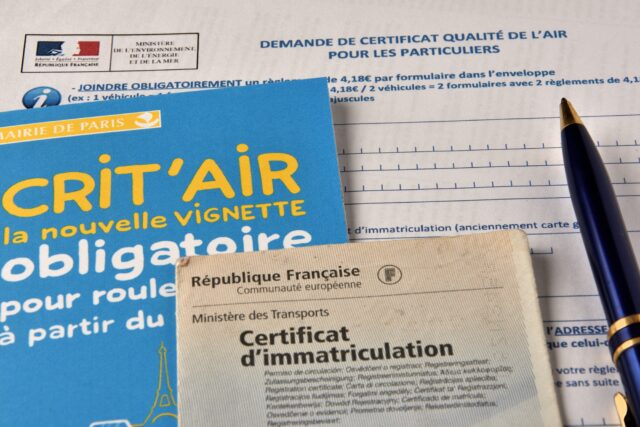
The little round windscreen sticker (the “Crit’Air vignette”) isn’t optional anymore.
France’s Low Emission Zones (Zones à Faibles Émissions, or ZFE) now cover Paris, Lyon, Marseille, Strasbourg, Lille, Reims, Rouen, Grenoble, and a growing list of urban areas.
Drive in without the right sticker, or with one whose category doesn’t meet the zone’s threshold, and you’re looking at a €68 fine.
Even if “you’re only just passing through”.
The sticker costs under €5 from the official site, certificat-air.gouv.fr, and lasts the life of the vehicle. Buy it there.
The resellers at the top of Google charge five times the price for the exact same thing.
3. Speed limits drop when it rains
Most foreigners learn the headline limits “130 km/h on the autoroute, 110 on dual carriageways, 80 on most main roads”.
Not many learn this, though: rain lowers limits automatically.
Motorway limits drop to 110, dual carriageways to 100. And if visibility falls below 50 meters for any reason (e.g., fog, heavy rain, smoke) everything drops to 50 km/h.
Yes, motorways included.
Foreign plates cruising at 130 through a downpour are exactly what radars mobiles are watching for.
The standard fine starts at €135.
4. Winter tires or chains: compulsory in 48 départements
Under the Loi Montagne, 48 mountainous départements require either winter tires, 3PMSF-marked all-season tires, or chains in the boot between 1 November and 31 March.
It applies whether there’s snow on the road or not, and whether you’re a resident or just visiting.
The affected zones stretch across:
- The Alps
- The Pyrenees
- The Massif Central
- The Jura
- The Vosges.
If your second home is in a postcard-pretty village anywhere in those regions, this is one piece of seasonal admin you can’t skip.
5. Priorité à droite
The rule that traffic emerging from your right has priority (priorité à droite) is alive on countless rural and suburban roads, and at unmarked junctions in older town centers.
There’s no stop sign. There’s no give way. You’re simply expected to know.
If you don’t know better, this might happen to you:
- A car you didn’t even see pulls out
- You hit it
- The insurance claim goes against you.
So, to be safe, remember this rule of thumb: treat any unmarked junction as if traffic from the right has right of way, and ease off the accelerator.
6. The alcohol limit is lower
France’s blood-alcohol limit is 0.5 g/L — well below the 0.8 g/L still in force in England, Wales, and Northern Ireland, and roughly the same as the US 0.08%.
For drivers in their first three years on the road, the limit drops to 0.2 g/L (effectively zero).
One generous glass of wine with lunch can put a smaller adult over.
Penalties scale quickly: from €135 to €4,500, points on your license, and possible suspension.
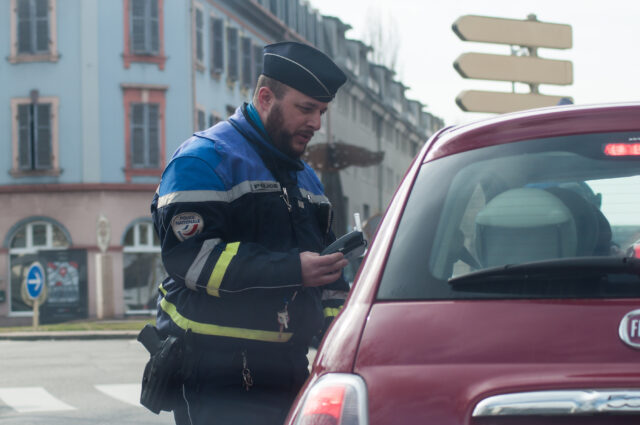
Random breath tests are routine, including on Sunday mornings.
7. Hands-off ≠ engine-on
Holding a phone while driving is illegal. That part is familiar.
What catches most newcomers out: the same rule applies when you’re stopped at lights or parked with the engine still running.
Pull over fully, switch the engine off, then check the message.
The fine is €135, and three points are taken off your license.
8. Forget the green card (rules changed in 2024)
As of April 2024, France has abolished the carte verte, the green insurance certificate that drivers used to display on the windscreen.
Insurance is now verified through a digital database, the Fichier des Véhicules Assurés (FVA).
You don’t need to display anything, but you do still need to carry your carte grise (vehicle registration) and a form of ID.
One catch: if your insurer hasn’t filed your details into the FVA, you can be treated as uninsured.
Always ask for written confirmation when you take out or switch a policy.
About Feather
Settling into French life means working through a stack of admin most expats don’t see coming — driving rules, mutuelle top-ups, household cover, responsabilité civile.
Feather was built specifically to simplify the insurance side, with English-speaking support and policies designed for international residents in France.