
Exploring France Behind the Wheel of a 51-Year-Old Citroën
Real life stories
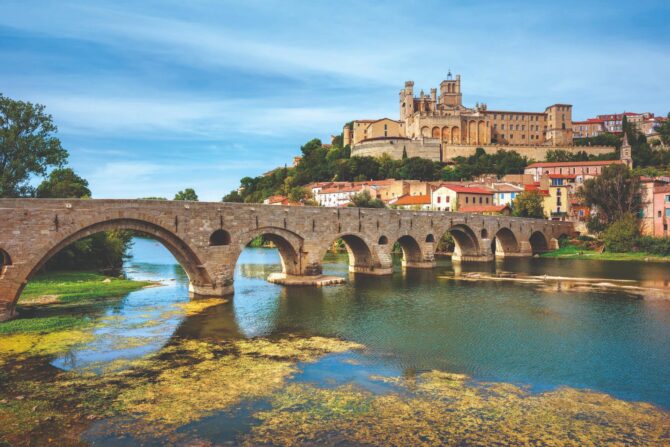
Ian Morris recalls a scenic (and memorable) journey the length of France in Poppy, his 51-year-old Citroën 2CV…
I have lived in France for over 15 years and try to get over to the UK once a year to visit family and friends. However, last autumn I thought I’d make the trip more interesting by going in Poppy, my 51-year-old Citroën 2CV, in which I do much of my local running about. There are, of course, quicker and more comfortable ways of travelling between France and the UK, but this is something I’d thought of doing ever since I acquired her, just over seven years ago. During that time, I’ve added a little bit of extra comfort and convenience, such as reupholstering the seats, installing wiring for a GPS and mobile phone and (to the amusement of my friends) fitting a basic cruise control!
I get around France quite a lot in connection with my work as a building surveyor, using my ‘regular’ car, and much of that is undertaken on motorways. For this trip, however, I decided to travel mostly on N and D roads (the routes nationales and routes départementales) – partly because I wanted to see a little more of the countryside and villages in areas that I seldom get to. In addition, the top speed of a 2CV is not much more than 100kph, so the benefit of driving fast on motorways doesn’t really figure in the equation. And, oddly enough, travelling from A to B using motorways is often longer in distance than the journey using N and D roads.
THE SCENIC ROUTE
Being based close to Béziers, almost on the Mediterranean coast, I have long since given up trying to rush across the length of France in a single day. Usually, I arrange an overnight stop halfway, but for this trip I had to work out a route that would take account of the somewhat lower average speeds that I could expect to achieve, both on and off motorways.
And anyway, I intended this to be an enjoyable journey, not a competition. So, I decided I’d drive perhaps five to six hours a day which, with the occasional stop, came down to planning a journey that would cover perhaps 300-350km a day. In other words, it would take three days to get from my home to the north coast of France.
I booked Logis hotels, as I always do when travelling across France. Unlike most other groups of (mostly modern) hotels, nearly all of the Logis are independently owned – some run by the same family for several generations. All are very different, and some are very old with their own particular character. They do have to adhere to minimum standards set by Logis de France, the umbrella organisation for marketing purposes. They are almost always excellent value for money, and I was very happy with those I picked this time.
Wherever you travel in France, I always think it’s a good idea to try and do some of the journey between the hours of 12 noon and 2pm, or after 7pm.
You can almost set your watch by French mealtimes and you’ll find there is much less traffic on the roads at these hours!
I’ve lost count of the number of times I’ve driven up the motorways through Toulouse, so for the first day I decided to skip Toulouse altogether and head off through St-Chinian and the Haut-Languedoc regional park. I continued across the Tarn department through Mazamet and Castres, some way east of Toulouse, and on to Gaillac.



FIRST STOP: JAYAC
I then joined the A20 motorway at Caussade for a steady one-hour drive across the Lot department, leaving the motorway at Souillac to travel half an hour into Dordogne and my first overnight stop in a small village called Jayac. The scenery across Tarn, Lot and Dordogne is magnificent.
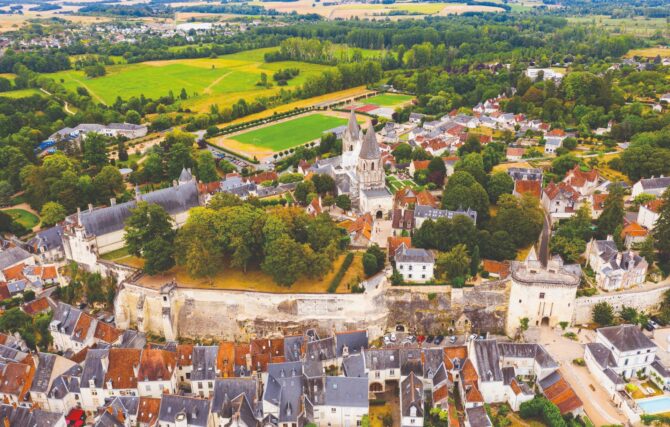
For my second day’s drive I avoided motorways altogether. Travelling north from Jayac, and running almost parallel to the A20, I took the D road up through St-Yrieix-la-Perche. I skirted the west side of Limoges, then took the N147 to Bellac and from there headed along the D roads again through the Brenne National Park. My second overnight stop was in the medieval town (or rather the ‘Royal City’) of Loches, although sadly I didn’t have enough time to visit the château.
I thought I’d prepared Poppy pretty well before departure, including a full engine service, but a day or so before I set off, I noticed signs of wear around the walls of the rear tyres and, although the tread was good, I thought they ought to be replaced. It’s almost impossible to obtain the narrow tyres used on older vehicles from the usual providers, and unfortunately, I didn’t have time to order new ones from a specialist supplier before setting off. As luck would have it, I was able to make a little detour from my planned route on the second day of my journey, stopping off at the specialist 2CV garage Rénov’2CV in Châteauroux, where they fitted two new tyres while I waited. The tyre fitter said he’d noticed an oil leak at the front of the engine. More about that later…
Still avoiding the motorways, the third day of my journey continued northwards through Amboise on the Loire and La Ferté-Bernard to the east of Le Mans. I then travelled on D roads across the department of Orne, narrowly missing the famous village of Camembert, and crossed into the Calvados department just to the north of Vimoutiers. I was now within striking distance of the English Channel and it only remained for me to skirt the east side of Caen to arrive at the ferry port at Ouistreham.
I had some time to spare before catching the overnight ferry. I’d toured the Normandy Landing Beaches several times previously over the years, but had never before managed to visit Café Gondrée at Bénouville, so made a point of doing so on this occasion. I was rewarded by being able to shake the hand of, and being served coffee by, Arlette Gondrée, who witnessed the events of D-Day in 1944 as a child. Hers was the first family in France to be liberated and she remembers the occasion well.
The overnight ferry made a late departure so I just had time for a meal, which included a generous portion of moules marinières at a restaurant aptly named La Moulerie And so I arrived at Portsmouth. But I was not popular when, on the morning after my first overnight stop in Oxfordshire, my friend pointed out a puddle of oil on the drive. It was Sunday morning and I set off to Hereford where I had arranged to meet up with my sister-in-law and niece. At lunch I briefly explained the problem and to my astonishment my niece said: “I’ve heard there’s a garage just outside Hereford that specialises in 2CVs!”. And indeed there is.



OIL BE DAMNED
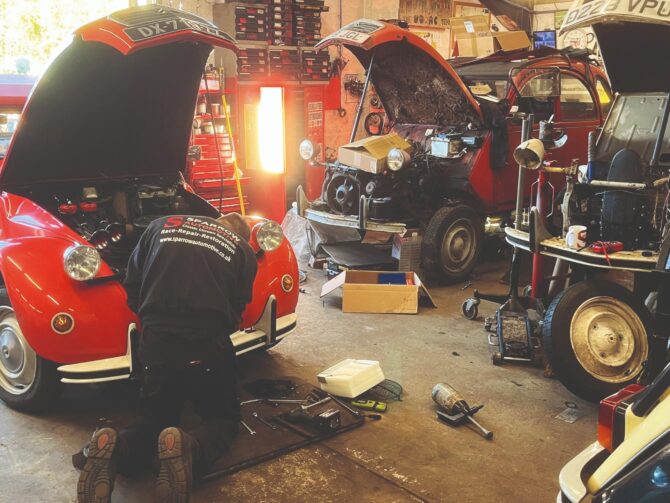
Dave Sparrow of Sparrow Automotive proved to be a hero. With over 30 years’ experience of working exclusively on this type of car, it took him just seconds to identify the problem – a fractured pipe on the oil cooler. He was kind enough to drop what he was doing and set to work with a replacement. I should imagine you’d have to travel several hundred miles across England to find anyone else with a 2CV oil-cooler element on their shelf!
He also said the car would run better with slightly larger jets in the carburettor, so he enlarged these and fitted a new flasher unit for the indicator lights while I was there. A real star! The rest of the English leg of my journey, taking in visits to friends in Lincolnshire, Derbyshire and Wiltshire, passed without incident and Poppy’s little 602cc engine ran like an electric sewing machine.
My only other misfortune was on my return to France. Leaving the ferry port before daybreak and driving through heavy rain in the French rush-hour on the outskirts of Caen, I accidentally exceeded the 70kph speed limit, costing me a fine and the first ever point on my French driving licence. I can understand getting flashed for speeding in a Ferrari, but in a 2CV?!
So, would I do the 3,000km return trip in my 2CV again? I certainly would. This wasn’t just driving, it was ‘motoring’ in every sense of the word, passing through beautiful French towns, villages and countryside, and I enjoyed every minute.

lan Morris is a property surveyor working in France french-surveys.com
The unique mix of legal, financial and tax advice along with in-depth location guides, inspiring real life stories, the best properties on the market, entertaining regular pages and the latest property news and market reports makes French Property News magazine a must-buy publication for anyone serious about buying and owning a property in France.

Lead photo credit : Beziers, Photo: Shutterstock
Share to: Facebook Twitter LinkedIn Email
More in Driving through France, Road trips through France
Related Articles


Leave a reply
Your email address will not be published. Required fields are marked *