
Owning a home in France is the dream. However trying to manage it from Surrey or Somerset, or wherever else you live most of the year, is the bit nobody warns you about. There’s always something to do: a gutter to clear, a lock to fix, a garden that’s decided it wants to be a jungle before your next visit.
That’s where a property manager comes in.
What does a property manager do?
At its heart, property management is about having a reliable local presence for owners who aren’t always in France. Services may vary between companies, but typically include regular property inspections, key holding and security checks. Overseeing gardening and pool maintenance, cleaning and preparing the property for your arrival and organising repairs and maintenance. This may involve meeting tradespeople and overseeing their work, dealing with emergency call outs, managing deliveries, preparing the property for holiday guests, and handling guest arrivals, departures and rental administration.
Take a pool, for example. We’re often contacted by owners in early spring asking when they should open it for the season. After a mild winter, we would usually recommend mid-March, whereas April is safer following a particularly cold one. Once the water stays above around 18°C, algae can develop quickly, so having a manager who already knows your property and pool can make a real difference. They may spot a leak, a faulty alarm or another problem long before you would notice it from the UK.
For owners based in the UK or elsewhere, the real benefit is having someone local who can spot a problem and deal with it before it becomes a much bigger and more expensive one.
Why does it matter so much?
Picture arriving for your annual summer holiday and finding a burst pipe waiting for you. If the house has been empty for six months, the damage could already be considerable. You don’t want your holiday to become a plumbing project.
Regular inspections catch leaks, damp, storm damage, heating failures, electrical issues and security problems while they’re still small and manageable. A good property manager doesn’t just tell you “all fine”, they send updates, photographs, and honest recommendations, and can arrange access for trusted local tradespeople so you’re not trying to coordinate a repair from three countries away.
Does a property manager do the repairs themselves?
Sometimes, yes, a good property manager will happily take on the small, straightforward jobs themselves: tightening a loose hinge, resetting a trip switch, unblocking a drain, changing a lightbulb somewhere awkward. This tends to stay fairly limited, and deliberately so.
The reason comes down to insurance and qualification as much as anything else. Electrical, plumbing, roofing, heating and structural work should always go to an appropriately qualified, insured tradesperson. It’s not that a property manager couldn’t have a go, but their insurance and professional registration will generally only cover certain types of work. Step outside those limits, and both the manager and the owner could be left exposed if something goes wrong.
For anything beyond the everyday, a professional property manager is far more likely to organise and supervise the job, rather than carry it out themselves. They’ll spot the plumbing problem, photograph it, ring a local plumber, get a quote, arrange access, and report back to you.
Take a chimney sweep, as one example. French law requires most chimneys to be swept and certified at least once a year, and finding a good one is exactly the sort of thing local knowledge is useful for, a property manager will already know which registered ramoneur to call, will ask the right questions about how an old building will be treated, and will make sure you’re left with a proper certificat de ramonage rather than just a receipt.
It’s a similar story with more specialist artisans. Renovating an old barn, say, might call for a charpentier, a menuisier or an ébéniste depending on the job, three quite different trades that can be hard to tell apart from overseas. A good property manager already knows the difference, knows who’s properly registered and insured for the work, and can act as the go-between with the artisan, the mairie and local planning rules, rather than trying to be a technical expert themselves.
It’s a distinction worth understanding: the value a good manager brings here is judgement and local knowledge, not doing every job with their own hands which, if anything, is exactly what you want when it comes to anything regulated or safety-critical.
What about holiday rentals?
Property management becomes even more valuable if your French home is let to holidaymakers, as the rules around meublés de tourisme (furnished tourist accommodation) have changed considerably.
The legal deadline for registering a tourist rental through the new national system, was 20 May 2026, though the national portal itself is still being rolled out through the rest of the year, so many owners are still registering via their commune for now. Local authorities also have more power to regulate holiday lets, including introducing quotas and, in some cases, reducing the principal-residence letting limit from 120 to 90 days a year.
Tax rules have shifted too. For income earned in 2026, the micro-BIC allowance is 30% for unclassified furnished tourist accommodation up to €15,000, while classified accommodation benefits from a 50% allowance up to €83,600 up from €77,700 for income earned in 2025. Energy requirements are tightening as well: certain tourist properties subject to change-of-use authorisation must meet DPE standards, moving to a required rating of A to D by 2034. Because local rules vary so much, it’s worth checking the requirements for your own commune and getting proper tax advice for your situation.
How do you choose a property manager?
Don’t pick someone just because they happen to live nearby. Ask any potential manager whether they’re properly registered and insured, what services are included in their fee, and how often they’ll inspect your property. Find out whether you’ll receive photographs and reports, who has access to your keys, and what happens during an emergency. It’s worth knowing how much they can spend without your approval, which contractors they use, whether they can manage holiday guests and changeovers, and how you’d end the agreement if you ever needed to. If a company carries out regulated property-management activity, ask whether it holds the right professional authorisation, including the relevant carte professionnelle where it applies and always check its professional insurance.
Is it worth the cost?
If you live in France full time, you’re on hand to deal with most day-to-day things yourself, so the case for a full management service is weaker. It’s still worth a conversation with a tax adviser, though: French tax residents can often claim back 50% of the cost of certain home-help services, gardening and small maintenance jobs, through the crédit d’impôt for services à la personne, something non-residents generally can’t access. If your property manager, or one of their team, is registered to provide those services, part of what you’re paying could effectively be halved come tax time.
If you live overseas and only get to your French home a few times a year, professional management can be one of the most useful services you’ll ever arrange. The value isn’t really about someone mowing the lawn or opening the shutters before you arrive. It’s knowing that when something does go wrong, someone’s already on it.
A good property manager becomes your eyes and ears in France, protecting your property, coordinating local professionals, and giving you one less thing to worry about when you’re hundreds of miles away.
About Les Bons Voisins
Les Bons Voisins is a network of property managers providing property-care, maintenance, inspection and rental-related services to owners of French property. Their local managers help absentee owners deal with the practical responsibilities of owning and maintaining a home in France.
Please note: French property, rental and tax regulations can change and local rules may vary. This article provides general information and should not be considered legal or tax advice.
If you are planning to move to France, understanding the visa and residency process is one of the most important steps. From proving your financial resources and arranging healthcare to validating your visa and applying for a titre de séjour, here is what you need to know.
12-month non-working visa leading to residency: the VLS-TS visa
For those moving to France without working, the VLS-TS long-stay visa is one of the main routes towards residency.
There are three key requirements for a successful long-stay visa application.
1. Financial resources
You will need to prove that you have sufficient financial resources to support yourself while living in France.
For an individual, this means a minimum of around €1,800 gross per month in income, or approximately €22,000 for the year.
If you do not have a regular income, savings, investments, shareholdings, ISAs or similar financial assets can be used instead, provided they are equivalent to the annual requirement. A combination of income and savings is also acceptable.
For a couple, the requirement is around €2,500 gross per month, or the equivalent in savings, or a combination of the two.
It is also possible for one person to financially provide for other members of the group.
2. Private health insurance
You will need compliant private health insurance for the duration of your visa.
The dates of your policy should correspond with the dates of your visa, so it is important to make sure the cover is arranged correctly before submitting your application.

3. A verified French address
You will also need to provide evidence of a French address covering the full 12 months.
This could be:
- a property you own
- a property you rent
- accommodation with family or friends, supported by written confirmation
- two consecutive six-month rental agreements
A series of short-term Airbnb reservations is rarely accepted as sufficient evidence of a permanent address.
The stages of the visa application process
The French long-stay visa application process involves several stages.
1. Complete your online application
The first step is to submit your application online.
If several family or group members are travelling together, applications can be prepared for everyone who will be making the move.
2. Book your TLScontact appointment
In the UK, TLScontact has been appointed to handle the physical application process on behalf of the French Consulate.
Applicants need to attend an appointment at one of the TLScontact centres in London, Manchester or Edinburgh.
There is also an “Apply Anywhere” option, where TLScontact can arrange to meet you at your home or another convenient location, although this service comes at an additional cost.
3. Submit your documents and passport
Once you have attended your appointment, your application dossier and passport are sent to the French Consulate in London for a decision and, if successful, the issue of your visa.
You cannot submit your application directly to the French Consulate. Applications must be handled through TLScontact.
4. Make sure your dossier is complete
The exact documents required will depend on your personal circumstances.
Errors, missing documents or omissions can result in an application being refused, and the reason given may not always explain exactly what was missing.
For example, a refusal may simply state that one or more required documents were absent, without specifying which ones.
For this reason, some applicants choose to use a specialist professional to help prepare their dossier, particularly if their circumstances are more complicated.
5. Receive your passport and visa
Once the application has been processed by the French Consulate, your passport and visa are returned to TLScontact.
You can then collect your passport, or arrange for it to be returned by courier for an additional fee.
Self-employed working visa leading to residency
VLS-TS “entrepreneur/profession libérale” visa
The application process for a self-employed working visa is similar, but there are additional requirements that need to be dealt with first.
1. Prepare a viable business plan
You will need to prepare and submit a viable business plan demonstrating that your proposed activity will generate enough income to support you and, where relevant, other members of your household.
The business plan and supporting documentation must be in French, with translations provided for official documents where necessary.
The plan needs to contain enough detail for the assessor to judge whether the business is genuinely feasible.
Typically, the key information can be presented in a four- or five-page business plan.

Importantly, the business must also be based at a specific address. It cannot simply be described as being based “somewhere in France”, even if you are planning to work remotely.
2. Apply for the visa once the business plan is approved
Once the business plan has been accepted, you can move on to the working visa application itself.
This should not be done before the business element of the application has been approved.
What happens after you arrive in France?
Obtaining your visa is only the first stage. Once you arrive in France, there are several further steps to complete.
Validate your visa
Your visa must be validated after your arrival in France.
For most long-stay visas, this needs to be completed within three months of your arrival, although those arriving on a working visa should generally complete the process sooner.
Healthcare: the first steps
Once you are resident in France, you can begin the process of joining the French healthcare system.
Depending on your circumstances and visa type, this may involve dealing with French immigration and healthcare authorities and providing the required supporting documentation.
Apply through CPAM
The next stage is to apply through your local CPAM (Caisse Primaire d’Assurance Maladie).
Once your application has been processed, you can receive a French social security number and, subsequently, a Carte Vitale, giving you access to the French healthcare system.
Working visa holders
If you have moved to France on a working visa, your business should be registered as soon as possible after your arrival.
Registering the business will also start the process of entering the French social security and healthcare system.
S1 certificate holders
The process is different for those who are entitled to healthcare through an S1 certificate, so S1 holders should follow the procedure that applies specifically to their situation.
Applying for your titre de séjour
If you want to remain in France after your initial visa expires, the next step is to apply for a residence permit, known as a titre de séjour.
The process normally starts online and may be followed by a visit to your local prefecture.
Many of the documents required for your original visa application will also be needed when applying for residency, so it is worth keeping copies of all your paperwork.
Residency can then be renewed, provided you continue to meet the necessary conditions.
After five years of legal residence in France, you may become eligible for a longer-term residence card, depending on your individual circumstances and the conditions that apply at the time.
Need help with your French visa or residency application?
The visa and residency process can be complex, and the exact requirements depend on your personal circumstances.
Navigate France can assist with preparing your visa dossier, checking the required supporting documents, helping with business plans for self-employed applications and guiding you through the next stages of residency once you are in France.
Provided you meet the relevant requirements, Navigate France also offers free resubmission in the event of a visa refusal.
Find out how Navigate France can help with your move to France.
Information correct at the time of publication in September 2026. Immigration and residency rules can change, and individual applications are assessed on their own circumstances. Always check the latest guidance from France-Visas and the relevant French authorities before applying.
Finding the right French property is often the exciting part. But before signing on the dotted line, it is worth thinking beyond the purchase price. How you intend to use the property – as a holiday home, investment or permanent home – can have wider tax, residency and administrative implications.
Here are five areas worth considering.
1. Decide How You Intend to Use the Property
A holiday home and a permanent home can create very different considerations. Are you planning occasional visits, spending several months a year in France, renting the property or moving permanently?
Thinking about this at the outset will help identify the residency, tax and administrative questions you need to address.
2. Don’t Confuse Property Ownership With Residency
Buying a house in France does not automatically give a non-EU national the right to live in France permanently.
If your intention is eventually to relocate, investigate the appropriate visa or residency route separately from the property purchase.
3. Understand the Taxes Associated With Ownership
The purchase price is not the only cost to consider. Property owners should understand the French taxes and charges that may apply during ownership, as well as the potential tax consequences if the property is rented or eventually sold.
If you remain resident in another country, there may also be reporting or tax considerations there.
4. Consider the Wider Financial Picture
Buying a French property can be part of a much bigger financial decision. If the purchase is connected with a future move to France, consider how becoming French resident could affect your pensions, investments, savings and other income.
5. Keep Good Records From Day One
Keep copies of your purchase documents and records relating to significant expenditure on the property.
Invoices and supporting documents for eligible works and expenditure may become important later, particularly when the property is eventually sold.
The property itself is only one part of the picture. Considering residency, tax, finances and administration at the beginning can help you make better-informed decisions for the future.

There is plenty to catch up on from across France this week, so if you’ve been keeping an eye on the latest news, here are some of the stories worth knowing about. France is preparing for its Senate elections later this month, while Marine Le Pen steps up her campaign ahead of the next presidential race. The government is also facing a difficult budget battle as it looks for savings, with workers across the country taking to the streets over pay, working conditions and rising costs. Meanwhile, France is making another attempt to restrict social media use by children under 15, and new rules have clarified how minors can get their own Carte Vitale.
For those of you travelling between France and the UK, the rollout of new biometric border checks continues to be a moving target, with further delays to the full implementation of the system. There is better news for history lovers, the Bayeux Tapestry has crossed the Channel for its first UK exhibition in almost 1,000 years. We also have news for anyone dreaming of owning a home in France, with free tickets now available for the French Property Exhibition in London, while Céline Dion has returned to Paris for a new run of performances.
France and EU countries delay full rollout of biometric border checks
France is among nine European countries that have been given more time to implement the EU’s new Entry/Exit System (EES), which will eventually require non EU travellers, including British visitors, to register fingerprints and facial images when entering the Schengen Area. The system was designed to replace passport stamping and improve the tracking of short stay visitors, but technical problems and concerns over queues at busy border crossings have delayed the full rollout. The latest decision means the system will continue to be introduced gradually rather than being fully enforced across France immediately. For British travellers using Eurostar, ferries, the Channel Tunnel or French airports, this means the exact border procedure may continue to vary depending on where they travel.
Workers across France stage protests over pay and rising costs
France is seeing a broad wave of strikes and protests on 15 September 2026, with workers across sectors demanding higher pay, better working conditions and more resources. Energy workers are among those mobilising, alongside police, healthcare, higher-education staff and other public-sector groups. The energy strike has already affected electricity production, with around 6.5 GW of capacity taken offline overnight, including output from seven nuclear reactors. The protests come amid wider political tensions over France’s budget and public spending.
France makes new attempt to ban social media for children under 15
France is making another attempt to restrict social media use by children under 15 after the Constitutional Council rejected the government’s previous proposal in August. President Emmanuel Macron has continued to push for stronger protections for children online and has also called for action at European level. The revised French proposal comes amid growing concerns about children’s exposure to harmful content, excessive screen time and the effects of social media on young people’s wellbeing. The government will now have to navigate the legal objections that led to the first proposal being rejected.
Children in France can now get their own Carte Vitale
New rules have clarified how minors can obtain their own Carte Vitale, making it easier for children to access healthcare in France. Parents can request a Carte Vitale for children from the age of 12, while those aged 16 and over can obtain one with parental consent. The card is linked to the child’s healthcare rights and can simplify reimbursements when they receive medical treatment. The change is particularly useful for families living in France, including those with children who may need to attend appointments or access healthcare independently.
France’s budget battle intensifies as government looks for savings
France’s government is facing a difficult battle over its 2027 budget as it tries to bring down the country’s deficit while avoiding measures that could further anger voters and opposition parties. The government’s finances have come under increasing pressure, with France’s growth forecast for 2026 recently cut and borrowing costs rising. Prime Minister Sébastien Lecornu’s government is preparing its budget proposals ahead of their presentation to parliament, with difficult decisions expected over public spending, taxation and social benefits. The debate is likely to become increasingly important as France approaches the 2027 presidential election, with purchasing power and the cost of living already major concerns for voters.
French Senate elections: Do you need to vote on September 27?
France will hold its Senate elections on 27 September, with 178 seats across 64 constituencies up for election. That is around half of the seats in the Senate. If you are a French citizen, however, you will not need to head to the polling station unless you are one of the country’s “grand électeurs”, or members of the electoral college. Unlike presidential and National Assembly elections, senators are chosen indirectly. Most of those voting are local elected representatives and delegates from municipal councils.
The election covers roughly half of France’s mainland departments, as well as several overseas territories. Six of the 12 senators representing French citizens living abroad will also be elected. So, for most French residents, there is nothing you need to do on 27 September. The results will nevertheless be worth watching, as the Senate plays an important role in France’s law making process and the election comes as the country heads towards its next major political contests.
Marine Le Pen puts housing at the centre of her presidential campaign
Marine Le Pen has begun setting out her plans for France’s next presidential election, putting housing at the heart of a campaign launch in northern France. The Rassemblement National leader is using the issue to promote her “national priority” policy, which would give French citizens preference in areas including access to housing. She is also returning to familiar RN positions on immigration, crime and environmental policy. Housing is likely to be an important issue in the years ahead, with high property prices in many parts of France and growing concerns about rents and access to affordable homes.
For British people living in France, the wider debate will be worth following too. Questions around immigration, nationality and access to public services are likely to feature heavily as the presidential campaign develops. The election itself is still some way off, 18 April 2027 to be exact, but France’s political parties are already positioning themselves and the issues emerging now could shape the campaign to come.
Bayeux Tapestry is back in the UK for the first time, and on display in almost 1,000 years
One of France’s most famous treasures has crossed the Channel. The Bayeux Tapestry is now on display in the UK for the first time in almost 1,000 years, giving British visitors a rare chance to see the remarkable medieval artwork without travelling to Normandy. The nearly 70 metre long tapestry tells the story of the Norman Conquest of England in 1066, from the events leading up to the invasion to William the Conqueror’s victory over Harold at the Battle of Hastings.
It was created in the years following the conquest and has been kept in Normandy for centuries, making its visit to the UK a particularly significant moment for both French and British history. For FrenchEntrée readers, it is also a lovely reminder of the shared history between Britain and France, and the enduring links between Normandy and England. If you are planning a trip to see it, expect plenty of interest: visitors have already been queuing to get a glimpse of one of the world’s best known pieces of medieval art.
Free tickets now available for the French Property Exhibition
Planning to buy a property in France? Free tickets are now available for our next French Property Exhibition, taking place on 23–24 January 2027 in the Champagne Suite at Novotel London West. Meet French property experts, discover thousands of properties and get advice on everything from buying and finance to tax and moving to France. If you’re serious about buying in France, this is a must-attend event.
Céline Dion returns to the stage with Paris residency
Céline Dion has begun her long awaited Paris residency, performing her first show at the Plenitude Arena on 12 September. The residency marks a major return to live performance for the Canadian singer following her extended absence from the stage. She is scheduled to perform a series of concerts in Paris during September and October, before returning for further shows in May 2027, bringing the residency to 26 performances. The concerts are particularly significant for French audiences following Dion’s emotional performance of Hymne à l’amour at the Eiffel Tower during the opening ceremony of the 2024 Paris Olympics.
Want more help with your France property journey? Join Membership, search our Property Portal, subscribe to French Property News, and follow our YouTube channel for the latest advice and updates. Join us at the French Property Exhibition for expert advice and property inspiration.

Here’s the latest currency news from our partner Moneycorp, to help you find out what your money is worth.
This week’s Fed meeting, due to announce its interest rate decision at 7pm BST on Wednesday, has been preceded by a significant amount of conflicting data. That culminated on Friday with August CPI figures, which continued to report subdued core inflation. The challenge for the Fed is that the data are pointing in different directions, providing no clear picture of the current state of the US economy, labour market, or inflation pressures.
Also released on Friday was the preliminary September University of Michigan consumer sentiment figure, which recorded another sharp decline in sentiment after recently recovering from the lows reached in May. Will that translate into weaker retail sales figures for the remainder of Q3, with August figures due just ahead of the Fed decision?
The risks to US economic growth, the negative effects of high necessity goods prices on discretionary spending, and signs of ongoing sluggish labour demand would all argue against a Fed hike. However, inflation risks offer a significant counterargument. Market forecasters think the Fed will stand pat, but Bloomberg interest rate probabilities assign an almost 90% chance of a hike.
As for the USD, I think it may struggle for headway this week, despite the improvement seen late last week against most major currencies, especially if the Fed defies market pricing and leaves rates on hold.
What will this week’s data deluge and BOE tell us after last week’s stronger activity figures for July?
Last week concluded with a strong July UK activity outturn, driven by strength in services, which may have tested the BOE’s patience regarding its policy hold strategy. The BOE meeting concludes on Thursday at midday. Market forecasters are unanimous that there will be no change, while Bloomberg interest rate probabilities estimate roughly a one‑in‑five chance of a hike.
Ahead of the BOE decision, the UK releases labour market data for July and August, along with August CPI figures, both of which could prompt a shift in rate hike probabilities. There have been some signs that the UK labour market may be set to improve, which would represent a welcome shift from the deterioration seen over the past two‑plus years.
However, aside from the employment and unemployment figures, weakness in average earnings will again be a focus. If these continue to show a further slowdown in growth compared with previous months, that could continue to squeeze disposable incomes. As for CPI, headline inflation is forecast to rise back above 3%, while core inflation is expected to remain steady at 2.6% y/y.
Following the BOE decision, GfK consumer confidence, retail sales, and public finances data are released. None of these are likely to offer support to GBP, but developments elsewhere may still leave sterling stronger against the USD and potentially other major currencies as well.
ECB’s hike in the face of headline inflation pressures could backfire, if followed up with more
The ECB raised official rates last week in a move that surprised nobody. The subsequent press conference contained numerous contradictions, but it did appear to hint at further hikes, despite weakness in the Euro Area economy and ongoing headwinds facing key sectors such as autos and engineering, given the renewed tariff regime from the US and other countries.
Growth is set to remain weak, despite ECB officials putting a brave face on developments, particularly with public sector expansion set to crowd out the private sector through higher debt financing costs and the prospect of higher taxation.
There are no particularly significant releases due this week, with September German ZEW figures unlikely to materially alter the outlook for the Euro Area economy or sentiment towards the euro. Consequently, the focus is likely to remain on developments elsewhere and the stream of comments from ECB officials due between now and the end of the week.
Canada PM pushes for closer EU ties after US trade talks collapse
According to a Wall Street Journal article, Canadian Prime Minister Mark Carney has sought to foster deeper ties with Europe as relations with the US continue to deteriorate.
The same article highlighted potential cooperation in energy, AI, and defence, including the joint construction of AI data centres, cloud storage infrastructure, and new satellite networks.
The deterioration in trade relations between Canada and the US is, in my view, an own goal for both sides. The US could potentially cause lasting damage to trade relationships covering energy, car parts, travel, and construction imports from Canada. At the same time, Canada could face higher costs for some agricultural goods, electronics and consumer products, vehicles and machinery, and defence equipment.
Today at 13:30 BST, Canada releases August CPI figures. Could these force the hand of the Bank of Canada on interest rate hikes? I do not think so, as Canada has experienced some of the smallest increases in CPI inflation since the conflict in the Middle East began.
Chances of US‑Iran peace deal remain remote as Hormuz talks between Iran and Gulf States delayed
A meeting planned for today between Gulf nations and Iran, aimed at establishing a temporary shipping lane through the Strait of Hormuz, has been postponed, according to Oman’s Foreign Minister.
Reports suggest that disagreement over details, including fees that Iran planned to introduce, prevented an agreement from being reached, despite a flurry of diplomatic activity that included a rare meeting between officials from Tehran and Abu Dhabi.
Meanwhile, the US and Iran appear unwilling to engage even through proxies on the possibility of a ceasefire, although there was no escalation in strikes between the two sides over the weekend.
Oil prices continue to rise, which is likely to prove harmful to the President and Republican Party ahead of the US mid‑term elections. Consequently, the possibility remains that negotiations could restart before the elections, if only to reduce pressure on energy prices, in my view.
Why Moneycorp?
With a Platinum Trusted Service Award 2020 from independent review site Feefo and 40 years of experience in the industry, FrenchEntrée has been recommending Moneycorp for more than 15 years. During this time they have helped thousands of client planning the best way to pay for their property as well as supporting them afterwards with any further payment from paying bills, mortgages to repatriating UK pension payments for those who have retired to France.

Furthermore, we have worked with the same person at Moneycorp for more than a decade! You might be familiar with her as she often writes for our French Property News magazine. She has 13 years’ experience in foreign exchange, and is a qualified European lawyer with experience in European transactions. Mar will be happy to answer any questions or enquiries to support you through these difficult times
Opening an account is really easy and free of cost. You can register online or over the phone in a couple of minutes and for FrenchEntrée readers there are no transfer fees in any payment.

You might not know the name Hérault, but you’re sure to recognise Montpellier, the Mediterranean and the stunning, sun-drenched scenery – Annaliza Davis looks at why Hérault is a great pick for househunters
Hérault, in central southern France, enjoys around 300 sunshine days each year, and its landscapes encompass picturesque fields of vineyards and olive trees, sparkling Mediterranean seas and dramatic gorges. In other words, it encapsulates the essence of the south of France. It’s one of the country’s most popular regions for tourists, drawn by the sandy beaches, the glamour of the southern coast or by the rugged natural grandeur of the dramatic gorges and characterful rural villages – that’s without even mentioning the famous Canal du Midi. You can get lost in the bustling streets of Montpellier, explore the great outdoors of the mountain-biking and hiking trails in the gorges, or browse brocantes and markets in quiet cobbled streets. Even the architecture has it all, from tiny dry-stone huts in the corners of vineyards to grand classical structures framed by fountains, and the property market has just as much variety. Whether you want a modest stopover studio flat or a sprawling estate with acres of land, Hérault will have a home to suit you.
MATCH THE PLACE TO YOUR POCKET
According to the national network SeLoger, properties in Hérault cost an average of €3,357/m2, which is around 8% higher than the average property price across France. Whereas houses in France generally offer far better value than apartments (€2,531/m2 compared to €3,870/m2), in Hérault they are almost equal at €3,364m2 and €3,351m2
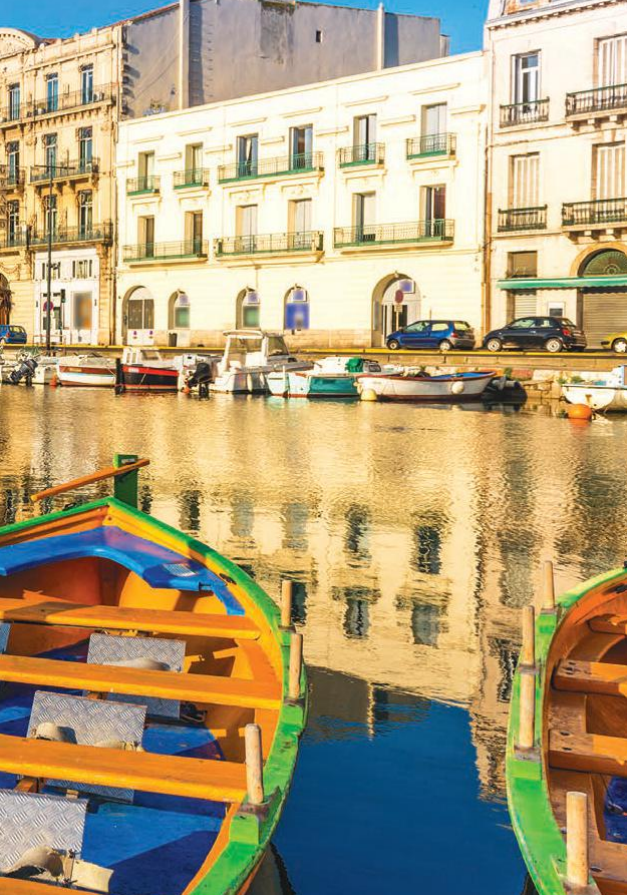
On the Mediterranean coast, you’ll pay a premium of 60% or more, with homes in Palavas-les-Flots fetching €5,576/m2 although other resorts such as Agde and Sète are more reasonable at €3,700/m2. For the best prices in the region, look to the east around St-Pons-de-Thomières where properties sell for around €1,500/m2. This means that a 50m2 apartment in Hérault could cost anywhere from €75,000 to €280,000 depending on the location.
A MEDIEVAL GEM IN A STUNNING SETTING
St-Guilhem-le-Désert is a medieval village located 45 minutes northwest of Montpellier. An official Plus Beau Village, it attracts about 700,000 visitors a year, many of whom come for the Unesco-listed Abbaye de Gellone, one of the steps on the Compostela pilgrimage trail. The winding streets are lined with craft workshops and boutiques, beckoning you to explore, and you can pause in the shade of a 160-year-old plane tree in the central square. Stay longer to make the most of the incredible surroundings, and cross the ancient Pont du Diable to explore the underground wonders of the Grotte de Clamouse.
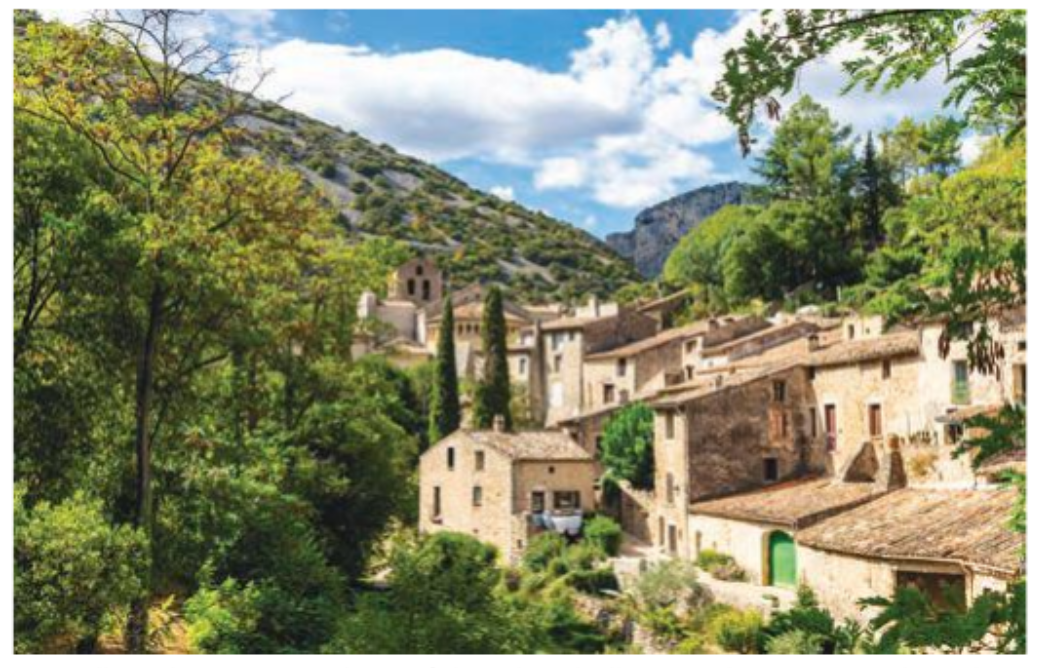
St-Guilhem-le-Désert is a beautiful medieval village on the Compostela trail
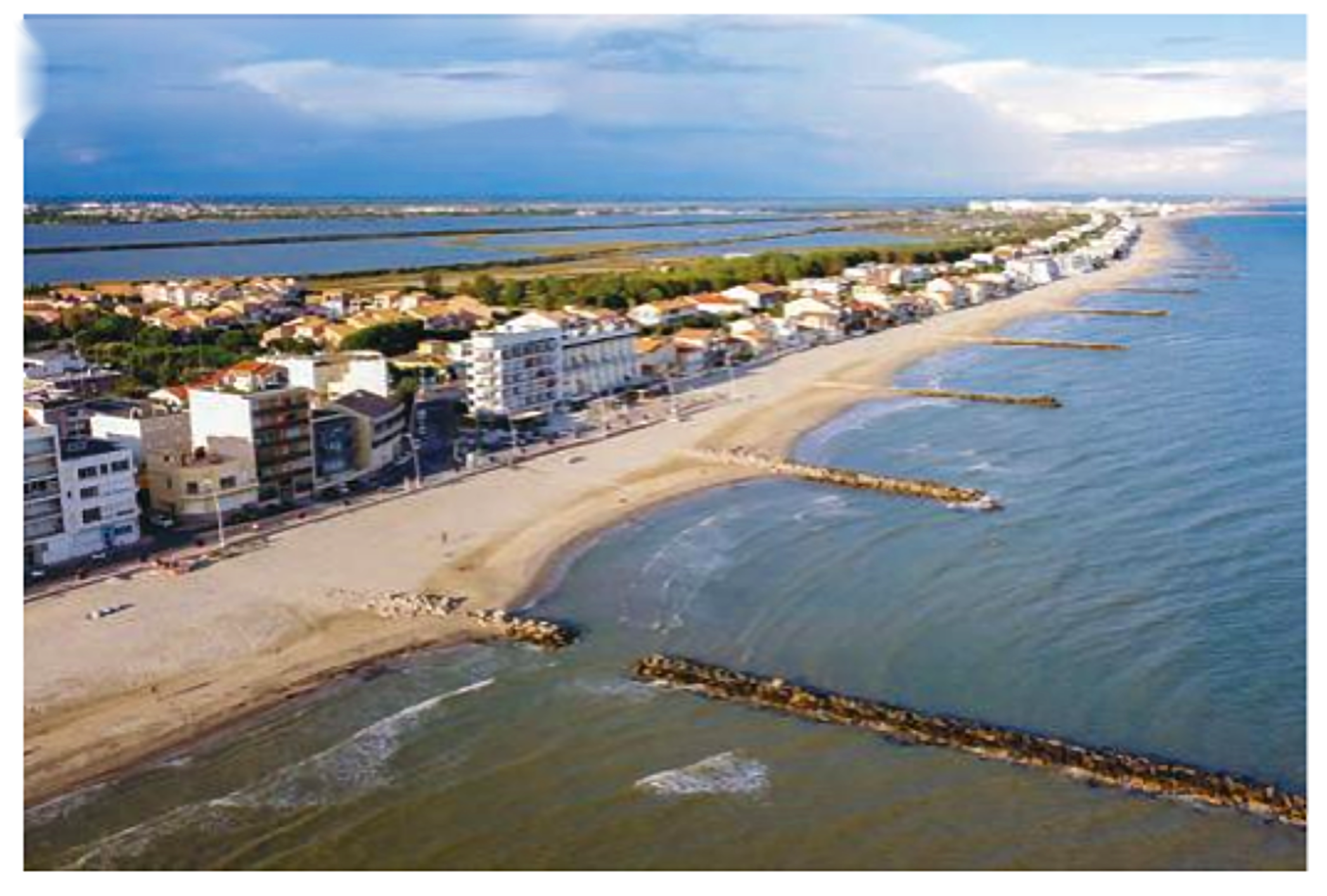
Palavas-les-Flots is an exclusive (and pricey) coastal option
LOCATION: WHERE TO FIND WHAT YOU WANT
If you’re looking for city life, Montpellier tops the list: it’s a large, cosmopolitan hub that is easily accessible by train in three-and-a-half hours from Paris or Barcelona, and just 11km from the Mediterranean. Montpellier is bursting with heritage from all eras, including a university founded in the 1200s, while its grand citadel is now home to students of the Lycée Joffre.
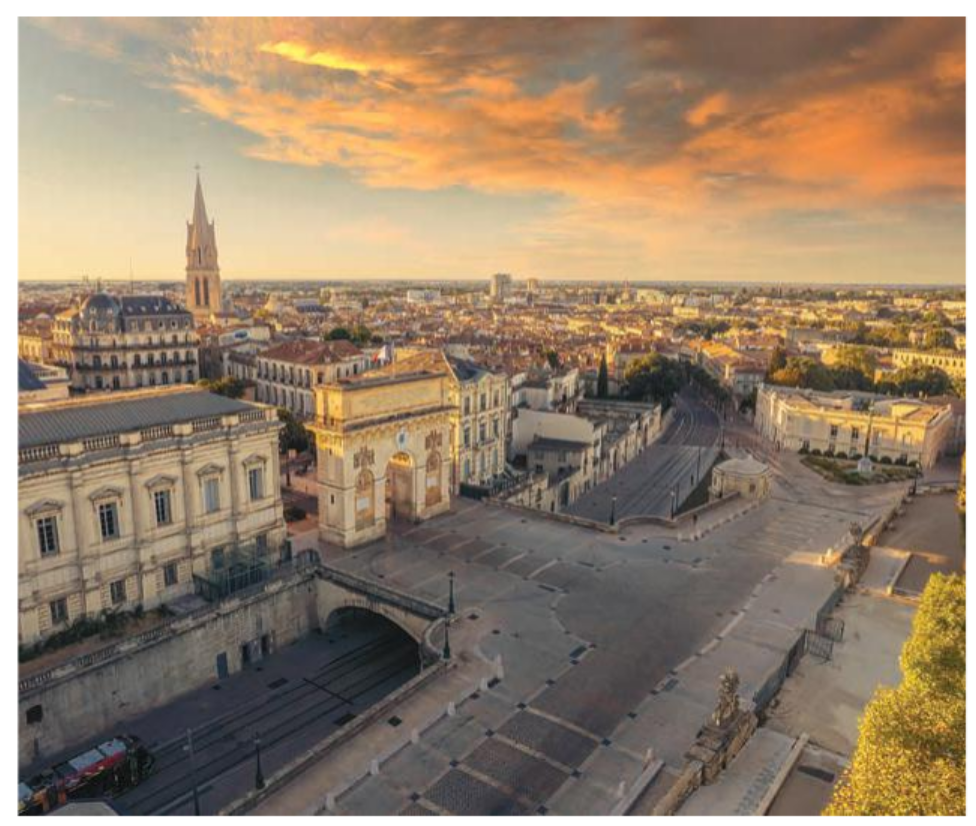
A large cosmopolitan hub, Montpellier is an easily accessible urban centre
Of the city’s 550,000 residents, 66% are rental tenants and around 17% are students, making it an ideal place to invest in rental accommodation. An overwhelming 87% of city properties are apartments. A €50,000 investment in a 20m2 studio should bring a rental income of around €350 a month and there is often a shortage of rental options available, as Montpellier attracts around 8,000 new residents every year.
For a smaller historic town, Béziers (population 81,000), on the River Orb, offers both wide pedestrian boulevards and smaller medieval streets as well as some of the best value in terms of price per square metre. Over 55% of residents are rental tenants, and the average sale price of €1,973/m2 means you can buy a 20m2 studio for under €30,000 and rent it out for €300 a month. Béziers is accessible, with 10 daily rail services to Paris (four hours) boosting its ranking for holiday lets.
Inland, but still close to the coast, Pézenas is also popular, with charming historic streets, a theatrical heritage, enormous antiques fair and all amenities. The average price here is €2,736/m2. In the heart of the town, a three-bedroom house is for sale at €299,000, while a one-bedroom duplex apartment is on the market for €82,000.
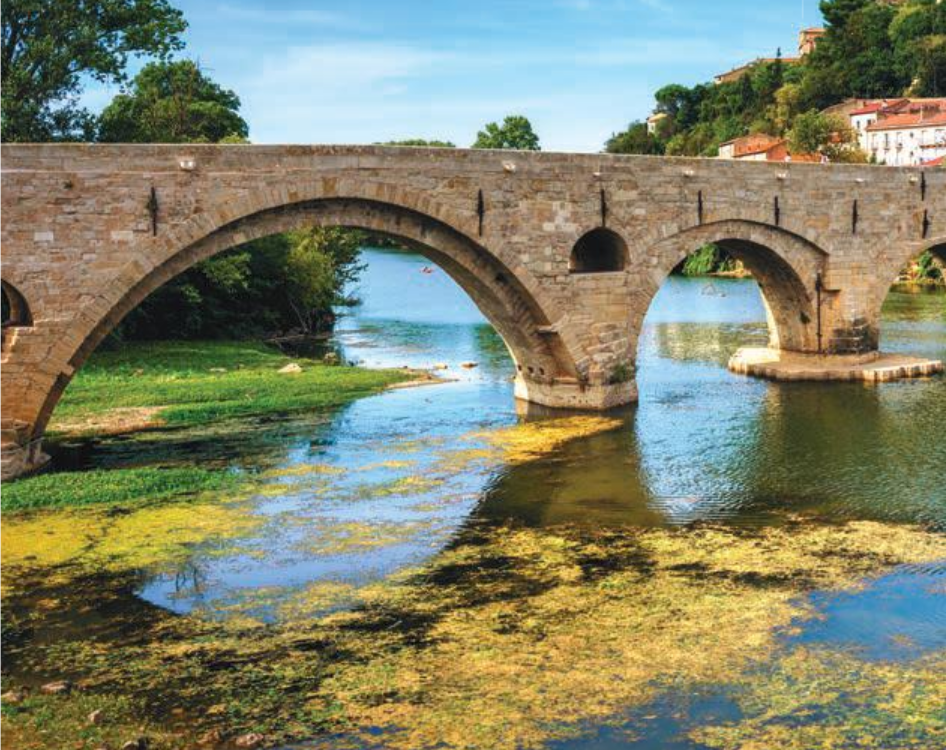
“To maximise your budget, Béziers offers excellent value”
Another great tourist draw is St-Guilhem-le-Désert, a gorgeous medieval village northwest of Montpellier (see box-out on p25). Properties rarely come onto the market here, but a small townhouse with a courtyard would cost around €200,000, a character three-bedroom home in the region of €350,000 and a larger, modern property with B&B potential about €500,000.
For seaside living, try La Grande-Motte, a popular resort near Montpellier that sprang up in the 1960s and 1970s and features recognisable pyramid-shaped hotel buildings. There’s every type of holiday accommodation here, and you could buy your own 18m2 studio for around €80,000 or €100,000 in a complex with a swimming pool. In the slightly more upmarket, but older, resort of Palavas-les-Flots you’ll look a little harder and pay a little more, but you can still find a studio for around €110,000 – sometimes with a seaview balcony.
Alternatively, head to Sète, where you can enjoy the Mediterranean and the freshwater Étang de Thau lagoon, known for its fishing villages and oyster farms. Prices can rise to more than €5,000/m2 in the ‘Pierres Blanches’ neighbourhood, but you can buy a studio flat for €70,000 with a strong market for holiday lets.
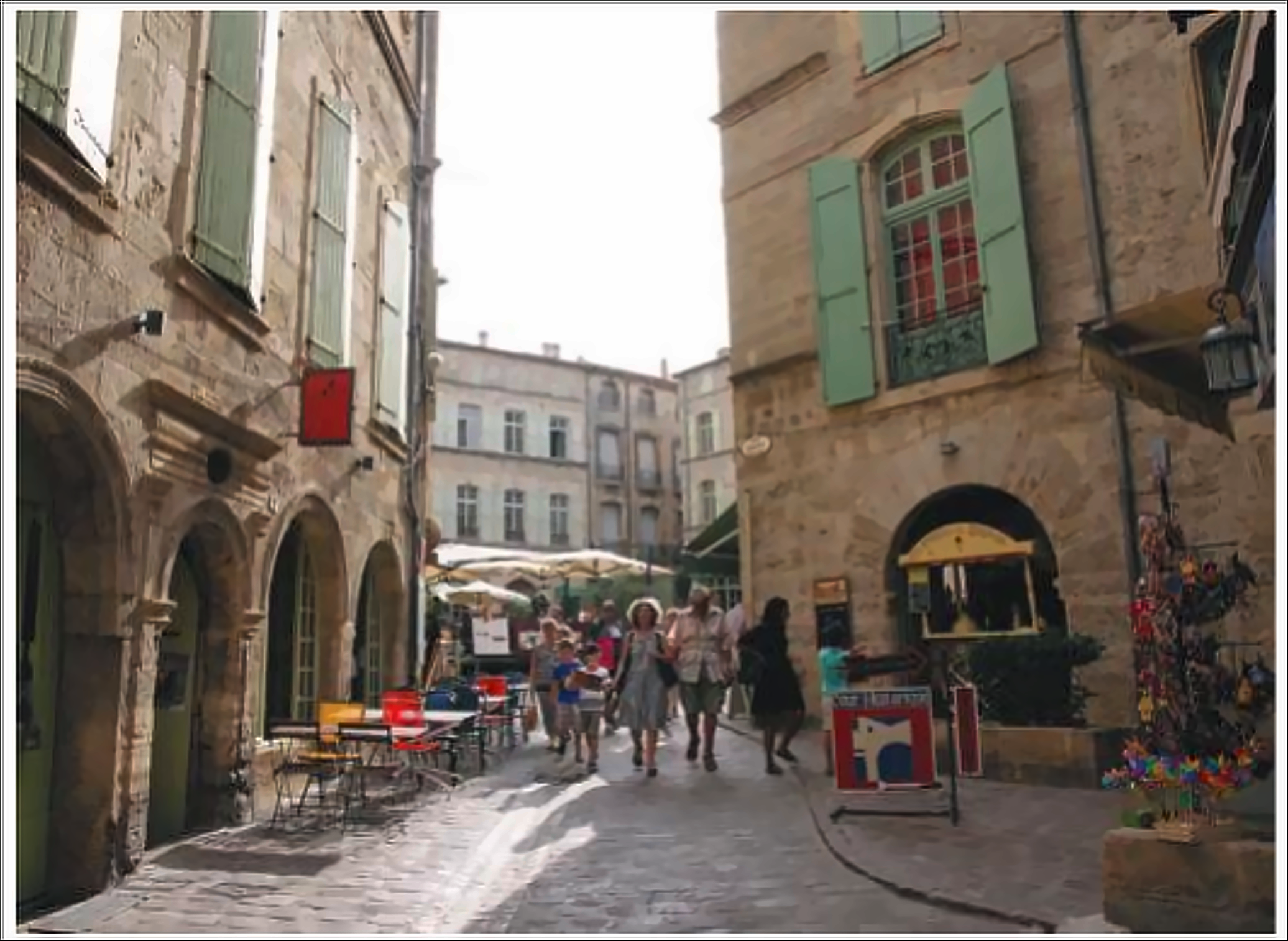
With charming cobbled streets, Pézenas has a strong theatrical heritage
To maximise your budget, Béziers offers excellent value with a choice of apartments around €30,000 and small properties on a holiday complex for about €110,000. For larger homes, look in northern Hérault, in the Regional Natural Park between Bédarieux and Mazamet, where you can buy stone properties to renovate for as little as €28,000.
This is also the best area to focus on if you’re hoping to build your own home, as you’ll find more plots here. A €50,000 budget would buy you 2,449m2 of terrain constructible (land that is permitted to be built on) in Lamalou-les-Bains or 1,000m2 in St-Julien, but only 85m2 in Vendémian closer to the coast.
FOOD AND DRINK
James Judd runs a B&B in Hérault and uses his skills as a chef to offer delicious evening meals.
“The choice of produce in Hérault is amazing, it’s great for traditional French cuisine, as well as dishes with Spanish and Moroccan influences. At the weekly markets, you can find a rabbit or whole chicken, nothing like what you might find in an English supermarket. As for local wine, Picpoul white or rosé is ideal for sipping in the summer sunshine, while red wines tend to be stronger and heavier. At our nearby cave cooperative, take a plastic drum and you can get an amazing rosé for €7.50 for five litres – an absolute bargain!”
Also look out for Pélardon goat’s cheese, which was selected to be served at a state banquet in Versailles for King Charles III, hosted by President Macron, and if you have a sweet tooth, the tartelettes aux noix (walnut tartlets) drenched in caramel are dangerously moreish.
WHY WE MOVED HERE

Photographer Steve Turnbull moved from the UK to Hérault more than 10 years ago, with his French wife, who was originally from Paris. “We live in the charming market town of Lodève, near the Lac du Salagou and I make my living as a writer and photographer. This area is the ‘gateway to the Mediterranean’, and what I love most is the landscape. It’s remarkably varied, from deep dramatic gorges and vast limestone plateaux to lush forests and majestic mountains. In the summer, the Haut-Languedoc Regional Natural Park is covered in purple heather and bathed in sunshine. “There’s so much on the doorstep and beyond, with Spain only a couple of hours’ drive away, so we never tire of Hérault and I would recommend it to anyone.”
LOCATION
Property Types
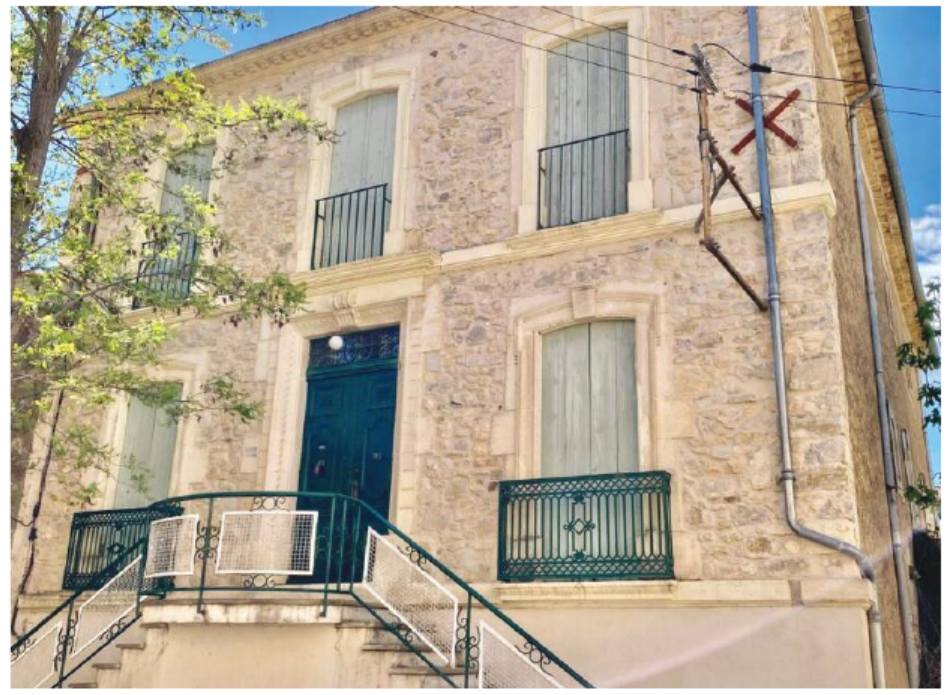
You’ll find plenty of grand winemakers’ houses, including this six-bedroom home with pool for sale at €359,700 (propertyinfrance.com, ref CC397850E)
Mas
A ‘mas’ is often a former farmhouse, so you can expect lots of land and outbuildings. The property itself is usually a two-storey stone building, a solid square or rectangular structure that can be very rustic or more refined. You can get an extensive mas with open views and several acres for €700,000, while more upmarket versions can sell for more than €2m.
Vineyard
This is wine country, so you’ll often see ‘viticole’ properties featuring a winemaker’s home among fields of vines, with outbuildings for processing the grapes into wine. A €1m budget will buy a period property bursting with character features and acres of working vines, or look for a ‘maison de bordier’, a former vineyard-worker’s home, which you can buy for around €350,000 complete with 1.5 acres to plant your own vineyard.
Maison de maître
These manor-like properties are often part of a vineyard or working estate, but you can also find them in towns or villages. Typically dating from 1850 to 1880, they are often symmetrical, featuring delightful architectural details such as sweeping staircases. A €595,000 budget buys a six-bedroom, fully renovated ‘maison de maitre’ complete with pool, but you can find some for €250,000 if you’re happy to update them.
Business investment
As this is a tourist destination, you might like to invest in an existing business, such as a 350m2 five-bedroom guest house with an annual turnover exceeding €60,000 in a tourist village near Clermont-l’Hérault for €425,000. For €850,000, consider a holiday complex with three gîtes, leisure facilities, a pool, an acre of land plus a fi ve-bedroom family home.
Village house
This area has a plentiful supply of charming villages, many featuring on the list of France’s Plus Beaux Villages (including Minerve, Olargues and St-Guilhem-le–Désert), while others such as Capestang sit on the Unesco–listed Canal du Midi. Renovation projects start at €35,000, while move-in-ready village homes with small garden start at €80,000, depending on location.
Apartment on the Med
It’s possible to find a 20m2 studio in Cap d’Agde with a harbour view for €75,000, or a one–bedroom apartment with full sea view for €140,000, while a 138m2 modern apartment with sea views and balconies will fetch over €1m: something for every budget!
EMPLOYMENT AND THE ECONOMY
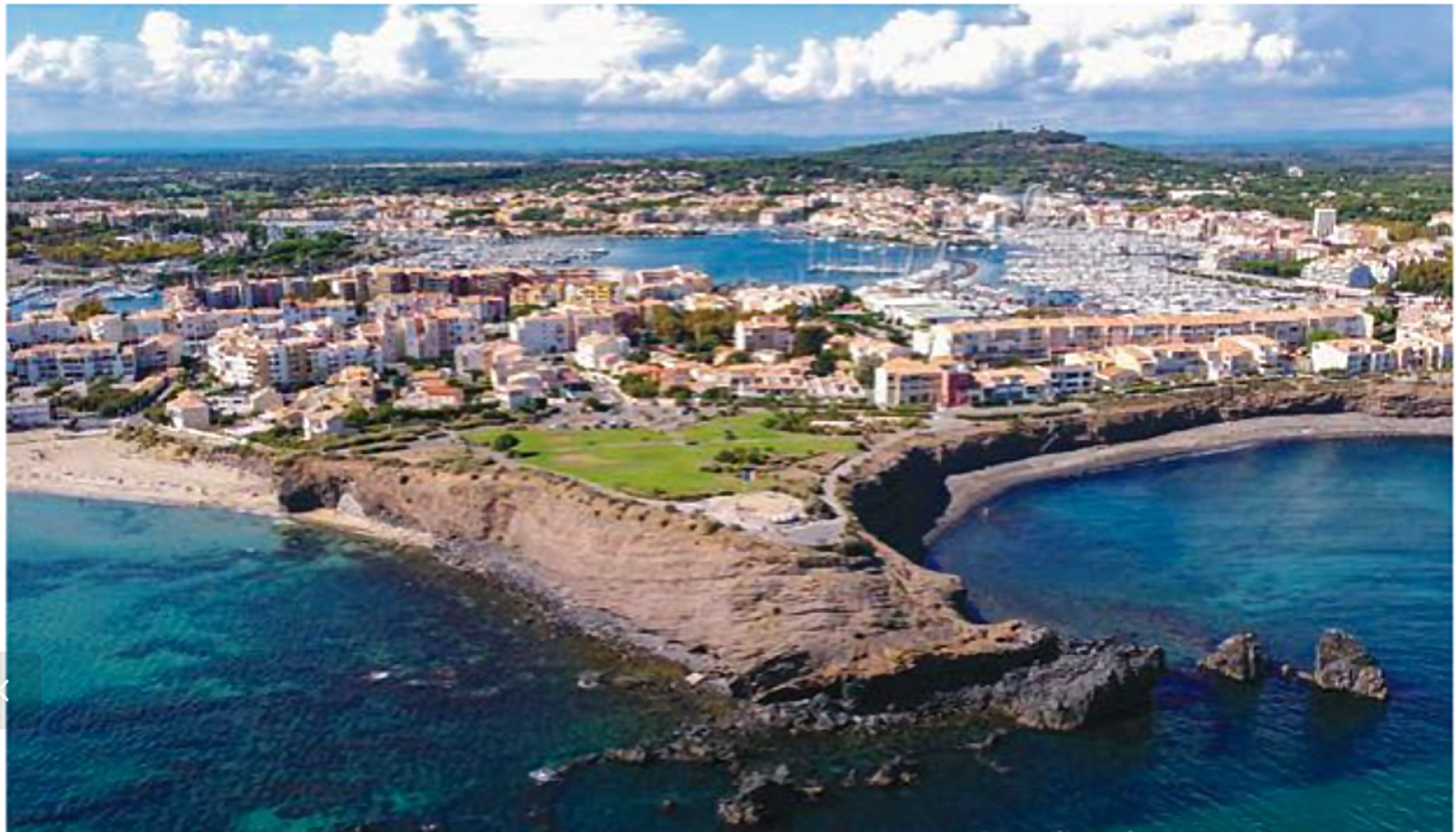
Cap d’Agde is a major coastal resort with a large marina
Hérault’s is a service economy: 73% of jobs are involved in the production of goods and services and focused in Montpellier and the main urban centres. Tourism accounts for 9% of Hérault’s economy, and much work is seasonal: 49% of overnight stays happen in summer, 25% in spring, 15% in autumn and 11% in winter. An impressive 45% of visitors head to the 90km stretch of coastline and 42% to the area just behind, so that’s where you should focus if you want to set up a tourism business in the department. Unemployment is at 28% among 15 to 24-year-olds, but drops to 12.6% for those aged 25 to 64, higher than the national average of 7.7%. Of those employed, there’s a fairly even split between employees (27%), middle management (28%) and upper management (20%). Only 15% are manual workers.
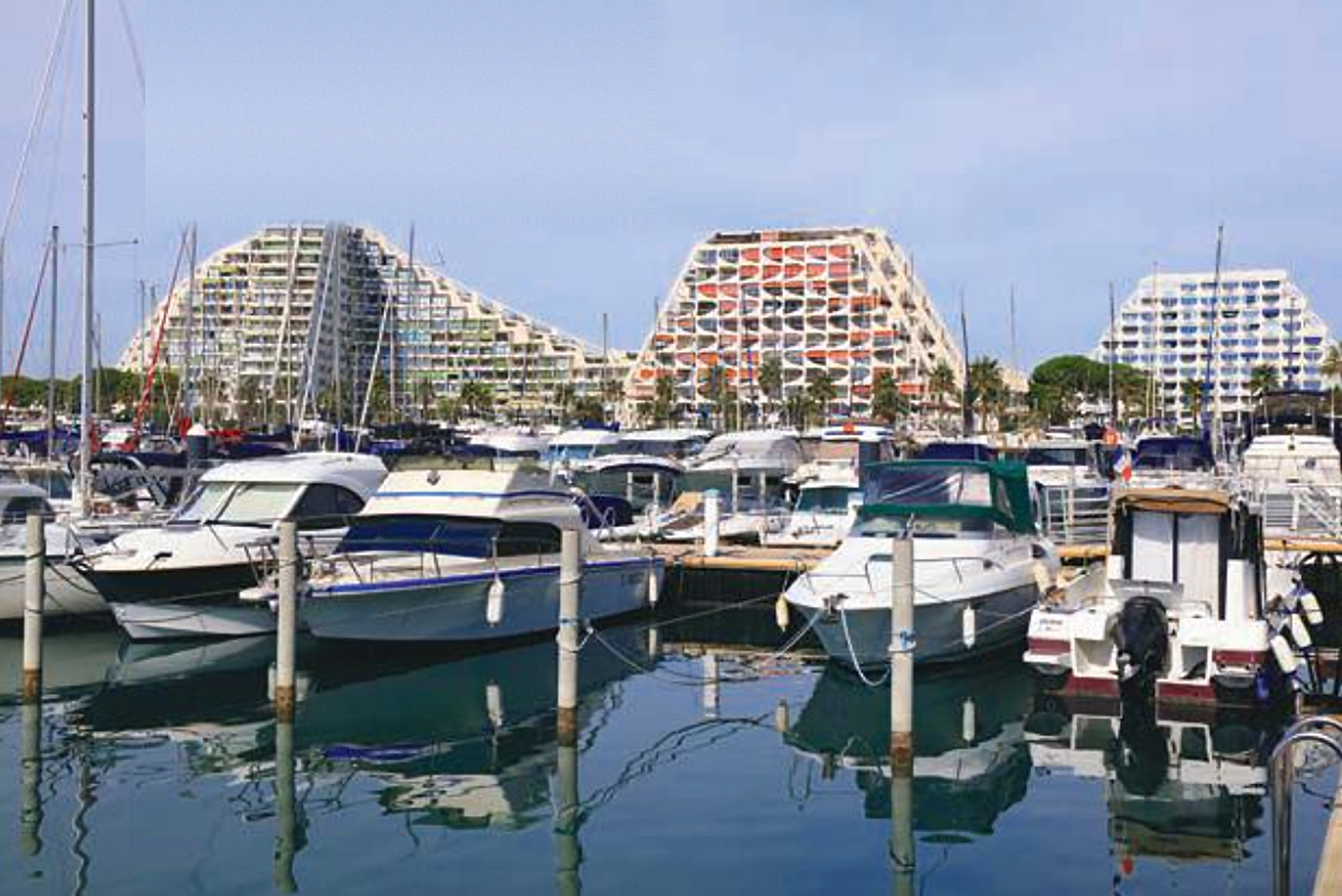
La Grande-Motte is a distinctive seaside resort built in the 1960s and 70s
TRANSPORT
Hérault’s transport links make it a very accessible place to get to from the UK and further afield. Montpellier airport is a 10-minute drive from the centre and is currently home to 13 different airlines connecting across Europe and beyond, and welcoming 1.8 million passengers a year. There is also an airport in Béziers, although this is much smaller (260,000 passengers a year) and connects to only eight destinations. Rail links are excellent with up to 10 connections per day taking you to the country’s capital in four hours or even less. By road, Montpellier is just three-and-a-half hours from Barcelona, four hours from Italy, and roughly eight hours from Paris. If you’re travelling by ferry, the drive south will take you around nine hours from Caen and perhaps 11 hours from Calais.
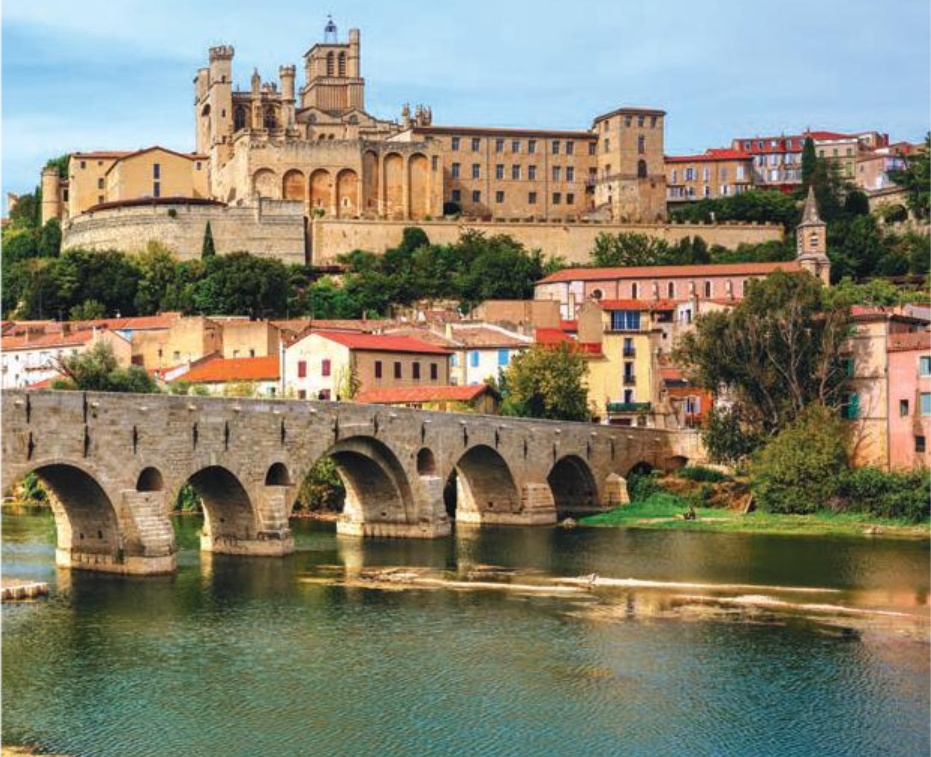
The town of Béziers sits on the River Orb and is just six miles from the Mediterranean coast
Local property agent Freddy Rueda runs Real Estate Occitanie and has worked in the region’s property market since 1995.
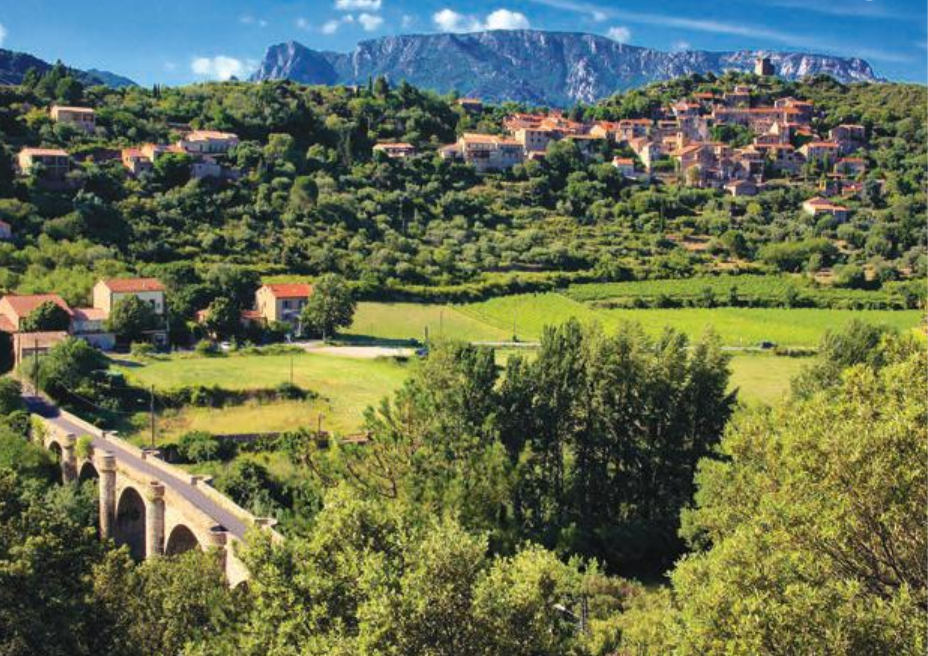
St-Chinian is a renowned wine region
WHAT THE AGENTS SAY…
“For a couple of years buyers were holding back on buying property, but that seems to be changing. We’re noticing more interest from Americans and Scandinavians as well as British buyers, and there’s been a rise in people wanting to buy mortgage-free, with only around 20% needing a loan. “Many are still drawn to the key tourist areas, but if you head inland from Béziers there are beautiful towns and villages that are not yet well known, especially Pézenas and St-Chinian, for example. You can get excellent value for money in Hérault, particularly in the villages around Béziers, where you can buy a single-storey villa with a gîte, pretty garden and swimming pool for under €250,000.”
The unique mix of legal, financial and tax advice along with in-depth location guides, inspiring real life stories, the best properties on the market, entertaining regular pages and the latest property news and market reports makes French Property News magazine a must-buy publication for anyone serious about buying and owning a property in France.

Living in France has been truly life-changing for these expats, who are all healthier and fitter than they’ve ever been before, they tell Gillian Harvey
WE NATURALLY DROPPED WEIGHT!
Before the Covid-19 pandemic, Billy, 58, and Sandra Moffat, 56, spent much of their time travelling for work. The pair ran a legal management consultancy company, which meant long hours on the road and at desks. However, the pandemic opened up the world of remote working and changed everything. “We suddenly realised we could work from anywhere,” says Sandra.
The realisation led to a property hunt, initially in the UK. “We visited a house in the Lake District and the owners were moving to France. It got us thinking and we expanded our search area.”
The couple settled on a 17th-century stone house on an acre of land in Chouppes in Vienne, near Poitiers, from which they now work as independent management consultants. They were looking forward to adopting aspects of the French lifestyle, but weren’t prepared for the health benefits of living in a rural location.
“After lockdown, we’d put on a lot of weight,” says Sandra. “We both had health problems too. I had an arthritic hip so couldn’t exercise much. Billy had diabetes, high blood pressure and raised cholesterol. We were both obese.”
However, over the years since their move, both have found their weight reduce significantly, with little conscious effort. “We’ve each lost exactly 32kg,” says Sandra. “It’s happened completely naturally, without our really setting our minds to it. We put it down to both the healthcare system here and the lifestyle we’re now living.”

The Moffats are now more relaxed
After their move, within six weeks of seeing a surgeon in France, Sandra was given a new hip. And fewer hours on the road have meant more time outdoors, walking and looking after the five cocker spaniels they’ve adopted since their move. “My new hip has meant I’m much more mobile,” says Sandra. “And Billy’s weight loss and improved fitness has meant he no longer has to take medication for his high blood pressure or diabetes.”
But how could moving to France have such dramatic benefits? “For a start, there are no takeaways near us,” says Sandra. “Before, we were travelling a lot, leaving at 6am and returning at 9pm. We’d often grab a takeaway as a result. Now, working from home and without a local takeaway, we’re cooking for ourselves at more reasonable times.”
“We’ve each lost exactly 32kg – we put it down to both the healthcare system here and the lifestyle”
The local markets also mean that the couple are eating more seasonally, choosing fresh fruit, and veg, less red meat. Plus, they’re now the proud owners of five cocker spaniels who have ensured that both are active on a daily basis.
“We also have more regular mealtimes, rarely snack, and have learned to savour our food the way the French do. We no longer guzzle and go. Taking our time means we’re more in tune with our bodies and aware when we’ve eaten enough.
“We’re also more relaxed generally. I feel better than I have for decades. I don’t wake up in the morning thinking ‘here we go again’. I have a spring in my step straightaway. The change is phenomenal!”
I TOOK UP JOGGING AND ENDED UP ON TEAM GB!
When Angus and Sarah Cameron, 52, moved to France in 2003, it was to fulfil a long-held dream of running a vineyard. Both worked for an airline at the time – Angus, now 55, as a pilot, and Sarah as cabin crew. “I got a degree in Wine Studies from Brighton University in 2003, and we bought a vineyard in the AOP Fronton region, which we ran until 2018.”

While managing a vineyard was quite an active pursuit, after the couple’s two children were born in 2005 and 2008, Sarah wanted to find a way to get fitter. “If I’d still been living in England I might have taken a class,” she says, “but in rural France there are very few options, so in 2012 I decided to try jogging.”
To her surprise, Sarah found she really enjoyed hitting the road. “I wasn’t sporty at school and hated PE – I used to hide in the bushes!” she says. “So nobody was more surprised than me when I realised I was enjoying myself.”
In 2013, a friend suggested they compete in a 10k together for fun in Montauban. “I thought I’d come last, but I came eighth out of 387 female runners. When I mentioned this to another friend, Mike, he suggested I sign up for the Sauternes marathon with him, just seven weeks later. We’d run together and aim for five hours.”

Sarah and husband Angus sample the competition to their AOP Fronton wine
“But when the day came, he had to drop out due to injury, so I ran at my own pace. To my astonishment, I finished in three hours and 32 minutes and came seventh, which qualified me for London and Boston.”
Sarah began to learn more about pacing and nutrition in an attempt to get her speed up. Then in 2019, she took part in a 24-hour race in Albi – running 215km, which qualified her for Team GB. “I was overjoyed!” She represented GB in a six-hour race in Bordeaux in August 2020, and was selected for the 24-hour European Championships the following month. Sadly, these were cancelled due to Covid.

Sarah with Team GB; (inset) winning the six-hour event in Bordeaux
Shortly afterwards, in 2021, Sarah had an accident. “I came off my bike and had to have a hip replacement.” Despite her injury, Sarah was determined to run again and has since completed a marathon and a few ultra marathons with her bionic hip. She finished an 80km race in November 2025 and won a 12-hour trail race in the Aveyron last February. But her pace isn’t as competitive and she does suffer some pain.
However, this doesn’t stop her running for up to five hours most mornings, and she now works as a coach in the afternoons, alongside her support role in the GB 24-hour management team. “I take my daughter Taliyah, 18, to school, then run in the Pyrénées or the Gorges d’Aveyron. Then it’s back for a siesta and coaching in the afternoon.”

Sarah’s running has also inspired husband Angus, who was already into fitness, to try his hand at marathons and triathlons. “I think if I’d stayed in the UK, I’d have been going out with friends and wouldn’t have had the same motivation. But we live in the middle of nowhere, and as a result, I became an international-level athlete. I credit France for changing my life for the better.”
“To my astonishment, I finished the race in three hours and 32 minutes and came seventh, which qualified me for London and Boston”
MORE MOVEMENT DID WONDERS FOR MY BACK
Sophie Hargreaves, 38, and husband, Will, moved to France in 2020, after he was made redundant. “Will was working in the wine industry supplying restaurants, many of which were completely decimated during Covid. I was working as a housing officer, but fancied a change,” explains Sophie.

Originally, the couple had been looking at properties in the UK, but wanting to purchase both a house and land, they gradually started looking at places further afield. “We’d always talked about having some sort of farm and living an outdoor life,” says Sophie. “Eventually we found the perfect property in Deux-Sèvres and moved over there in December 2020 to start farming alpacas!”
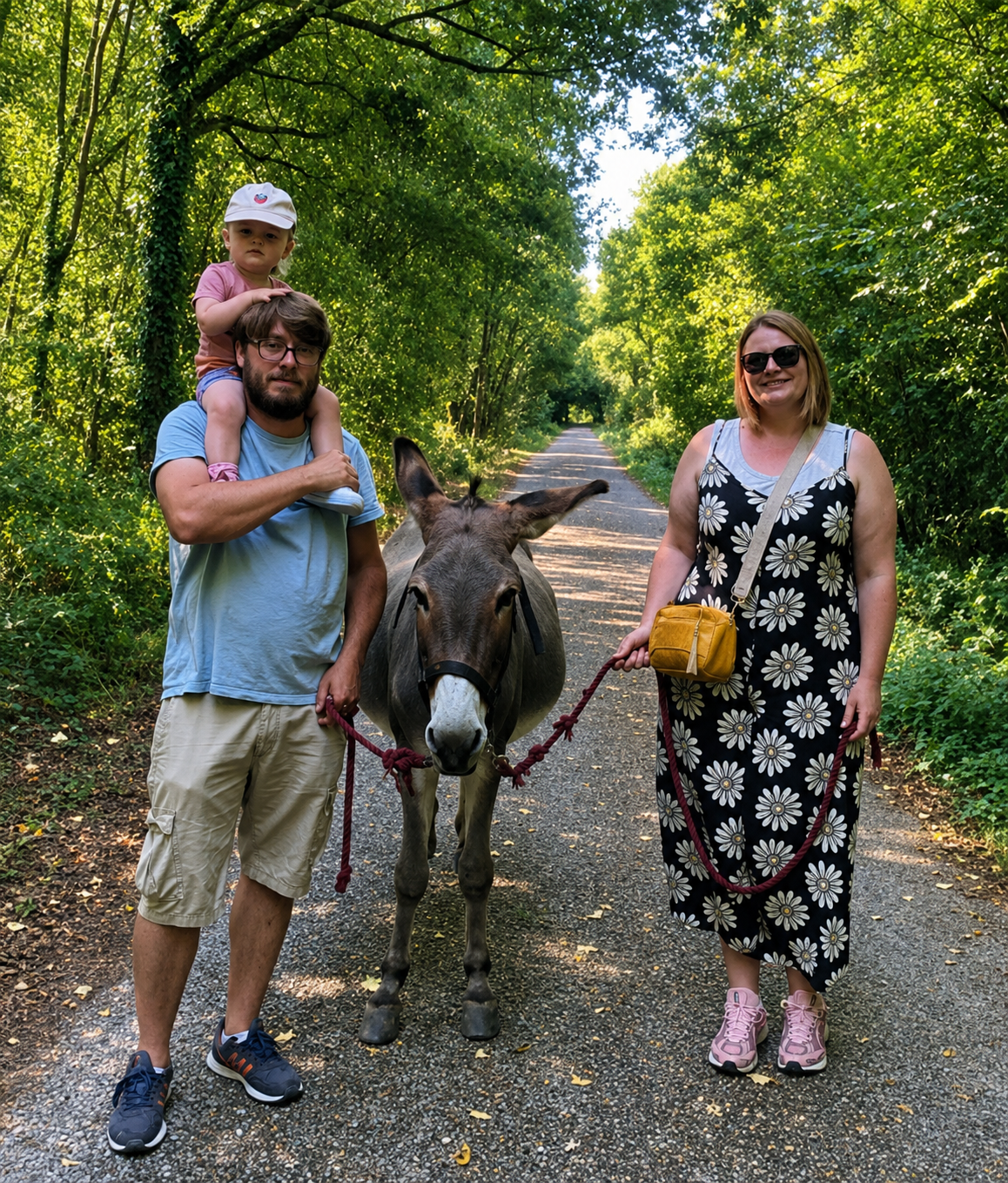
Sophie and Will take a stroll with Emilie (and a donkey)
At the time, Sophie was suffering from chronic pain after sustaining a back injury in 2015. “I tore a disc in my spine, and while I’d had treatment, I’d been left in terrible pain. The only way to deal with it was to take a lot of pain medication. In the UK, I’d been under a pain management team.”
Sitting down to drive or working at her desk seemed to exacerbate the pain, so Sophie hoped that, on moving, she might be able to practise a little more self-care. But she didn’t expect to experience the dramatic improvement she did. “When I first came to France, I went to the GP and explained my history,” she says. “He was happy to prescribe painkillers. But I began to realise that I was barely taking them,” she says. “Previously, I’d know immediately if I missed a dose, but my pain had eased considerably.”
Sophie credits much of her improvement to her new more active role on the farm. “I’m often moving and rarely sit still,” she says. “Being my own boss, too, means that I can listen to my body and choose tasks appropriately.”

Sophie and Will with their alpacas on La Petite Ferme d’Alpagas, Sanzay
“I had hoped for some improvement on moving, but nothing could have prepared me for the dramatic change. Just a month after we arrived, I was bashing a fence post in with a 16kg post knocker. Will just couldn’t believe it.”
The reduction in pain and end to her reliance on pain medication have also meant that Sophie has been able to become a mum, something she wondered whether she’d be able to do. “I had my first child, Emilie, in 2023, and I’m currently pregnant with baby number two,” she says. “I’ve actually found my back pain clears up almost completely during pregnancy, which is the opposite of many pregnant women!”
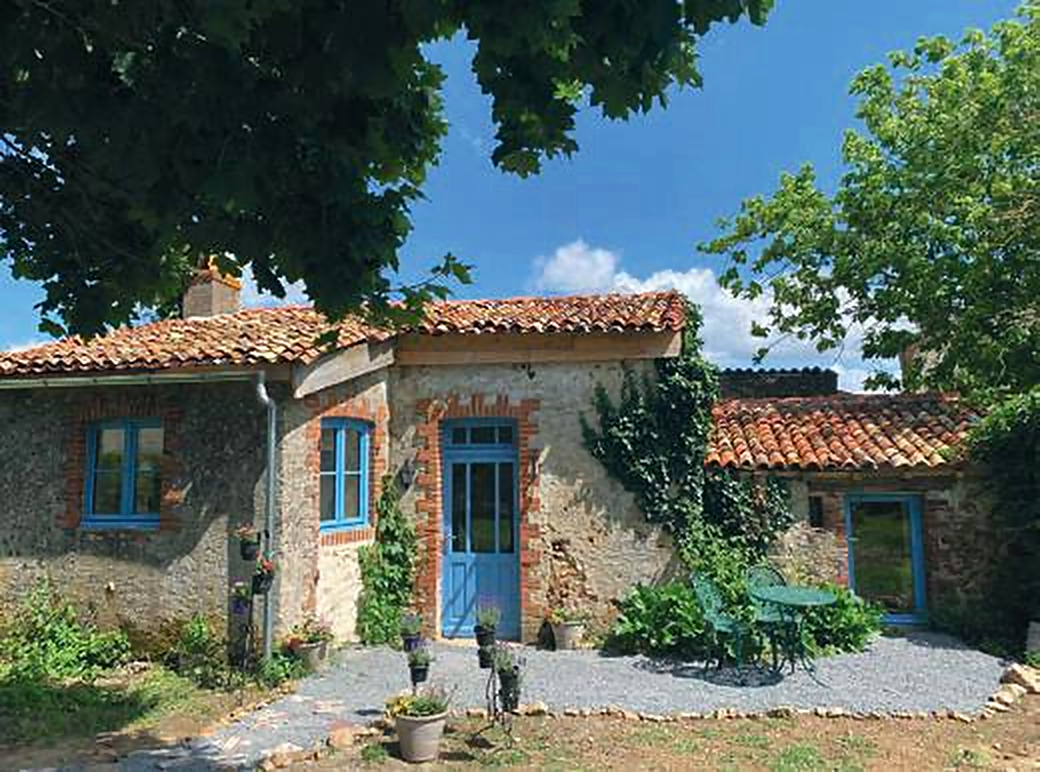
The Hargreaves also have a gîte, Vue du Château, that they rent out to visitors
While Sophie’s injury hasn’t healed – “I’ll always have to be more careful than the average person of my age” – her new lifestyle has worked wonders. “Working on the farm means my muscles are stronger, which really helps with spinal injuries. No two days are the same. I’ll be filling buckets, cleaning the fields, feeding the alpacas, or moving 12kg bales of hay. The range of movement has really helped. Living in France has been life-changing.”
The unique mix of legal, financial and tax advice along with in-depth location guides, inspiring real life stories, the best properties on the market, entertaining regular pages and the latest property news and market reports makes French Property News magazine a must-buy publication for anyone serious about buying and owning a property in France.
Moving to France is an exciting prospect, but there is considerably more to think about than finding the perfect property and organising the removal van. Residency, tax, healthcare and financial planning can all be affected by your move. Addressing some of these questions before you relocate can make the transition considerably easier.
Here are five things to consider.
1. Understand your residency requirements
Owning a property in France does not automatically give you the right to live here permanently. If you are a non-EU national, you may need an appropriate long-stay visa before moving to France, depending on your circumstances and what you intend to do once here. Research the correct route early.
2. Think about tax before you become resident
Immigration residency and tax residency are not the same thing. Once you become French tax resident, France will generally require you to declare your worldwide income. This can include pensions, salaries, investments and rental income arising outside France. Understanding your likely position before moving gives you time to plan.

3. Review your existing financial arrangements
Investments, savings products and financial arrangements established in your current country may be treated differently once you become French resident. Before relocating, make a list of your pensions, investments, savings and other assets and consider whether becoming French resident changes their tax treatment.
4. Plan your healthcare
Do not leave healthcare until after you arrive. Your route into the French healthcare system will depend on your circumstances. Establish what will apply to you and whether you need healthcare cover during any transition period.
5. Bring your paperwork with you
Good preparation can make French administration considerably easier. Before leaving, obtain good-quality copies of important documents and keep secure digital versions too.
Many administrative difficulties can be made easier by considering them beforehand. A little planning before the move can make calling France home considerably simpler.

News from across France takes centre stage this week, with a dramatic art heist at the Renoir Museum on the Côte d’Azur making headlines, while property owners face rising taxe foncière bills in towns across the country. Meanwhile, the Eiffel Tower has reopened following a staff walkout, and France’s firefighters have begun a nationwide strike after a summer of record-breaking wildfires.
Elsewhere, changes to the DPE calculation coming in 2027 could affect the energy ratings of some electrically heated properties, potentially giving homeowners and landlords more flexibility when it comes to future renovation decisions.
€9 Million Renoir Museum Heist on the French Riviera
Two suspects broke into the Renoir Museum in Cagnes-sur-Mer in the early hours of Tuesday 8th September, attempting to steal four works of art from the former home of French Impressionist painter Pierre-Auguste Renoir: the alarm was triggered at 5:48 am and police arrived just five minutes later, but the suspects had already fled. Two of the stolen works were dropped during the getaway, leaving two others still missing, along with the suspects. The museum, founded in 1960 and renovated in the 2010s, is now the focus of a police investigation.
Cagnes-sur-Mer mayor, Bryan Masson, described the theft as an attack on the town’s history and heritage. Local reports have identified the four targeted works as Portrait de Madame Stephen Pichon (1895), Madame Colonna Romano (around 1910), Coco lisant (around 1905) and Jeune femme au puits (around 1886), all by Pierre-Auguste Renoir.
The heist comes less than a year after the high-profile Louvre robbery in Paris, when eight pieces of historic jewellery worth an estimated €88 million were stolen. Empress Eugénie’s crown, which was also taken during the raid, was dropped during the getaway and later recovered.
Taxe Foncière 2026: Where Property Tax Is Rising and Key Payment Deadlines
French property owners stay alert as property tax is on the rise in various towns, in several municipalities homeowners are facing significantly higher bills. In Île-de-France, increases range from 9% to 25%, with Montrouge seeing the largest rise at 25%, followed by Clamart at 16.9%, Drancy at 14.1% and Aulnay-sous-Bois at 9.18%. Nationally, 13.6% of communes have increased their taxe foncière rate this year, although nine in ten of these rises are below 3%.
For French property owners, the amount of taxe foncière varies depending on the municipality and the property’s cadastral rental value. The tax is paid by owners and usufructuaries, and the 2026 notices began arriving from late August. The payment deadline is 15 October for most non-online payments; check, bank transfer, or cash are only accepted if the amount is under 300 euros. While homeowners paying online have until 20 October.
Eiffel Tower Reopens Following Staff Walkout
Good news for Eiffel Tower visitors, the iconic Paris landmark has reopened following a one-day closure on Monday 7 September. The Eiffel Tower was closed after staff walked out during a dispute over arrangements for a private visit by a Hindu religious delegation on Saturday.
Around 100 people linked to the BAPS spiritual movement attended the visit. The tower’s operator, SETE, said the arrangements did not meet its usual standards, while BAPS later apologised for any inconvenience caused. The Eiffel Tower reopened to visitors on Tuesday 8 September.
French firefighters begin six-week strike after record wildfire summer
The devastating impact of this summer’s record high wildfires has led to increased pressures on France’s emergency services. Professional firefighters have begun a six-week nationwide strike as a result, due to lack of funding, staffing and resources. At least 120,000 hectares burned across France this summer, the highest figure since satellite imagery began being used to measure wildfires 20 years ago. Four firefighters died in July, while more than 100 were injured over the summer while responding to or travelling to fire incidents.
Eight unions are calling for more financial and material resources, as well as the mass recruitment of professional firefighters. The strike is due to run until 20 October, with further demonstrations planned in Paris later this month. Emergency services are expected to continue operating during the action, as France’s 44,300 professional firefighters can be ordered to work to ensure essential public services are maintained. Their campaign is due to end on 20 October when parliament begins examining France’s 2027 budget.
French DPE Changes 2027: What Property Owners Need to Know
From 1 January 2027, France will change the way electricity consumption is calculated in the DPE, with the conversion factor falling from 1.9 to 1.7. The change could improve the energy rating of some electrically heated properties, potentially giving owners and landlords more flexibility before carrying out costly renovations. If your property is close to a DPE rating threshold, it may be worth checking how the new calculation could affect its classification.
Want more help with your France property journey? Join Membership, search our Property Portal, subscribe to French Property News, and follow our YouTube channel for the latest advice and updates. Join us at the French Property Exhibition for expert advice and property inspiration.
Here’s the latest currency news from our partner Moneycorp, to help you find out what your money is worth.
US and Iran exchange fire on shipping targets, pushing oil prices higher once again
Oil prices have surged again after the US struck three Iranian crude oil tankers in retaliation for the IRGC firing ballistic missiles at two US warships. The renewed escalation pushed Brent crude oil to its highest level since the collapse of the peace accord in July.
Admiral Brad Cooper, head of Central Command, stated that the US intends to impose the highest economic cost on Iran. However, such action increases the risk of attacks on shipping in the Strait of Hormuz by the Iranian regime, as well as the potential for attacks on refining facilities across the Middle East.
Meanwhile, US envoys completed talks in Russia and Ukraine, but neither side appeared ready to agree a ceasefire and Ukrainian President Zelensky predicted another winter of war. The prospect of a prolonged conflict in the region could provide further support for oil prices as supply remains constrained.
REC reports labour market stabilisation following a multi‑year downturn, though Jaguar Land Rover concerns weigh
The REC/KPMG employment report released this morning was more positive than recent releases, suggesting the labour market is showing signs of recovery in permanent job placements, while temporary placements grew at their strongest rate in more than three years.
However, employment news has not been universally positive. Media reports continue to focus on discussions between the UK government and Jaguar Land Rover, which may reduce its workforce by up to 4,000 employees as it seeks to lower costs. JLR faces significant revenue pressures as demand remains subdued following the 2025 cyberattack, a misplaced advertising campaign and increasing competition from Chinese EV manufacturers.
This week’s focus is on UK monthly GDP, industrial production, index of services and construction output data. Could the combination of the World Cup and warm weather provide further support to activity, or will activity have been negatively affected? The former remains the greater risk in my view, which could offer sterling some modest support into the end of the week.
Following robust US payrolls data, what will the CPI figures indicate?
Last week’s strong US non‑farm payrolls data left financial markets with a dilemma. Other secondary indicators suggested the labour market remains weak, but the USD rallied following Friday’s employment report. Yields also moved higher, suggesting the US Treasury’s attempts to reduce yields at the longer end of the curve have so far proven unsuccessful.
The key release this week is August CPI inflation on Friday at 13:30 BST. Risks remain that the headline rate stays elevated at 3.4% y/y while the core rate falls back to 2.4%. If that happens, it could increase the dilemma facing US policymakers. The Federal Reserve would face a choice between raising interest rates in response to headline inflation and risking limited transmission into core or second round inflation effects, or leaving rates unchanged and risking its credibility that policy is behind the curve if secondary inflation effects materialise.
The USD remains under pressure, particularly against the JPY, with the currency pair finally adjusting to economic realities as the yen had become significantly undervalued relative to purchasing power parity measures.
AfD wins in Saxony‑Anhalt, German industrial production falls despite strong factory orders, ECB in focus this week
News over the weekend that AfD secured victory in Saxony‑Anhalt, winning 43.8% of the vote according to preliminary results, left the party short of an outright majority but potentially makes a rainbow coalition among the remaining parties extremely difficult. The result is likely to send shockwaves through the German political establishment, with the largest governing party polling just over 17% of the vote.
German industrial production data for July also disappointed this morning, falling 1.1% m/m despite the surge in factory orders recorded over the past three months. The weakness may prove temporary, but it is another warning sign that conditions in the German economy remain precarious, particularly given ongoing challenges within the automotive sector.
The ECB meets on Thursday and is expected to raise all official interest rates by 25 basis points. Greater interest may lie in officials’ assessment of the disconnect between headline and core CPI rates, and whether tariff‑related pressures and trade uncertainty risk weaker GDP outcomes towards year‑end. If the ECB signals support for further tightening, the euro could strengthen. However, risks remain skewed to the downside for growth, which could weigh on the currency over the medium to longer term, in my opinion.
AI backlash presents potential challenges for Canada, while Mexico focuses on CPI figures
Some Canadian municipalities are introducing moratoriums on data centres or vetoing proposed projects as public scepticism towards AI continues to grow. Prime Minister Mark Carney has been keen to encourage such investment as the economy contends with the impact of US tariffs.
Concerns about labour market weakness driven by AI appear overstated. Nonetheless, they may continue to form part of the negative narrative around AI promoted by unions, alongside concerns around noise, energy consumption and water usage. With limited Canadian data releases this week, attention may remain on the weaker Canadian August employment report released at the end of last week, which has checked recent gains in the CAD.
For the MXN, focus this week falls on the release of August CPI inflation data in the middle of the week. Could inflation record a further decline in both headline and core measures, or even see the two move in opposite directions? The balance of risks for Mexican interest rates remains tilted towards lower rates, something recent strength in the peso may have accentuated, in my opinion.
Why Moneycorp?
With a Platinum Trusted Service Award 2020 from independent review site Feefo and 40 years of experience in the industry, FrenchEntrée has been recommending Moneycorp for more than 15 years. During this time they have helped thousands of client planning the best way to pay for their property as well as supporting them afterwards with any further payment from paying bills, mortgages to repatriating UK pension payments for those who have retired to France.
Furthermore, we have worked with the same person at Moneycorp for more than a decade! You might be familiar with her as she often writes for our French Property News magazine. She has 13 years’ experience in foreign exchange, and is a qualified European lawyer with experience in European transactions. Mar will be happy to answer any questions or enquiries to support you through these difficult times
Opening an account is really easy and free of cost. You can register online or over the phone in a couple of minutes and for FrenchEntrée readers there are no transfer fees in any payment.
There’s a particular kind of morning that only happens in Provence in early autumn: the morning light turns gold, the vines are harvested, and everyone seems to be in less of a hurry than usual. On the 1st of October, we’d like to spend a couple of hours of that morning with you.
Le Tour de Finance – “where money talks.”
These events have been running for more than 10 years and number in excess of 150. They bring relaxed, genuinely useful financial conversations and open forums to expatriates across Europe.
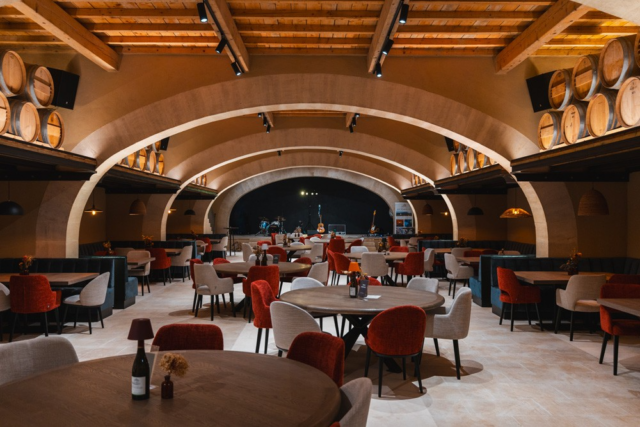
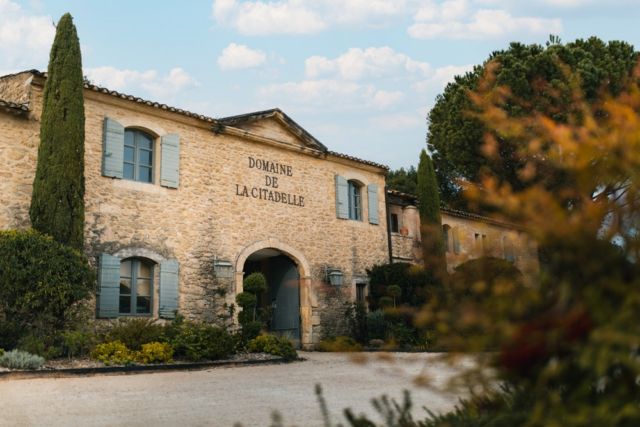
No stuffy conference rooms, no hard sell, no jargon-for-jargon’s-sake. Just good information, delivered by people who know the terrain, in glorious locations worth visiting anyway. This time, that place is Le Domaine de la Citadelle in Ménerbes, a working vineyard in the Luberon with its own small claim to fame: a museum of over 1,200 corkscrews, spanning three centuries of remarkably inventive engineering devoted entirely to the noble goal of opening a bottle of wine.
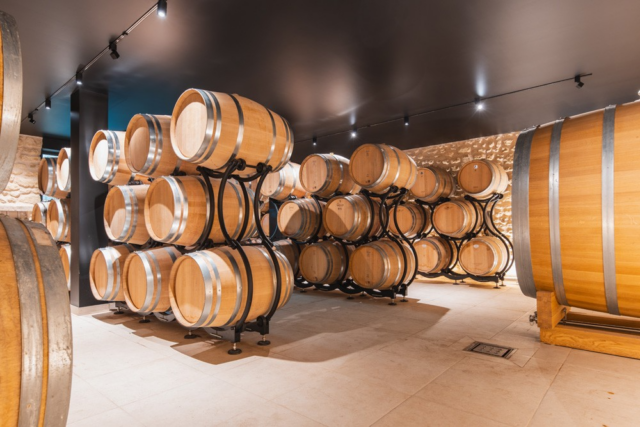
The event itself runs from 10am to midday on Thursday 1st October, and it’s built around the questions that tend to follow anyone who moves their life across a border: What happens to my pension now? Am I structured efficiently for French tax? Is my portfolio actually working for me, or just sitting there? A small panel of specialists – from The Spectrum IFA Group, Prudential International, Utmost Pan Europe, New Horizon Asset Management, and AGN Avocats, will walk through expatriate financial planning, coordinated tax strategy, and where the investment markets currently stand, in plain language and short, digestible sessions rather than one long lecture. There’s plenty of room for questions, and even more room for the kind of one-to-one conversation that a formal seminar rarely allows.
And then, because this is Le Tour de Finance, and because it’s Provence… there’s lunch. A proper buffet, with the Domaine’s own wine, taken outside if the weather cooperates (it usually does). Afterwards, attendees get free entry to that museum, and a 5% discount in the wine shop on the way out, which feels like exactly the right way to close out a morning that started with investments and ended with rosé.
Who should come? Honestly, anyone living the expatriate life in this part of France who has ever had a nagging feeling they should “get around to sorting out” their finances properly. You don’t need a complicated portfolio or a specific problem to justify an invitation – half the value is simply hearing what questions other people in your situation are asking, over a glass of wine, from advisers who aren’t trying to sell you anything in the room.
It’s a free event, but spaces are limited, so a little advance notice helps. To reserve your place, drop a line to [email protected] with your name and contact details, or register through the Le Tour de Finance website: www.ltdf.eu
Bringing trusted international financial experts closer to you – We’d love to see you there.
Le Domaine de la Citadelle · 601 route de Cavaillon, 84560 Ménerbes, France · Thursday 1st October 2026 · 10:00–12:00, lunch to follow
Half-timbered houses are an iconic sight around the Normandy region of France. The unique architectural style dates back to the late 15th century and remained an influential technique in property design for around 300 years.
The style evolved from a time when people used materials readily available in their local area rather than transporting materials from other parts of the country. As Normandy has an abundance of wooded areas, even more so centuries ago, timber was an obvious choice as a building material. In addition to timber, stone was available in the area, although its limited supply meant that it was often only used as a foundation.
The wooden structure was built on top of the stone base, using a mix of sablières basses, low horizontally placed beams, and vertical beams, known as colombes. Once the frame was in place, the spaces between the timber planks were filled with a mixture of small stones, earth, sand and straw – known as hourdage. There were no set rules, and the owners would often make do with what they had to hand. The outside of the structure was then covered in torchis, a mixture of lime, straw, sand and clay to seal the external structure from the natural elements.
Practicality over charm?
The most important factor at the time would have been building a home that was structurally sound and hardy. This was the main priority over cosmetic appeal and yet today we find the mismatched timbers and uneven structures a uniquely charming characteristic of the Normandy half-timbered house that we are all so very fond of.
Should you travel to Normandy today you will find half-timbered properties wherever you go, the colourful non-conformist structures accompanied by vibrant flowered gardens provide a beautiful old-world charm.
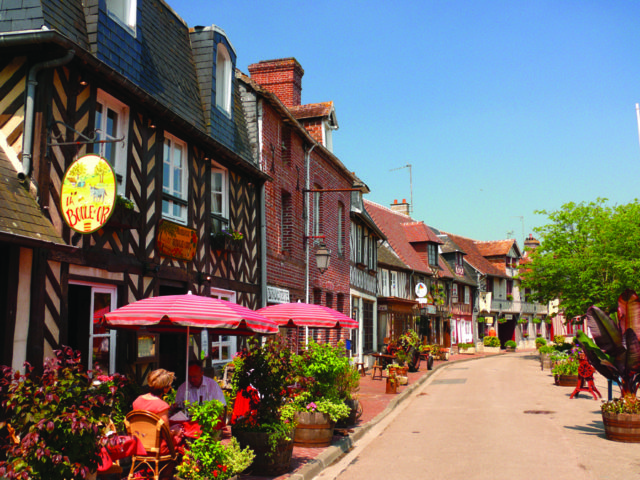
Where to see Normandy’s half-timbered houses
Some of the best examples of Normandy’s half-timbered houses are on display in the regional capital, Rouen, which has boasts the largest collection of half-timbered buildings in France. Regional favourites, Honfleur and Bayeux also have some picturesque examples.
Or, if you want to venture outside of the main towns, the following Normandy villages have been awarded the coveted label ‘Les Plus Beaux Villages de France’ and showcase some exquisite examples of half-timbered houses.
Beuvron-en-Auge: a village almost entirely made up of half-timbered properties. Those that aren’t have been sympathetically designed to provide a beautiful, subtle contrast.
Lyons-la-Forêt a beautiful village that sits within a forested setting on the site of a 12th-century castle.
Le Bec-Hellouin is picturesque and well-known, not only for its fine examples of half-timbered properties, but also for its substantial abbey.
These are just some suggestions, I am sure there are many more, and I wish you much enjoyment discovering them.
Browse properties for sale in Normandy
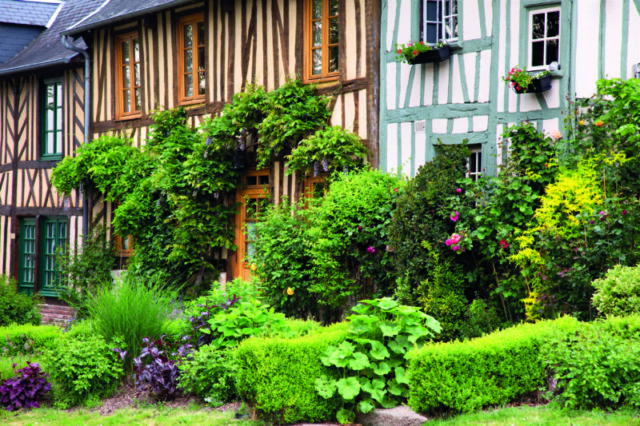
Renowned for its gorgeous châteaux, and unforgettable food and wine, the Pays de la Loire has all the French hallmarks visitors look for… Annaliza Davis explains why it’s also a great spot for househunting…
The Pays de la Loire region covers a huge area in northwest France, from the Atlantic coast below Nantes reaching northeast up beyond Le Mans. At 32,000 km2, it is 1.5 times the size of Wales and its current population is estimated at nearly four million.
Looking at the architecture in the Pays de la Loire, you’ll notice a shift from the granite-and-slate properties close to Brittany, moving through the pale limestone of the Loire Valley and into the terracotta tiled roofs towards the south.
The region includes a wonderfully diverse range of landscapes, from the coastal areas of Loire-Atlantique (44) and the Vendée (85) to the vineyards of Maine-et-Loire (49), the quieter and more rural Mayenne (53) and Sarthe (72), which are filled with woodland and heritage sites to explore. And of course, all along the River Loire are the historic châteaux for which France is rightly renowned, a legacy of regal architecture that will take your breath away.
While its natural beauty, stunning landscapes and history make the Pays de la Loire an obvious tourism destination, it also has a strong economy that encompasses everything from shipbuilding to tech companies, and it is renowned as one of France’s top regions for employment.
The Vendée attracts retirees and families seeking a coastal life, while Loire-Atlantique’s growth is driven by the economic strength of Nantes and St-Nazaire, pulling in workers and start-up companies. Angers in Maine-et-Loire has a solid reputation as a ‘lifestyle’ destination, and if you’re looking to move to a quieter, more traditional part of France, then Sarthe and Mayenne offer space and affordable properties.
MATCH THE PLACE TO YOUR POCKET
According to SeLoger, the average property price across France currently stands at €3,115/m2. In Pays de la Loire, they’re lower than this, costing an average of €2,672/m2, but there is huge variation across the region. In Mayenne, it’s possible to buy a home for less than €1,200/m2, but in Loire-Atlantique this can rise to €4,100/m2 in Nantes centre or even €6,500/m2 on the coast in La Baule-Escoublac.
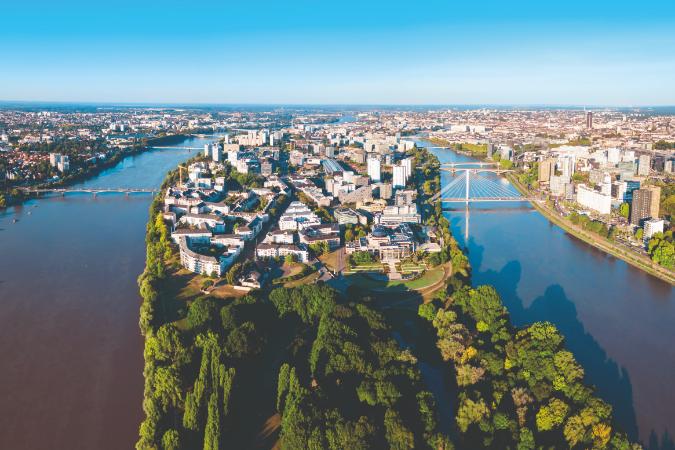
Nantes is an economic powerhouse, but still has plenty for tourists to enjoy
Whether you’re looking for an investment property, a family home, a city-centre studio or a rural idyll with acres of land, the diversity of the Pays de la Loire gives you a good chance of finding the type of property you’re looking for. It’s a matter of knowing where to look.
LE MANS: MORE THAN MOTORS
While we associate Le Mans with its 24-hour motor race, the town itself has so much more to offer. Nicknamed ‘The Plantagenet City’, Le Mans overlooks the Sarthe valley and has a surprisingly beautiful collection of half-timbered houses dating back as far as the 1400s, clustered along narrow cobbled streets. Le Mans cathedral is one of the largest in France, covering over 5,000m2, and is a showcase of Gothic-Roman architecture, complete with flying buttresses and glorious stained-glass windows.

And if you’re a petrol-head, the Musée des 24 Heures du Mans motorsports museum – located near the main entrance to the racetrack – was renovated early in 2026 and offers vintage vehicles, prototypes and historic racing cars.
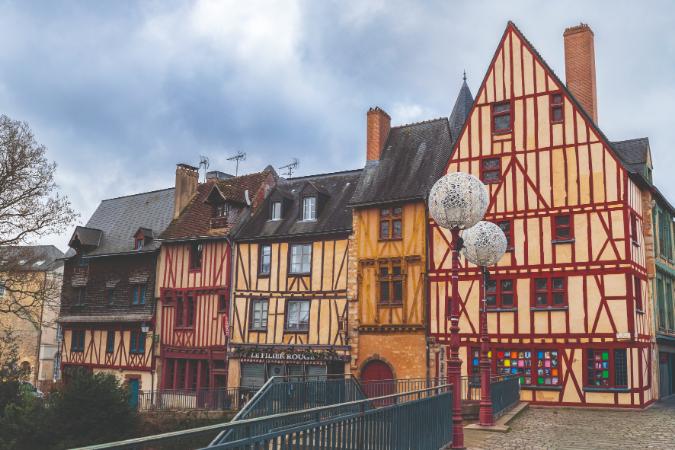
Le Mans has some beautiful half-timbered houses
FOOD AND DRINK IN THE PAYS DE LA LOIRE
The Pays de la Loire is famous for meat and fish dishes featuring beurre blanc sauce, sardines from St-Gilles-Croix-de-Vie and pork rillettes. Menus regularly feature a delicious type of garlic bread known as préfou and mogettes de Vendée, large butter beans, often served with local ham. Of the local cheeses, Le Curé Nantais and Port-Salut are the best known, while sweet specialities include the classic butter biscuit ‘Lu’, created in Nantes in 1886; the rum-infused sponge gâteau Nantais; and the brioche Vendéenne, often flavoured with orange blossom. Unsurprisingly, you’ll find plenty of local wines, from the crisp white Muscadet (ideal for seafood) to the red Saumur-Champigny and, of course, the orange liqueur Cointreau, which is still produced in Angers.

LOCATION: WHERE TO FIND WHAT YOU WANT
In terms of economy and tourism, the top city is Nantes (population 325,070), where you can buy a 50m2 apartment for as little as €155,000 in the developing district of Doulon, or spend over €200,000 in chic Hauts-Pavés. Nantes has a strong rental market and, as a university town with more than 65,000 students, small studios are extremely popular. A 20m2 studio starts at €85,000 (€4,250/m2) rising to €125,000 in premium spots like Place Graslin (€6,250/m2), or possibly higher if it’s a new-build with optimum energy performance. Most are rented out furnished for around €550 a month, and in the most popular areas – such as Hauts-Pavés or near the hospital – they can be snapped up within 48 hours of being listed.
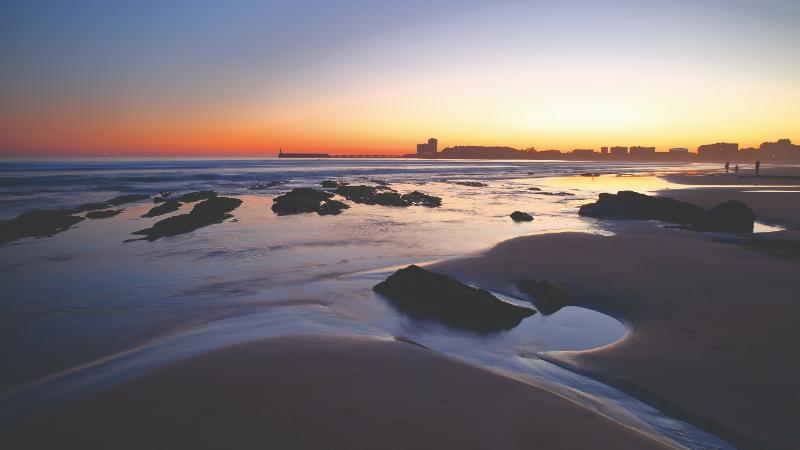
Popular seaside resort and port Les Sables-d’Olonne is on the Atlantic coast
Less than two hours east of Nantes, Saumur (population 26,074) offers a great balance of history, affordability and accessibility. With two-hour rail connections to Paris, this attractive riverside destination is topped by a stunning château built from the pale tuffeau limestone, as are many of the town’s historic buildings. Properties here average €1,901/m2 and you can buy a 20m2 studio for just €40,000, rising to €55,000 for a renovated studio in an historic building near the quays. Rental incomes on a 20m2 studio are €360–€460 per month, so it can bring better returns than Nantes, but with more risk of sitting vacant between tenants.
For seaside living, you could try Les Sables-d’Olonne (population 48,740) on the Atlantic coast above La Rochelle and three-and-a-half hours from Paris by train. This harbour town is the start and finish line for the famous Vendée Globe yacht race, which takes place every four years, and although it’s popular with tourists, it’s less crowded than some other destinations. You can buy an 80m2 family home with three bedrooms and a small garden here for less than €300,000 with a premium if you’re right by the sea.
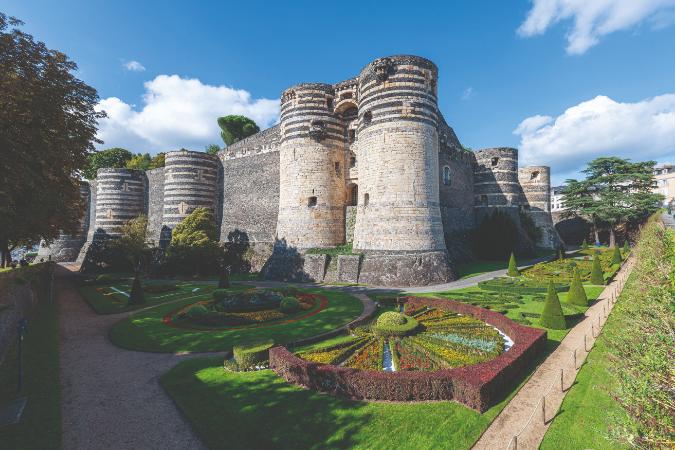
The medieval fortifi ed château in Angers dates from the ninth century
Talking of premium, La Baule-Escoublac (population 16,613) is another coastal town, but its desirability brings a high price tag: in a prime location with a sea view, a 20m2 studio can cost €240,000 and be rented out for €900 a week in peak season. However, the average cost for a 20m2 studio is €140,000, while houses actually represent better value: an 80m2 villa set back slightly from the seafront costs €370,000–€500,000.
For best value, head to rural Mayenne, where you can buy a 125m2 stone-built property with an impressive 1,500m2 of land for €130,000 or a 50m2 stone barn to renovate for less than €20,000.
If you’d prefer a building plot, a budget of €50,000 would buy 220m2 in the Vendée, 1,970m2 in a village in Maine-et-Loire or up to 8,500m2 in Sarthe. Always check the plot is constructible or you might find you’re not even allowed to park a motorhome on it.
WHY WE MOVED HERE
Originally from Wiltshire, Nicholas Le Ny-Clarke has lived in France since 2016, where he works as a real estate agent.
“My husband Remy is from Vannes, and the move to France was helped by the Brexit vote, along with the cost of living, quality of life and property prices. After initially living in Brittany, we chose to live near Nantes so we were still close to friends, had better weather and more facilities on our doorstep including a big airport. The Côtes-d’Armor (Brittany) was more remote and rural, with close-knit communities. There are fewer expats in the Loire-Atlantique and it’s harder to get to know people, but on a practical level, it brings me a larger client base for my estate agent business. And we love having more sunshine and Nantes on our doorstep!”

TRANSPORT
The Pays de la Loire has excellent transport links. Nantes Atlantique airport has international flights, direct flights to major European cities and various domestic connections, while Angers-Loire offers additional regional and seasonal services, and Rennes and La Rochelle airports are also within a couple of hours from the centre of Pays de la Loire.
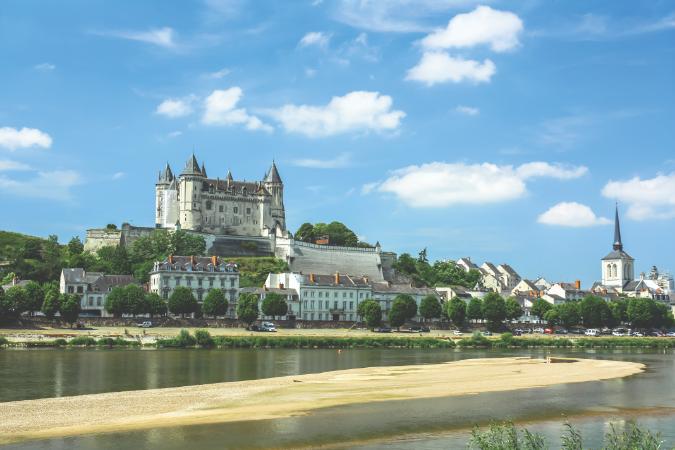
Saumur’s château overlooks the confluence of the rivers Loire and Thouet
PROPERTY TYPES IN THE PAYS DE LA LOIRE
Longère
This is a long, rectangular home built of local granite or schist, with steep slate roofs. Farming families would house livestock at one end and live at the other. Longères are found in Sarthe, Mayenne and Maine-et-Loire. Prices start at €55,000 for a renovation project, €275,000 for one that’s move-in ready and €450,000 for an immaculate example with lots of land and outbuildings converted into gîtes.
Maison de maître
The ‘master’s house’, these once belonged to the local nobility, and tend to be located on the outskirts of villages or within large estates. Expect an elegant, symmetrical property with high ceilings, large windows and a central hallway. In the Loire Valley, they are often built from pale tuff eau stone, giving them a regal, luminous appearance. For a well-maintained one in a good location, you’ll pay from €395,000 to over €1m.
The Nantaise
This urban style, found in and around Nantes, dates from the 1900s and the properties were designed to make the most of small building plots. They feature a ground-floor garage or utility area, with the living space on the first floor and bedrooms above that. They typically have an outdoor staircase leading up to the front door, and no load–bearing interior walls, so they can be easily adapted. These family homes cost around €450,000.
Hôtels particuliers
In the historic centres of Nantes, Angers and Le Mans, these private town mansions were built for wealthy families in the 1700s and 1800s. Period features include stone carvings and wrought-iron balconies, and maybe a hidden internal courtyard. Most cost between €550,000 and €1.5m.
Bourrine
This unusual property style is only found in the Vendée wetlands. It’s a traditional marshman’s cottage built from humble, local materials such as earth and straw, with a thick thatched roof. They are almost always whitewashed to reflect the sun and are perfectly adapted to the marshlands. If one comes on the market, it will typically sell for up to €400,000.
Troglodyte houses
Generations simply carved their own homes out of the limestone cliffs around Saumur and along the banks of the Loire. While troglodyte homes look like caves from the outside, the interiors can be surprisingly modern, and many have been converted into luxury guest houses, wine cellars or unique private homes. They start at €125,000, but larger examples can cost €375,000.
Travelling by car is also straightforward, and most roads around Nantes and the dual carriageways connecting to Brittany are toll-free. If you’re catching a ferry to St-Malo it’s only an hour and 45 minutes to Nantes.
EMPLOYMENT AND THE ECONOMY
The Pays de la Loire has a diverse economy, according to the national statistics agency INSEE ranking fourth for industrial job creation, thanks to its shipbuilding, aeronautics and food processing. Most working adults are concentrated in Loire-Atlantique, which accounts for nearly 40% of the region’s total population.
Nantes is an employment hotspot, particularly for services such as tourism, consulting and tech companies. In the last quarter of 2025, over 12,000 new businesses were created in the Nantes metropolitan area. The towns of Ancenis and Les Herbiers also have a great record for near-full employment.
The proportion of retired people is growing, and in some areas – such as coastal Vendée – 35% of the population is aged 65 and over. However, despite this, unemployment in Pays de la Loire is historically below the national average – currently standing at 6.2% (compared to 7.5% across France) – and 69% of newcomers to the region are of working age (15-64).
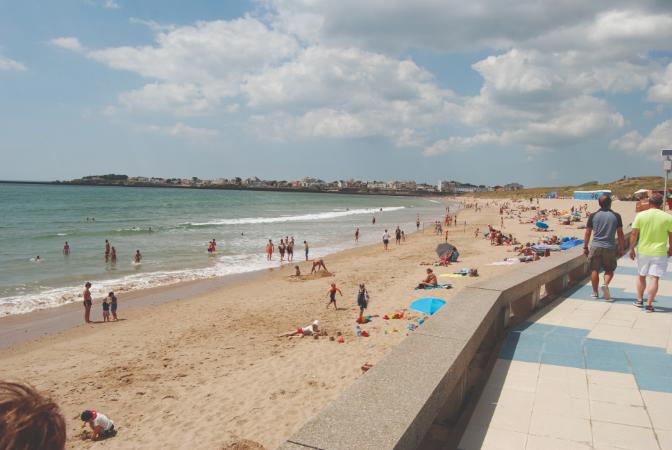
Bustling holiday resort St-Gilles-Croix-de-Vie is on the Vendée coast
WHAT THE AGENTS SAY…
Gonzague Le Nail has spent more than 27 years as a property agent. Here, he shares his insights into the market in Pays de la Loire.

“In the Pays de la Loire, the two most sought-after areas are the coast and the Loire Valley, with demand peaking around the major cities. This means that if you’re interested in cheaper areas, you need to venture off the beaten track, such as the junction of departments 44, 49 and 53, or the eastern Vendée bordering Deux-Sèvres, or even the upper Mayenne. In general, if you buy to renovate, you will make money on resale, but that depends on your building costs.
“The market has returned to a natural rhythm following the Covid upheavals, although Brexit has reduced the number of British buyers. That said, they still visit our website regularly and the Pays de la Loire remains appealing because it has a better climate, a certain savoir-vivre and proximity to regions further south that are simply too hot, so I’ll say ‘see you soon’!”
Want more help with your France property journey? Join Membership, search our Property Portal, subscribe to French Property News, and follow our YouTube channel for the latest advice and updates. Join us at the French Property Exhibition for expert advice and property inspiration.
With the sunny summer days behind us, many second-home owners will soon be closing up their properties for winter and saying goodbye to France until the spring. It’s a common scenario for those with French holiday homes, but an empty property can mean that problems go unnoticed—and winter weather can increase the risks. Here are some of the hidden risks you might not have thought of.
1. Frozen pipes and water leaks
Ask insurers, and they’ll tell you that the biggest risk for French homes left empty over winter isn’t burglary—it’s a water leak. The hidden risk isn’t the leak itself, which is often a simple fix if it’s discovered promptly. In an uninhabited property, however, a leaking tap or frozen or burst pipe could continue for weeks or even months, causing flooding or extensive water damage.
Homes in mountain regions and traditional properties with older plumbing systems are most at risk, but if last year’s weather is anything to go by, sub-zero temperatures are a possibility across all of France.
Reduce the risk: Get routine maintenance done before locking your home for winter (repair damaged roof tiles, fix leaking radiators, clean the gutters), turn off the water supply and ensure there’s no water left in the pipes, and consider installing a leak detector.
2. Storms and winter weather
From snowstorms to gale-force winds to hail, winter weather can cause a slew of unwanted issues, and even minor damage like a broken shutter, cracked roof tiles, or a fallen tree can compound if left unattended over time.
Reduce the risk: Secure outhouses, vehicles, and exterior items such as garden furniture before you leave for winter; trim any loose branches from trees; turn off the mains electricity and unplug appliances inside the house; and make sure doors, windows, and shutters are securely fastened.
Sign up for weather alerts in your area on the Meteo France app and ensure that someone checks on your property after storms, high winds, or heavy snowfall. If you live in an area that is at high risk of flooding, it’s worth taking additional precautions, such as moving valuables and electronics to an upper floor and storing important documents in waterproof containers.
3. An empty home is more vulnerable to break-ins
Burglaries might not be the top risk for leaving your house over winter, but that doesn’t mean that it’s not a concern. Uninhabited homes are always an easier target for thieves, and if you’re gone for more than a few weeks at a time, it is hard to hide the fact that no one is home. While some areas are much more at risk of a break-in (cambriolage) – INSEE has a map of the most at-risk departements here – don’t assume you’re in the clear just because you live in a quiet rural area. Isolated properties in the countryside can be equally at risk when left for longer periods.
Reduce the risk: If you live in a built-up area, befriend your neighbours, let them know when you are away, and ask them to keep an eye on your property in your absence. Installing secure fencing and an entry gate is a good idea, as is automatic security lighting. A security camera and alarm system, especially one that you can check online from home, can be a big deterrent for burglars, as well as offering you extra peace of mind while back home.
Before you leave, triple-check that everything is locked, shutters are closed, and valuables are stored out of sight. If you leave a key with a neighbour or friend, give it to them in person; don’t leave it ‘hidden’ on or around the property. With no one around, thieves will have plenty of time to hunt for a spare key!
4. A problem left is a problem doubled
We touched on this earlier, but this one is worth repeating. The biggest issue when leaving a holiday home empty for an extended period is rarely the problem itself: It’s that you may not discover that leaking pipe, theft, or fallen tree until weeks or months after it happened. Leaving small problems unfixed can lead to far larger problems and a much more costly repair bill. Some insurance companies also have a minimum claims window in which you must report damage or file a claim.
Reduce the risk: While security cameras both inside and outside the property can alert you to any major issues, the only way to have full peace of mind is to have eyes on the ground. If you aren’t able to visit the property yourself, ask a neighbour or friend to check on the property regularly, pick up mail, and do a walk around to check for any potential issues. If this isn’t an option, there are also professional property management companies that will not only check on your property, but also carry out routine maintenance over winter, ensuring your property is ready to go when you arrive next spring or summer.
5. Leaving your home empty could invalidate your insurance cover
Prevention is always preferable to dealing with costly repairs later, but no matter how well you prepare your property for winter, things can and do happen—which is where home insurance comes in. However, standard home insurance policies often have a maximum number of days that the house can be left empty (usually 60–90 days, but it depends on the insurer), which means your property won’t be covered if it’s left empty for several months at a time. Policies might also have specific requirements for properties being left empty (for example, minimum heating levels, draining of pipes, and regular property inspections), and not adhering to them could invalidate your claim if something happens in your absence.
Reduce the risk: Firstly, make sure you tell your insurance company that your property is a second home and be honest about how long the property will be left empty. Don’t be tempted to cover anything up: Insurance on a second home or a short-term rental property may be more expensive, but it’s not worth the risk of being left without coverage. Make sure understand exactly what you are covered for and how to file a claim from overseas if required.
Your insurer is also a great source of advice, so don’t be afraid to voice any concerns or ask questions about how to make your house more secure. It’s in both of your interests to reduce the risk to your property, and a good insurer would rather you improved security and took out a cheaper insurance policy than have to pay out thousands on repairs that could have been avoided. Many regional insurance companies also issue real-time weather and security alerts to property owners, which can be useful if you’re not able to be there.
6. Don’t forget the risks beyond the house
Winterising your property doesn’t just apply to the house itself—and neither does insurance coverage! Make sure you secure garages, barns, swimming pools, and all other outbuildings, as well as garden walls and gates. Think outside of your own property too: In France you are liable to maintain bushes, trees, and boundary fences to ensure that they don’t encroach on or cause damage to your neighbours’ properties.
Reduce the risk: Carry out routine maintenance, trim hedges, and cut down overhanging branches before you leave for winter, and if necessary, arrange for someone to maintain your garden and grounds while you’re away. Make sure swimming pools are securely locked while you’re away.
Finally, ensure that your home insurance covers your entire property and grounds, as well as including civil liability insurance (you’ll need this if a tree from your garden were to fall and cause damage to a neighbouring property, for example).
Ready to Get Insured In France?
Whether you need homeowners insurance, car insurance, or want advice on how best to protect your French assets, FrenchEntrée is here to help! Read the rest of our Essential Reading Articles, then get in touch with our trusted insurance providers for a quote or advice on your French insurance needs.
Travel leads the France headlines this week, with several new direct routes announced between France and the US, including new links to Toulouse, Marseille and Nice. Meanwhile, passengers travelling in September should keep an eye on planned strike action, and smaller regional airports are warning that proposed changes to European funding rules could put some routes and airports under pressure.
Elsewhere, drought restrictions look set to continue into the autumn in many parts of France, while a new French high-speed rail operator has taken a significant step towards competing with SNCF.
New direct US flights to Toulouse, Marseille and Nice
There is good news for American property owners, buyers and visitors, with several new direct routes between the US and France confirmed for 2027.
United Airlines will launch a daily, year-round service between Washington Dulles and Toulouse from the 26th of April 2027 – the first direct connection between Toulouse and the United States. A new daily Newark-Marseille route will follow from the 4th of June, while United is also adding a Denver-Paris service.
Nice is gaining another transatlantic connection too. American Airlines will launch a daily New York JFK-Nice service from the 6th of May 2027, giving the Côte d’Azur four direct links to the New York area and ten long-haul routes to North America overall. The additional routes could be particularly useful for US homeowners and buyers in Provence, Occitanie and the south of France.
September strikes could affect flights and public services
Travellers heading to France in September should keep an eye on a series of strike notices that could affect flights and public services.
Volotea pilots are set to strike from the 4th to the 6th of September, potentially affecting flights at several French airports, while a strike involving French bee cabin crew has been extended until the 6th. EasyJet cabin crew at its six French bases have also been covered by a rolling strike notice.
Further action involving public-sector workers is expected later in September. As always in France, a strike notice does not guarantee that disruption will take place, so passengers should check directly with their airline or transport provider before travelling.
French regional airports warn over proposed funding changes
Some of France’s smaller regional airports have warned that proposed changes to EU state-aid rules could make it more difficult for them to remain financially viable.
Under proposals due to apply from April 2027, the thresholds determining which airports can receive public money towards investment and running costs would be tightened. Airports including Montpellier, Lille, Ajaccio, Bastia and Strasbourg could potentially be affected, with further restrictions proposed from 2032.
The issue will be worth watching for British property owners in particular, as regional airports and seasonal UK routes play an important role in access to popular second-home areas. Brittany and south-west France are among the regions where smaller airports provide important alternatives to travelling through Paris.
Water restrictions could continue into autumn
France’s exceptionally dry summer could have consequences well beyond the traditional holiday season, with experts warning that water restrictions may remain in force through the autumn and potentially into winter in some areas.
As of the 27th of August, parts of 77 departments were subject to France’s highest crise level of drought restriction, while another 15 had areas at the alerte renforcée level. Measures vary locally but can include restrictions on watering gardens, washing cars and filling swimming pools.
Homeowners should continue to check their local restrictions through the official VigiEau service rather than assuming that limits end with the summer holidays, particularly in areas where groundwater and river levels remain unusually low.
New high-speed rail company moves closer to challenging SNCF
French rail start-up Velvet has received its operating licence from the Ministry of Transport, clearing one of the major hurdles required before it can begin competing with SNCF on France’s high-speed network.
The private operator plans to launch services from Paris to Bordeaux, Nantes, Angers and Rennes from 2028 and has ordered 12 new high-speed trains from Alstom.
Velvet still needs to obtain its safety certification before services can begin, but the licence marks an important step towards increased competition on some of western France’s busiest TGV routes. The company says it eventually plans to add around 10 million additional high-speed rail seats each year.
Want more help with your France property journey? Join Membership, search our Property Portal, subscribe to French Property News, and follow our YouTube channel for the latest advice and updates. Join us at the French Property Exhibition for expert advice and property inspiration.
Increasing numbers of people are starting a business in France, but what help can they expect at a national or regional level? Catharine Higginson explores the availability of grants and other assistance for entrepreneurs
While France has a reputation for being a nation of fonctionnaires (civil servants), the reality is far more nuanced, and the last few years have seen increasing numbers of people starting their own businesses. This is probably in part due to the simplicity of starting up as a micro-entrepreneur, but the extensive grants or aides available in France also play a part.
Specific aides are geared to different sectors of the populace including young entrepreneurs, women, the unemployed, people who have been made redundant and are retraining, and those with innovative projects. And this list is by no means exhaustive!
The type of help available includes tax exoneration and ongoing help and support in addition to financial assistance.
CASH INJECTIONS
The type of help available can be divided into three main categories. Firstly, there is what is referred to as les aides financières directes. These cover cash injections and making access to obtaining loans easier, and are generally in the form of grants, loans at zero percent interest or bank guarantees.
They include subventions à la création which allow start-ups to finance initial investments, pay for administrative costs and help with cashflow. They are administered by the state, regional departments or certain government agencies.
Then there are the prêts d’honneur, administered by various different networks such as Initiative France or Réseau Entreprendre. They provide a means for the business to borrow interest free and without providing a personal guarantee. There are also fonds de garantie available; these make accessing bank loans easier as they provide a guarantee for part of the risk being taken on by the bank.

Those on a low income can seek help with rent and mortgage payments
SOCIAL CHARGES
The next type of assistance covers what is referred to as les dispositifs fiscaux et sociaux. Starting a business may allow you to benefit from lower or exonerated social charges depending on your personal circumstances and location. These tend to apply to the young, unemployed and those in ‘priority’ zones.
The ACRE (aide à la création ou à la reprise d’entreprise) gives partial exemption from social charges over a fixed period and the ARCE (aide à la reprise et à la création d’entreprise) provides for the partial payment of unemployment benefits as two ‘lump sums’ when starting a business. Lower taxes may also kick in if you are in a specific geographic zone, notably deprived urban areas or rural zones designated as needing development.
HELPING HAND
The third form of assistance available covers help and support and this can be absolutely invaluable. There are numerous organisations, both public and private, that offer either free or subsidised support. Individual support is also offered by France Travail and structures such as the Chambres de Commerce et Industrie (CCI ) and the Chambres de Métiers et de l’Artisanat (CMA) or business incubators. The latter are often supported by public or private funding which has been put in place to support specific projects or groups of people such as younger entrepreneurs, women or people switching careers (en reconversion). There is also assistance to put together the paperwork required to apply for grants. Given that France is notorious for its paperwork, and that many of the aides require detailed documentation, this is a much needed and appreciated part of the ‘help’ on offer.

You can even get help with the paperwork required to apply for grants
“From 2023-2024, the government allocated some €12m to support the creation of shops and commercial ventures in isolated rural areas”
WHO IS ELIGIBLE?
And for what? The most important point to note is that the criteria varies according to personal circumstances and elements such as your professional and social situation, age and the type of project concerned.
If you are registered unemployed with France Travail you may be able to continue to receive unemployment benefits during the start-up phase along with benefits mentioned previously such as the ACRE and ARCE. France Travail will also assist with the business plan and any training requirements, and can steer you towards other partner organisations who may be able to help.
Those aged 26 and under are eligible for a variety of aides, often financed by the state, regions and universities. There is the contrat d’engagement jeune (CEJ), which offers an enhanced level of start-up support with possible financial assistance; students can opt for the étudiant-entrepreneur status which allows for business start-up and support from the PÉPITE network while studying and various regional grants are also available.
There are also numerous programmes designed to support female entrepreneurs such as the FGIF (fonds de garantie à l’initiative des femmes). This offers a bank guarantee to facilitate obtaining loans. There are also different regional proposals including grants, business incubators and project/contract tenders which are reserved for women. Numerous specialist business networks for women exist, such as Force Femmes, Action’elles and Bouge ta boîte, which are well worth exploring.
Those in receipt of RSA (income support equivalent) are also eligible for start-up help. Depending on personal circumstances you may be entitled to the ACRE, ARCE, the continued payment of benefits, local or departmental grants and assistance along with support and coaching. If you are or have been employed and changing direction, perhaps due to redundancy, or have resigned to start up a business, the CPF de transition/projet de transition professionnelle (PTP) will apply. These help to finance a related training course and you may be entitled to unemployment benefits. Those made redundant will qualify for the contrat de sécurisation professionnelle (CSP) which provides an extra level of help.
TAILORED TO YOUR NEEDS
Help is also available for those aged 50 and over. The ACRE is a possibility along with specific regional grants and assistance, and being able to combine working with drawing a pension.
If you have a project which is considered ‘high value’ in terms of innovation or technology, and are classified as an entrepreneur innovant, you may receive extra assistance in the form of help, grants and loans, strategic assistance, financing and the provision of a workspace in a French tech or state business incubator; and should you qualify for statut de jeune entreprise innovante (JEI) status, you may be entitled to lower taxation and exoneration from social charges.
And last but very much not least, specific targeted help is available for the disabled to improve and increase their professional autonomy. This includes the AGEFIPH, which encompasses financial assistance with start-up, personalised support and help with ensuring that the working environment is tailored to their needs. They are also able to access the ACRE and ARCE, plus various exonerations depending on the business statute and support with getting the project of the ground.
LOCAL LEVEL
It’s clear that there is a lot of help available in France for different categories of people wishing to start a business. It’s also vitally important to remember that depending on the type of business, there may be extra help available at either state or regional level.
For example, during the period 2023-2024, the government allocated some €12m to support the creation of shops (including mobile shops) and commercial ventures in isolated rural areas.
With up to €80,000 available per applicant and up to 50% of the cost of acquiring and fitting out premises being met, this type of help has proved invaluable for many small businesses.
Starting a business is never easy and doing it as someone who has moved to France is certainly challenging. But it can be done and the different forms of assistance available, whether monetary or as guidance, will definitely help you on your way.
Top Tip
If you’re thinking about setting up a business in France, do your research! Grants vary enormously from region to region, with the less populated and poorer regions often providing far more help and support. So it makes sense to spend time researching exactly what is available in your target area before going any further.
Tax and relocation updates lead the France headlines this week, with new reminders on taxe foncière exemptions, an upcoming impôt sur la fortune immobilière deadline and updated guidance for residency and citizenship applicants preparing for France’s civic knowledge requirements. Property buyers planning renovation work should also note changes to MaPrimeRénov’, while families moving to France can check university fee levels for the 2026-2027 academic year. There are also updates on electronic invoicing for French businesses, Eurostar disruption and new comparison tools for families choosing an Ehpad.
Some property owners may qualify for taxe foncière relief
Property owners and usufruitiers in France should watch for their 2026 taxe foncière bills, with notices arriving from late August. However, Service Public has also reminded owners that exemptions and reductions may apply in certain cases.
Some people receiving allocation de solidarité aux personnes âgées or allocation supplémentaire d’invalidité can be fully exempt, while over-75s and people receiving allocation aux adultes handicapés may also qualify if their income is below the relevant threshold. A €100 reduction may apply to some owners aged between 65 and 75, again subject to income conditions.
For more on how these local property taxes work, read our guide to French Property Taxes: Taxe d’Habitation and Taxe Foncière, or check key dates in our France Tax Calendar 2026.
Impôt sur la fortune immobilière payment deadline approaching
Some property owners liable for impôt sur la fortune immobilière, or IFI, should note the upcoming payment deadlines. According to the French tax calendar, taxpayers whose IFI payment deadline is the 15th of September have until the 31st of August to sign up for prélèvement à l’échéance.
For those paying online by internet, smartphone or tablet, the payment deadline is the 20th of September where the tax notice gives a 15th September due date. This will be relevant to higher-value property owners whose French real estate assets exceed the IFI threshold.
New Livret du Citoyen useful for residency and citizenship applicants
Anyone preparing for a French residency card, resident card or naturalisation application should make sure they are using the latest version of the Livret du Citoyen. The official handbook sets out the civic knowledge and values that applicants may need to understand for France’s integration and citizenship processes.
This is especially important because civic knowledge requirements have become more formalised in 2026 for some applicants, including those applying for a carte de séjour pluriannuelle, carte de résident or French nationality. For more background, read our explainer: What is the Livret du Citoyen? Essential Reading for French Citizenship & Residency Applicants.
MaPrimeRénov’ to exclude some major renovation projects
From the 1st of September, some major renovation projects will no longer be eligible for MaPrimeRénov’ support if the works leave a gas heating system in place after completion.
The change affects the Parcours accompagné route for major renovations in individual houses and is intended to prioritise projects that move households away from fossil fuels. Buyers planning to purchase a renovation property should check the heating system and likely funding options before relying on grant support in their budget. For a broader overview, see our guide to France’s Property Renovation Grants or MaPrimeRénov’.
University fees confirmed for the 2026-2027 year
University registration fees for 2026-2027 have been confirmed. In public higher education, the standard annual fees are €178 for a licence, €255 for a master, €398 for a doctorate, and €2,620 for an engineering diploma, with exceptions for some older engineering courses.
Non-European students face higher differentiated fees in many cases: €2,902 per year for a licence and €3,950 for a master. This is particularly relevant for British and other non-EU families budgeting for study in France from the autumn. For wider guidance on visa and residency planning, see our Complete Guide to French Visas.
Electronic invoicing begins for French businesses
Businesses established in France and subject to VAT will enter a new phase of electronic invoicing from the 1st of September. Large companies and mid-sized companies will need to issue electronic invoices, while all companies, including SMEs and micro-businesses, must be able to receive them.
This is relevant for anyone running a French business, setting up as self-employed after moving to France, managing a gîte or holiday-let business, or working with French suppliers. Businesses must use a state-approved platform or compliant solution under the new system.
Eurostar warns of French network cancellations
Travellers between the UK and France should check Eurostar bookings carefully for the end of August and early September. Eurostar’s travel updates currently list cancellations on the French network between the 31st of August and the 7th of September because of engineering works.
Anyone travelling to France for property viewings, late-summer holidays or the school and university rentrée should check their train status before departure and allow extra flexibility if connecting with onward travel.
New comparison indicators added for Ehpad choices
Families comparing care-home options in France now have access to three new quality indicators in the official Ehpad directory. Since August, the directory has included staffing-related information such as care staffing levels, staff absenteeism and staff turnover.
The update is useful for older residents, retirees moving to France, and families supporting elderly relatives. It adds to existing information such as prices, room types, services, medical support and places eligible for aide sociale à l’hébergement.
Want more help with your France property journey? Join Membership, search our Property Portal, subscribe to French Property News, and follow our YouTube channel for the latest advice and updates. Join us at the French Property Exhibition for expert advice and property inspiration.
Here’s the latest currency news from our partner Moneycorp, to help you find out what your money is worth.
Figures from KPMG suggest that fintech firms received around two‑thirds less investment funding in the first half of 2026 than a year earlier, marking the lowest level of funding since at least 2016. That decline may partly reflect a prolonged adjustment following the surge in funding during the COVID period, but it may also indicate that investors are increasingly directing capital towards AI‑related businesses. The news is unlikely to generate significant market reaction, but it should, in my view, serve as a warning to the UK government, which is considering increasing some taxes on larger corporates to reduce the tax burden on SMEs.
Meanwhile, reports in the UK press over the weekend detailed an Iranian cyber attack that shut down a small UK power plant for several days. This suggests the UK remains exposed to such activity from the Iranian regime. While the incident caused no significant disruption to the wider power grid, it is likely to reinforce efforts to strengthen cyber security across the network. Again, market reaction has been limited, but in my opinion it provides another reason for markets to remain cautious about the GBP rally and broader UK optimism.
Jackson Hole symposium later this week features US and Euro Area central bank speakers
The US Federal Reserve will hold its annual Jackson Hole symposium later this week. Speakers include Fed Chair Kevin Warsh and ECB Executive Board member Isabel Schnabel.
For markets, the focus will remain on the risk of higher interest rates. Here, I see a potential imbalance in what the speakers are likely to communicate. Kevin Warsh has been clear in his opposition to forward guidance and is unlikely to provide specific signals ahead of upcoming Fed meetings. His comments are therefore likely to focus more broadly on economic performance and the role monetary policy can play. Schnabel, by contrast, may be more vocal regarding the forthcoming ECB decision and the prospects for further tightening. In my opinion, the ECB remains more likely to raise rates than other major central banks, despite the negative outlook for Euro Area activity.
Why Moneycorp?
With a Platinum Trusted Service Award 2020 from independent review site Feefo and 40 years of experience in the industry, FrenchEntrée has been recommending Moneycorp for more than 15 years. During this time they have helped thousands of client planning the best way to pay for their property as well as supporting them afterwards with any further payment from paying bills, mortgages to repatriating UK pension payments for those who have retired to France.
Furthermore, we have worked with the same person at Moneycorp for more than a decade! You might be familiar with her as she often writes for our French Property News magazine. She has 13 years’ experience in foreign exchange, and is a qualified European lawyer with experience in European transactions. Mar will be happy to answer any questions or enquiries to support you through these difficult times
Opening an account is really easy and free of cost. You can register online or over the phone in a couple of minutes and for FrenchEntrée readers there are no transfer fees in any payment.
Love Neoclassical architecture? This style was a revelation, gives Paris a lot of its character and was forged in the lead up to the Revolution, says Joanna Leggett
It is undisputed, France is beautiful. Bound by wonderful coastline, its stunning countryside is peppered with ancient dwellings, divine châteaux, medieval villages and enchanting towns. Every city and major town boasts a rich diversity of architectural style. In the larger ones, wide boulevards – often lined with stately buildings in the ancient Greek and Roman styles – entice you to explore and remark upon the colonnades and columns that adorn their facades. Space and grandeur, symmetry and white stone are the dominant features of their design and a benchmark of French architecture.
This Neoclassical style of architecture first became popular during the reign of Louis XV in the early to mid-18th century and was said to have been inspired by the archaeological excavations at Pompeii. Louis XV was known for his massive building projects: Versailles, of course, being the largest he built. The style he chose for it was almost religiously followed by others aspiring to impress.
By the 1740s, fashion and tastes in interior design and architecture had started to change, decoration became less extravagant and more classic. Then the Marquis de Marigny – brother of Madame de Pompadour, Louis XV’s mistress – went on a road trip to Italy with a delegation of scholars and artists to see recent archaeological discoveries in Pompeii and Herculaneum and, naturally, made a grand tour of other classical monuments at the same time. They came back fired up with enthusiasm for a new classical style in architecture, which imaginatively became known as Neoclassical or le goût Grec (Greek style).
BREATH OF FRESH AIR

The Temple of Love at Marie Antoinette’s château, Le Petit Trianon, Versailles
Considered a revelation after the heavier Baroque and Rococo styles of previous eras, it really caught on. In 1757, the first illustrated textbook of the style was published, promoting the majestic style of the architects of ancient Greece – and the rest, as they say, is history. This ‘cutting edge’ new design style started appearing in royal residences during the last years of Louis XV’s reign and was prevalent throughout Louis XVI’s tenure, which is hardly surprising as Marigny had by this time become director of buildings for the latter. The style was especially popular in the interior salons and furnishings of Marie Antoinette in her boudoir at Fontainebleau, and with Parisian aristocracy. In fact, while labelled Neoclassical, it was a mélange of Greek, Roman and Etruscan styles, sometimes with chinoiserie and Turkish themes thrown into the mix.
By 1780, this new style started appearing externally too in the architecture of classically designed buildings, which notably included the Petit Trianon at Versailles and the Château de Bagatelle set within 24 hectares of the Bois de Boulogne in the 16th arrondissement of Paris. The latter was designed as a small lodge for brief stays for Louis XVI’s brother while out hunting – was this the ultimate comfort stop? It was completed in just 63 days to win a bet with Marie Antoinette over whether he could build a château within three months!
“The style was especially popular in the interior salons and furnishings of Marie Antoinette in her boudoir at Fontainebleau”
PARIS STYLE
Towards the end of Louis XV’s reign, Neoclassical had become the dominant style in civil architecture. The east facade of the Louvre had been reimagined, nearby the Hôtel de la Marine was erected with its grand colonnaded front elevation facing the Place de la Concorde, and then there’s the École Militaire, to name just a few such magnificent buildings in central Paris.
Then came the Revolution. The aristocracy fled Paris, most of their palaces and townhouses were stripped of furnishings and decoration, and many suffered the same fate as Marie Antoinette. While major building works virtually stopped during the initial revolutionary turmoil, the ethos of Neoclassical architecture escaped the confines of Paris and was taken to every part of France. With its style demanding the geometric forms, decoration and majesty of ancient Greece, it was perhaps a symbol of stability.
A modified version of Neoclassicism found favour briefly during the time of the French Directorate in the 1790s, mixing its style with the architecture and designs of Robert Adam in England. But when Napoleon Bonaparte took centre stage, Neoclassical became the Empire style – with crowns, laurel wreaths, classical heads seen in profile, Napoleon’s imperial bee symbol, the eagle and the letter ‘N’ proliferating.
CLASSIC CHATEAU
The Château de Compiègne in Oise had been the preferred summer residence for French kings, who enjoyed hunting in its nearby forest. Gutted during the Revolution, Napoleon reclaimed it as an imperial domain and made it habitable again – its beautiful facade featuring columns and porticos in a pleasing symmetry. He altered its layout, added a ballroom and replanted the garden in classical style incorporating an entry into the forest.
This era saw triumphal arches erected – the Arc de Triomphe dominated the Champs Elysées (as well as many a postcard). Townhouses became hôtels particuliers, with discreet street entrances opening onto square interior courtyards surrounded by massive dwellings with windows around each side bringing an abundance of light into rooms. Many grand buildings boast impressive arcades at street level, carefully balanced by rows of windows and columns with classical pediments. The Grand Théâtre de Bordeaux is a great example, its majestic stairway providing inspiration for the Opéra Garnier in Paris. Architecture for churches also used this vernacular, most notably the Panthéon in Paris.
The craze for Neoclassical design spread throughout France. There are wonderful examples of this architecture with its distinctive features including the Place Masséna in Nice, the exceptional 18th-century urban planning in Bordeaux, the mairie (town hall) in Annecy and three large plazas built under royal patronage in the 1750s in Nancy.
During the latter part of the Revolution, the Directoire style emerged, employing Neoclassical architecture, minimal carving and much decorative painting. It was a transitional style reflecting the values of Republican Rome and the changing egalitarian movement of the French regime. Beautiful furniture was created to fill rooms – similar perhaps to the Regency mode in England created during the same period.
CHATEAUX COUNTRY
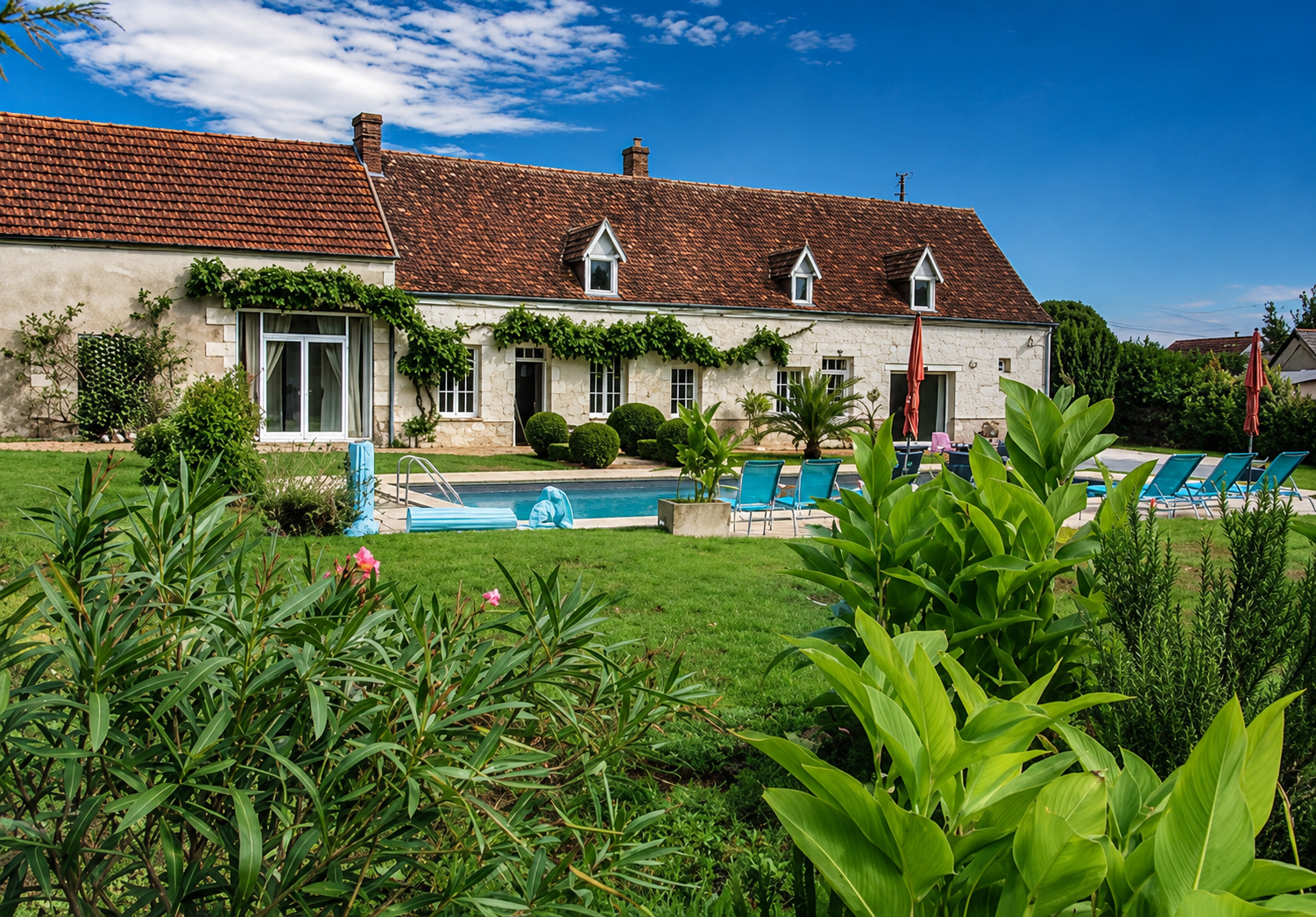
€327,540
In the heart of Touraine, close to Chenonceaux, Amboise and Tours, this classically designed mid-19th-century farmhouse is fully restored, offering an enormous living room, open-plan kitchen, three bedrooms and dressing room with single-storey living. Outside, in the 1.5-hectare private park, there’s a swimming pool, pétanque court and wisteria-clad lean-to – the perfect spot to while away hot summer days and evenings.
CLOSE TO NARBONNE
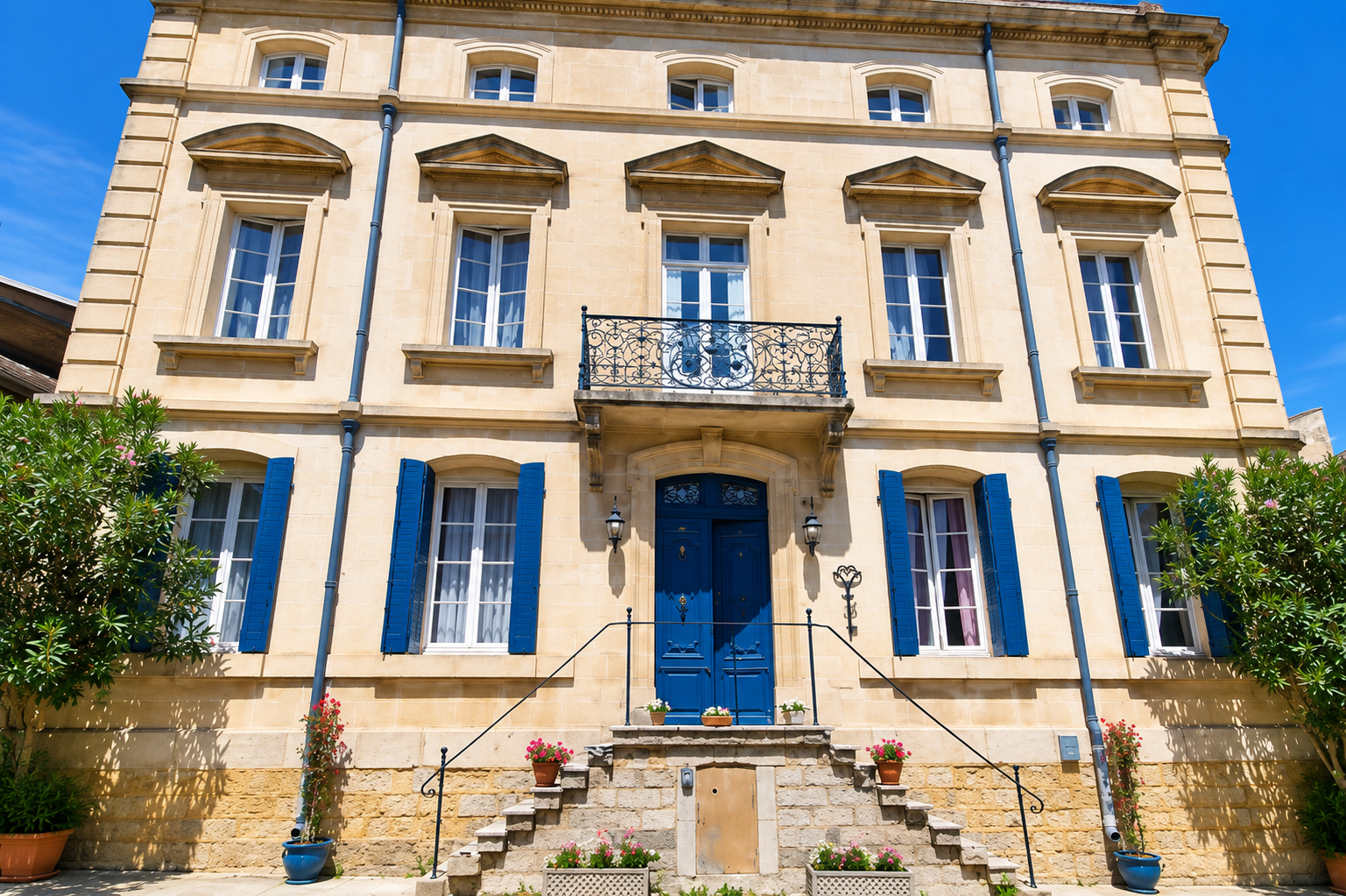
€695,000
In the south of France in Minervois, Ginestas is crossed by the Canal du Midi and surrounded by vineyards. Within walking distance of amenities, in a private courtyard garden, this stunning ‘maison de maître’ is full of authentic features offering an opportunity to create a ‘chambre d’hôte’ or extended family home. Its living rooms are spacious and a grand stone staircase leads to four ensuite bedrooms on the first floor ideal for guests. There are five more on the top floor, while outside the pool beckons, making it the perfect retreat.
ELEGANCE IN WINE COUNTRY
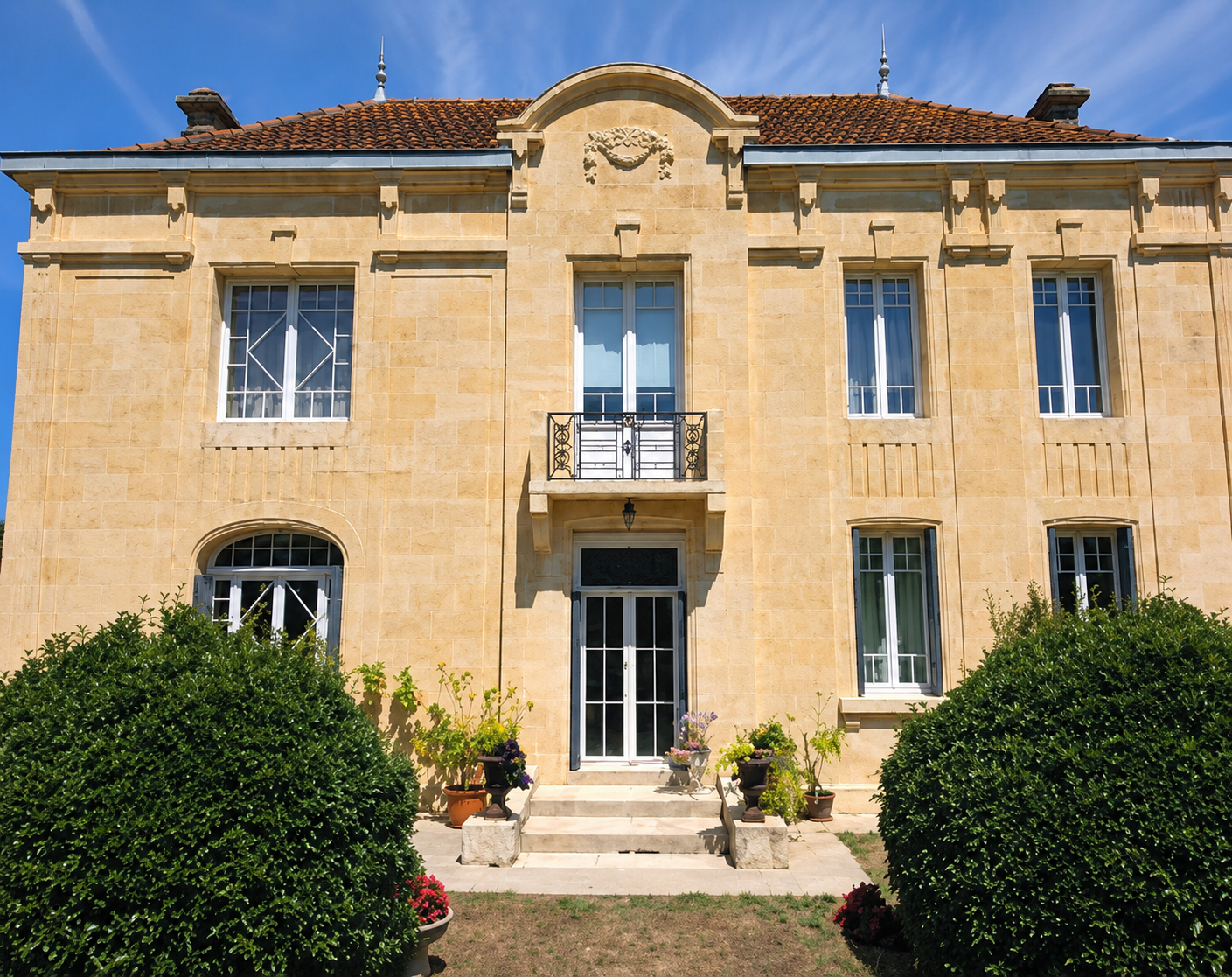
€635,000
Just 40 minutes’ drive from Bordeaux in the heart of Gironde wine country, this beautiful estate is in a private peaceful hamlet. Dating back to 1850, its facade charms with its porticoed classic design and wrought-iron-faced balconies. Completely renovated, the manor is set around the main house with two independent, two-bedroom guesthouses, a vast garden and large swimming pool, with numerous
outbuildings. All have achieved an ‘A’ energy rating. The ‘manoir’ has four/five bedrooms, large reception rooms and is bathed in sunshine.
PEACEFUL RETREAT IN THE CITY
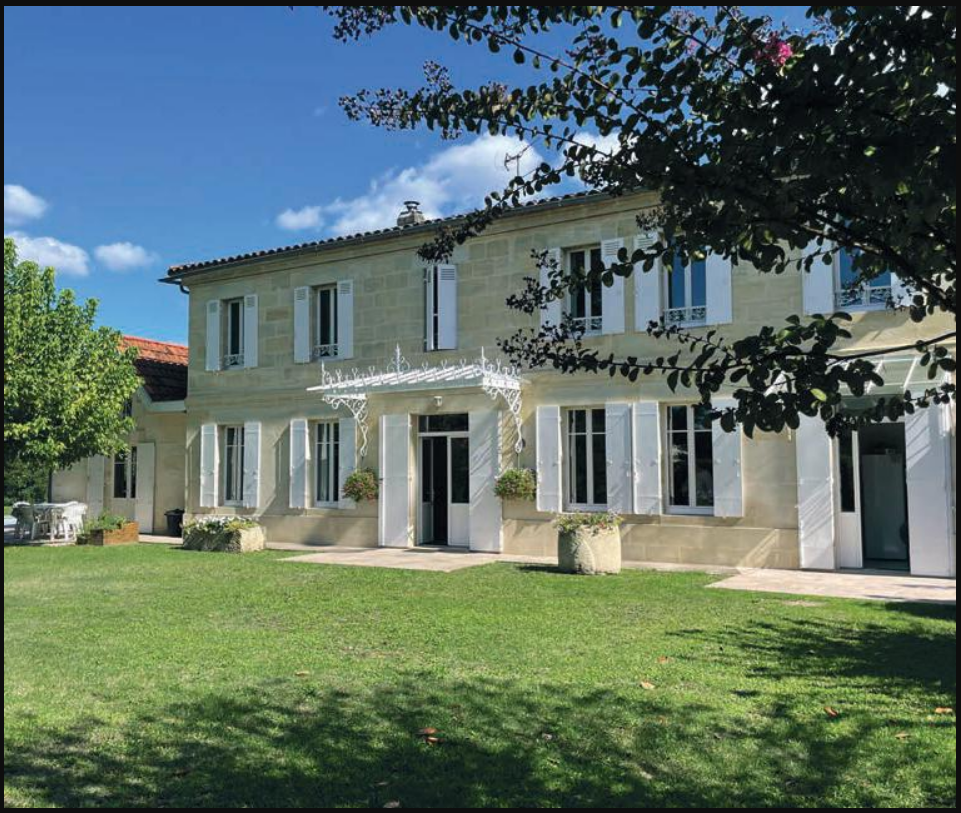
€790,000
This lovely stone ‘manoir’ is surrounded by a large fully fenced park with automatic gates. Just a stone’s throw from the centre of Libourne in Gironde, and not overlooked, it offers modern comfort in exceptional condition. With four large bedrooms, generous living spaces and a swimming pool, it balances urban living and country life to perfection.
TOURAINE TRIUMPH
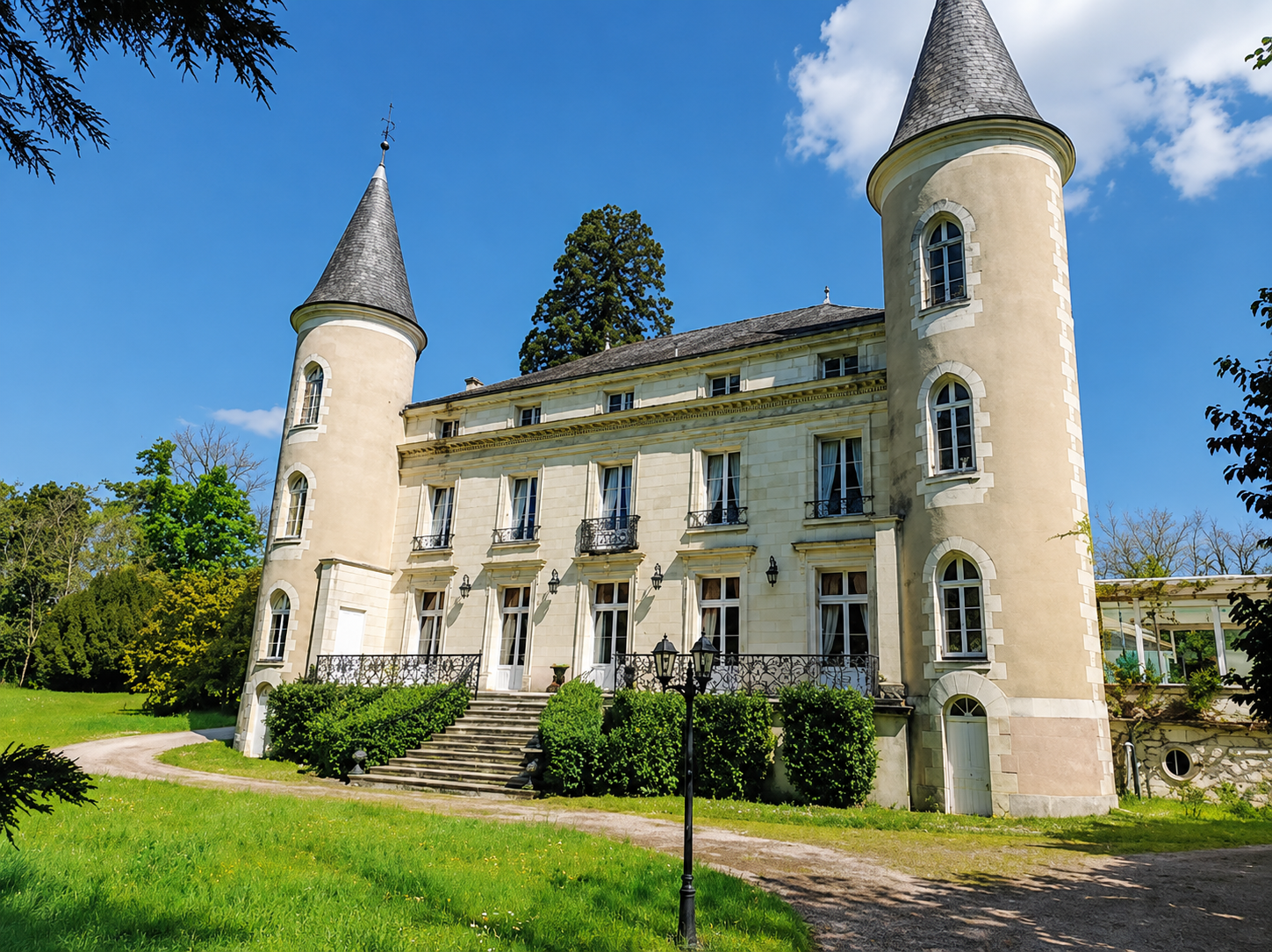
€1.41M
Built on the site of a previous château destroyed in the Revolution, this magnificent property sits in parklands of approximately 11 acres with a lake and some huge 200-year old trees. It has an enormous heated pool and 11 ensuite bedrooms, plus there’s a further five-bedroom house, three-bedroom guardian’s property and several outbuildings. It’s situated in beautiful countryside of the southern part of Touraine and Creuse, near Tournon-St-Pierre.
And so it continued throughout the Bourbon Restoration until Neoclassicism was gradually replaced as the dominant architectural style by Romanticism and Eclecticism. When Haussmann was redeveloping Paris though, Neoclassic style featured heavily in the buildings that took pride of place when he was creating his wide sweeping boulevards and enhancing the magnificent structures.
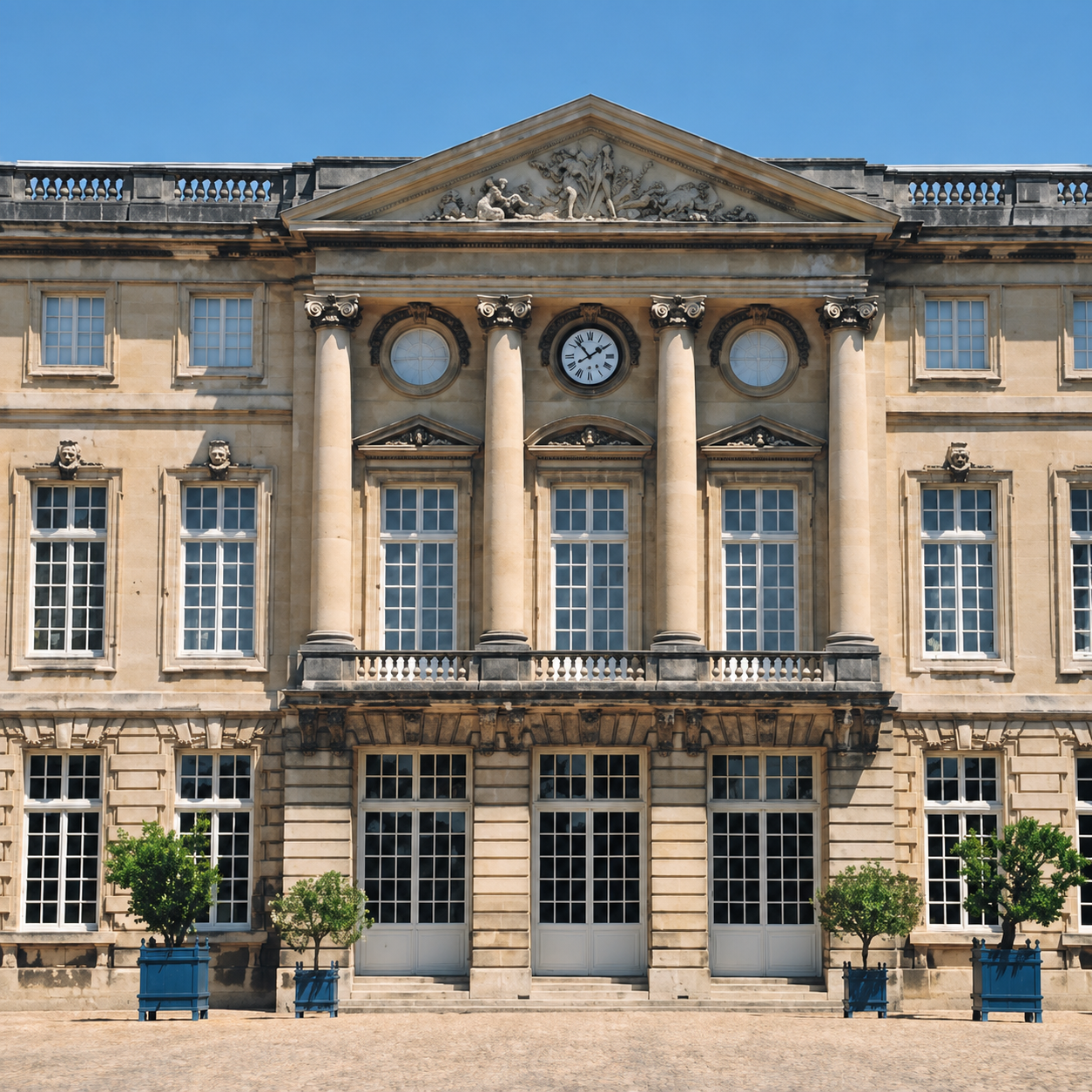
Château de Compiègne in Oise
MOVING ON
As the 19th century progressed, so too did class structure, and who could afford the building and upkeep of town and country mansions. More and more people were making enough money to build their own version of stately homes – what we might describe as ‘des res’ – including entrepreneurs who wanted their own châteaux or manoirs built to their own specifications. Many a Neoclassic château was built around the country including in the Loire Valley, once the exclusive domain of kings and nobles. Maisons de maître are smaller but still generous in proportion, offering the chance to create a more than enviable lifestyle for anyone lucky enough to buy one today – and they continued to be built in the Neoclassic style until the turn of the 20th century.
Joanna Leggett is Leggett Immobilier’s Marketing Director – view the full portfolio of properties at leggettfrance.com
The unique mix of legal, financial and tax advice along with in-depth location guides, inspiring real life stories, the best properties on the market, entertaining regular pages and the latest property news and market reports makes French Property News magazine a must-buy publication for anyone serious about buying and owning a property in France.
I’ve purchased my home jointly with my civil partner. We made sure that we included a ‘tontine’ clause in the purchase deed – should I make a will too?
As you may already know, if you’ve bought your home with a tontine clause, when either you or your civil partner passes away, the survivor will automatically become the sole owner of your French home.
It is still, however, a good idea to make a will. By making a will it ensures that your home passes as you wish (in so far as that is possible) in the event that you and your civil partner die together.
It will also ensure that following the death of the survivor of you both, the property passes as you wish. It will depend upon your nationality, and family structure, as to how you and your civil partner structure your wills, but we suggest reviewing your estate planning following a property purchase.
My husband and I, a retired couple, are in the process of separating. We have been living in France for around five years, but I wish to return to England, whereas my husband wants to remain living in France. We are both British nationals and were born in England. We have property in both France and England. Our pensions are in the UK and our children are living independently in England. Where can I issue divorce proceedings?
When looking at where to issue divorce proceedings, there are three factors to consider:
1. In which country can I issue divorce proceedings, i.e. is there jurisdiction for me to issue divorce proceedings in that country?
2. In which country is it most appropriate for divorce proceedings to be considered? This is known as forum conveniens.
3. Will one country provide a more beneficial outcome to me on divorce? The country in which divorce proceedings take place will then determine how the finances are to be separated in accordance with that country’s laws. This can provide a very different outcome if proceedings take place in France, or if they take place in England.
Jurisdiction: As you are living in and habitually resident in France, it is possible for either you or your husband to issue proceedings for divorce in France. However, as it seems that you remain domiciled in England, you are also able to issue divorce proceedings in England. There is therefore jurisdiction to issue proceedings in both countries.
Forum: If proceedings are issued in both countries, a decision will have to be taken by the courts as to which is the most appropriate forum for proceedings to take place. Consideration will be given as to factors such as where the family have their main home, where the assets are held, where the children are based.
In this example, it seems as though there is rather a fine balance between the two countries: while the fact that the family home is in France may be determinative, the presence of other assets in England (in particular pensions), may give weight to England being the preferred forum.
Financial outcome: England is known to be supportive of the financially weaker party when it comes to divorce law. There are greater powers with regard to the division of pensions and ongoing financial support than exist in France. French courts will not, for example, have the power to divide UK pensionson divorce and this may be a significant factor for a retired couple. However, it is essential that you seek advice from both French and English lawyers to ascertain the likely outcome in each jurisdiction.
It is also very important to work with your husband to try to reach an agreement with regard to the division of your finances. Forum disputes are notoriously expensive and, as outcome is not guaranteed, you are best placed trying to find a resolution through discussion, potentially with the support of an accredited mediator.
I’m selling my French property. Am I required to organise a buildings survey?
In France it is not necessary to provide a buildings survey to any prospective buyer of your property. However, in France it is necessary to provide buyers with a dossier de diagnostic technique (DTT).
The DTT includes reports on asbestos, electrical wiring, energy efficiency, gas installations, geotechnical risks, lead, natural and industrial risks, radon, septic tanks and termites. It is your responsibility to provide the buyer with this, and you will be expected to pay for the DTT. You should seek a surveyor who is appropriately accredited to ensure that the reports are comprehensive and can be relied upon.
If the buyer wishes to have a building survey, and you agree to this, the buyer would be expected to organise and pay for it. The buyer should do this before formally agreeing to buy your property.
Caroline Fell is a Partner and Head of the Family Law and Mediation team at Stone King, advising British individuals living in France or those with properties in France
Tel: 0800 111 4336
Peter and Carolyn Bear explain how their 18th-century manoir in northern Auvergne became an opera house
It all began with a rather crazy idea for a house-warming party. Like many French Property News readers, we had fallen in love with a French country property and upped sticks from the UK and moved to France. Our coup de coeur was the 1758 Manoir de la Gozinière in the heart of la France Profonde in northern Auvergne. It took us three years to renovate, carefully preserving its 18th-century character. Once done, we decided to give a slap-up party for the new friends we’d made.

Carolyn and Peter love opera
One of the few things we missed in moving to France were our regular outings to the opera. In the UK, we’d been accustomed in the summer, to packing up picnics and rugs and heading for ‘country house opera’. Unfortunately, the English love of these pastoral events isn’t reflected in France. This is partly because there are so many – about 30 – opera houses in the bigger cities. We were near enough to Vichy, where the lovely Art Nouveau opera house provides excellent productions, but tantalisingly few of them.
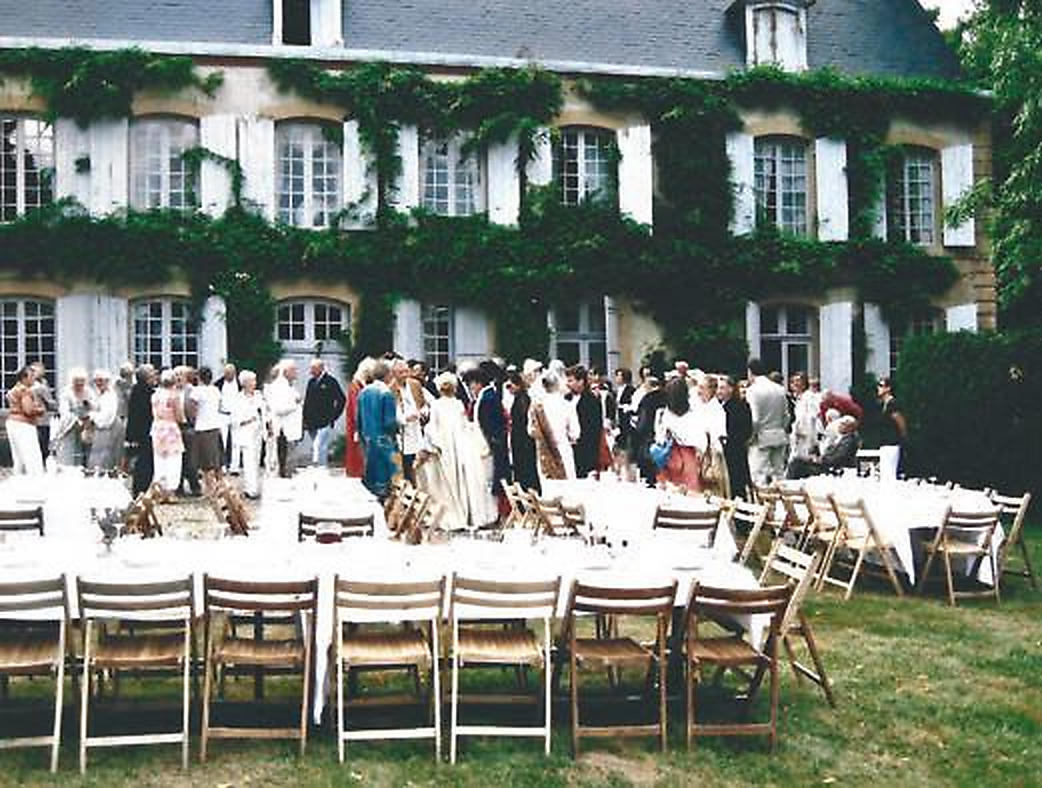
Guests dressed in 18th-century costume for Mozart’s ‘Marriage of Figaro’
BEAUTIFUL MUSIC
So, to celebrate the departure of the builders, we invited a pianist and some young singers from England to perform a few Mozart arias. We enjoyed this event so much, we asked the singers to return the following year to put on a fully staged opera. We chose Mozart’s ‘Marriage of Figaro’ based on the 1778 stage comedy by Beaumarchais, which dated from a similar period to the house. The French adore dressing up, so we asked our guests to come in 18th-century costume. One of our naughtiest friends came in full regalia as an 18th-century cardinal while another of our oldest friends got the century wrong, and arrived in doublet and hose, his catwalk legs memorable in ladies’ tights.
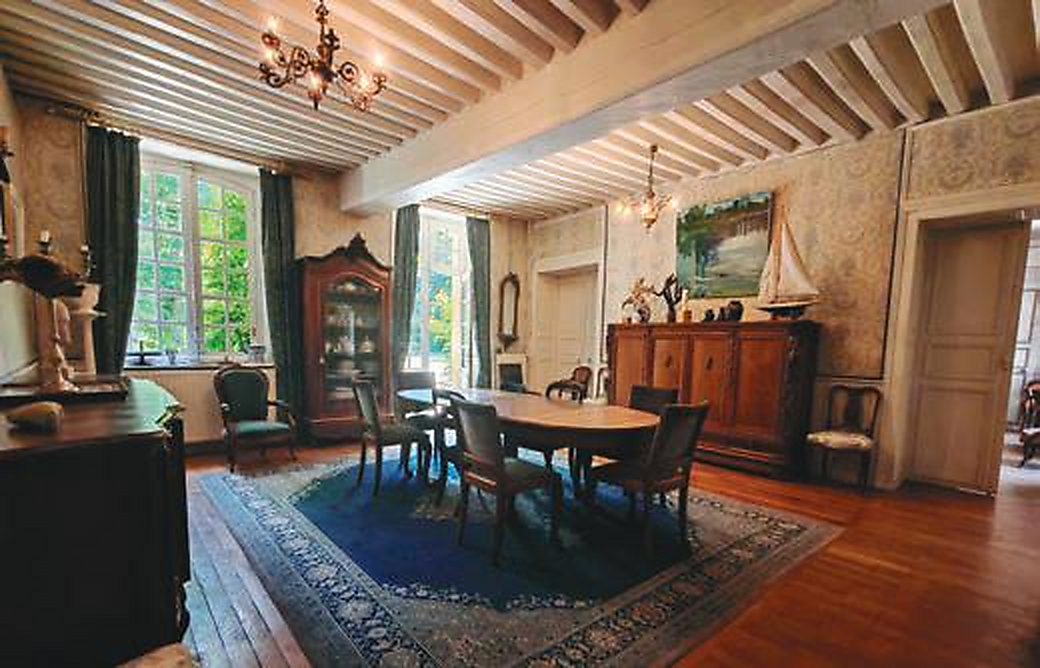
The manoir’s dining room has dual patio doors onto the courtyard
And so our first country house opera group was born. After Figaro, we had a long discussion about the possibility of setting up our very own opera company. The upshot was ‘Opera Loki’, named after our resident dog. Over the years, the company quickly developed, becoming a charity both in the UK and France and in the succeeding summers we put on a total of more than 20 productions.
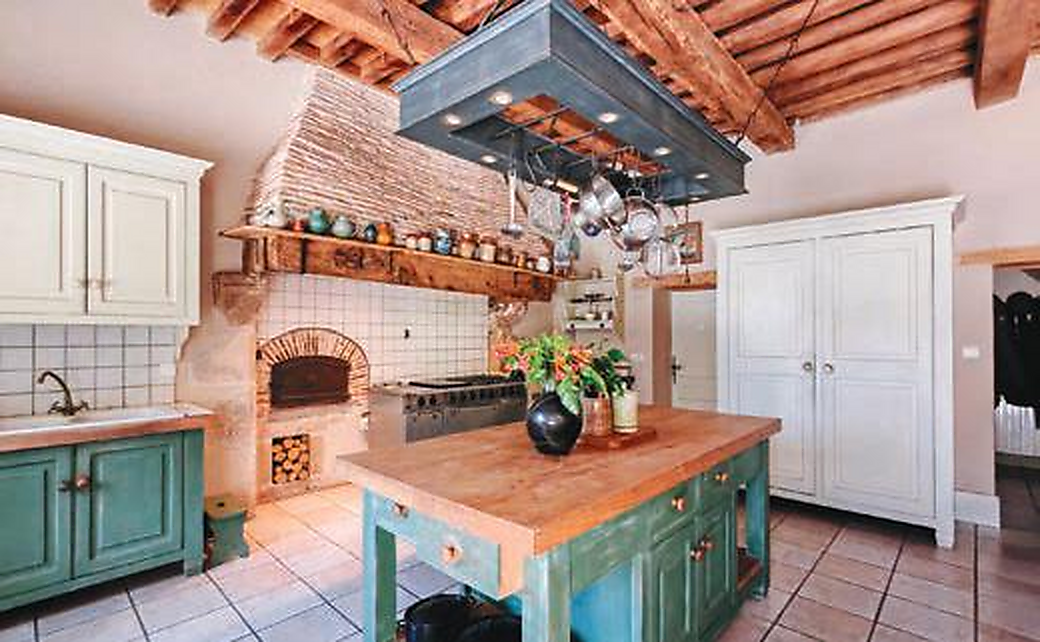
Exposed beams and a wood-fired bread oven give the kitchen its character
For each production, we auditioned singers in London, most of whom were studying at Royal College, Guildhall School of Music, Trinity Laban or other major music schools in Wales and Scotland. Many of our singers have gone on to enjoy prestigious careers with singing roles at Covent Garden, English National Opera, Glyndebourne and the Bayreuth Festival.
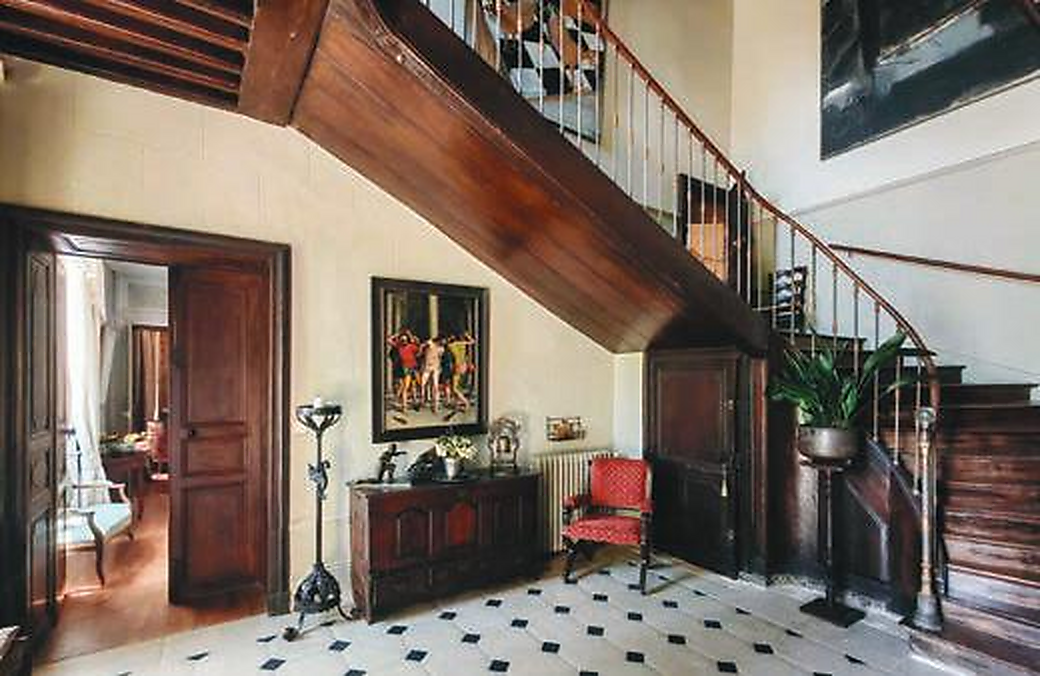
A graceful curved wooden staircase leads upstairs from the entrance hall
SINGING THE PRAISES
Word got around and our opera season grew to include more venues. Most were hosted by generous French friends who were willing to open their châteaux, manoirs, abbeys or spacious barns, not only to dedicated music lovers but also to people who might never have considered attending an opera. Opera Loki’s aim was to advance the careers of young singers and also to introduce opera to a wider audience.
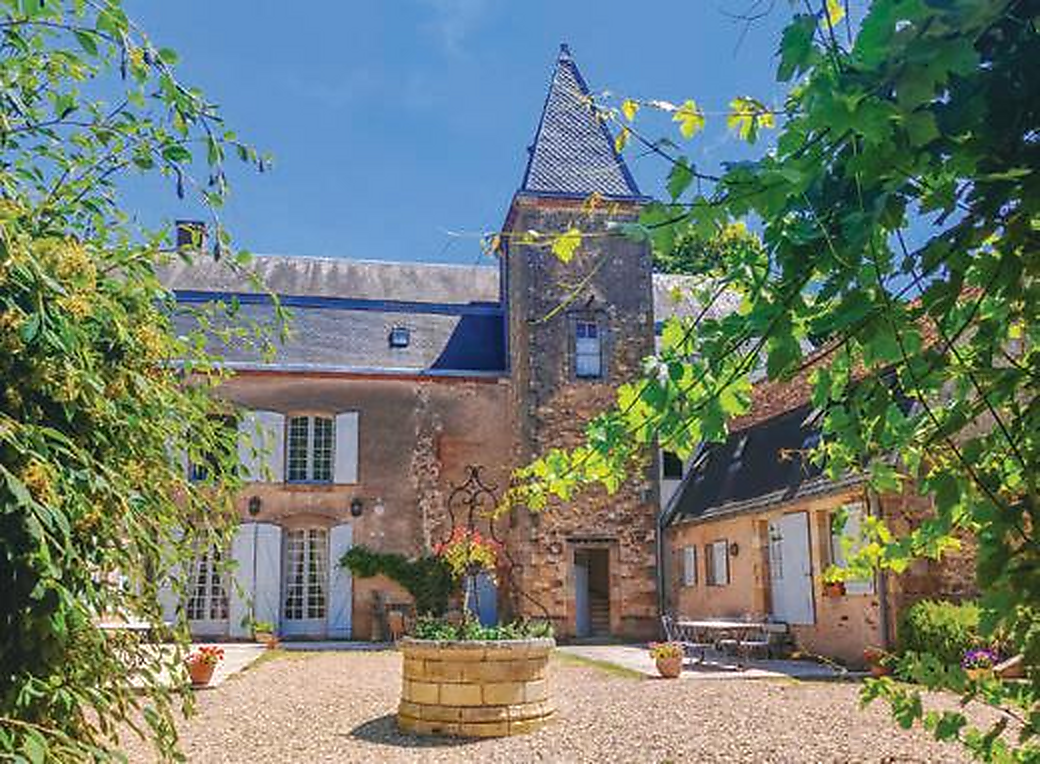
The central courtyard has access to the private guest wing and kitchen
“Over the past 26 years, we have hosted performances of operas by Mozart, Verdi, Puccini and Rossini”
Over the past 26 years, we have hosted performances of operas by Mozart, Verdi, Puccini and Rossini. We’re now working with London-based Regents Opera, which recently performed Wagner’s ‘Ring Cycle’ to critical acclaim.

A performance of ‘Rigoletto
Opera at La Gozinière isn’t the only imported fringe opera run by Brits. Opéra de Baugé was founded in 2002 by John and Bernadette Grimmett at Les Capucins, near Anjou, and m ore recently, in 2019, Jenny Hemans set up Theâtre Basse-Passière at her home in Perche-en-Nocé in Orne.
Cosi fan Tutte’ set during WW1
You can read more about the trials and tribulations of setting up and running an opera festival in the depths of France in the book written by Chloe Rayban, How to knit an opera, available from Amazon.
Puccini’s ‘La Bohème’ was performed in the attic at Manoir de la Gozinière
We’ve had an absolutely enchanting quarter of a century living at La Gozinière, but after so many happy years it’s time for us to move on. So should you want to buy a beautiful manoir that echoes to the enchanting melodies of Mozart, Verdi, Bizet and Puccini, you know where to come.
Manoir de la Gozinière is for sale at €950,000. Contact the owners direct at [email protected] or email Alison Brettell at [email protected]
French admin and household finances lead the headlines this week, after a major cyberattack on France’s tax authority raised concerns for taxpayers and property owners using online services. The government has also announced aid and tax relief for communities and businesses affected by the Gironde and Landes wildfires, while families can note the payment of the allocation de rentrée scolaire and upcoming applications for school bursaries. Property owners should also prepare for 2026 taxe foncière bills later this month.
French tax authority data breach raises phishing concerns
France’s tax authority, the Direction générale des Finances publiques, or DGFiP, has been hit by a major cyberattack, with the personal data of hundreds of thousands of individuals and businesses affected. The breach is particularly sensitive because it comes just after income tax notices were issued and shortly before many property owners receive their taxe foncière bills.
Affected taxpayers are expected to be contacted individually. Residents and non-resident property owners should be especially alert to phishing emails, fake tax-refund messages, false payment requests or calls pretending to come from the tax office. The DGFiP does not ask for bank details, passwords or tax login credentials by email or text message, and taxpayers should use their secure espace Finances publiques if they need to check a message.
Wildfire aid and tax relief announced for affected areas
The French government has announced support for areas badly affected by the recent wildfires in Gironde and Landes. Measures include emergency aid to help communes rehouse people who lost their homes, as well as tax and social-contribution relief for businesses whose activity has been affected.
The support will be particularly relevant for residents, second-home owners, tourism businesses and property owners in the areas around Le Porge, the Bassin d’Arcachon and the Landes coast. Those affected should keep insurance documents, photos, invoices and official evacuation notices, and should continue to follow mairie, prefecture and insurer guidance.
Property owners prepare for 2026 taxe foncière bills
Property owners and usufruitiers in France should prepare for 2026 taxe foncière bills, with online notices due from the 27th of August for taxpayers who are not paid monthly, and from the 19th of September for those on monthly payments.
The payment deadline is the 20th of October for online payment, or the 15th of October for other payment methods where the amount due is €300 or less. Buyers completing a French property purchase should also remember that taxe foncière is usually apportioned between buyer and seller in the final notarial statement, even though the person who owned the property on the 1st of January is legally liable for the year’s bill.
Back-to-school allowance paid in mainland France
The 2026 allocation de rentrée scolaire, or ARS, is paid today, Tuesday the 18th of August, in mainland France, Guadeloupe, Guyane and Martinique. The means-tested allowance helps eligible families cover back-to-school costs for children aged 6 to 18.
For 2026, the amounts are €426.87 for children aged 6 to 10, €450.41 for those aged 11 to 14, and €466.02 for those aged 15 to 18. Families who have recently moved to France should check their Caf or MSA account to make sure their household and school details are up to date.
Families with children in collège or lycée can prepare for the 2026-2027 school bursary campaigns, which open from the September rentrée. The bourse de collège and bourse de lycée are means-tested and help eligible households with school costs.
For the 2026-2027 school year, entitlement is assessed using the household’s 2026 tax notice, based on 2025 income. Families moving to France with school-age children should ask the school about the application process, especially if they are enrolling in a private establishment under contract or if they need to provide additional supporting documents.
Fuel aid deadline remains open until the end of August
Eligible high-mileage workers still have until the 31st of August to apply for France’s €100 fuel aid. The measure is aimed at people who use a petrol, diesel or non-plug-in hybrid vehicle for work and meet income and mileage conditions. Applicants must either travel at least 15km each way between home and work, or cover at least 8,000km per year for professional purposes, including commuting. This may be relevant for residents in rural areas where public transport options are limited.
Medicine reimbursement rules change from September
Residents using the French healthcare system should note that new reimbursement rules for some médicaments hybrides and médicaments biosimilaires come into force from the 1st of September.
If a pharmacist proposes an approved substitute and the patient refuses it without a valid medical reason stated by the doctor, the patient may lose the benefit of tiers payant and may have to pay upfront before being reimbursed. In some cases, reimbursement may also be calculated on the basis of the cheaper substitute.
Virgin Trains moves closer to rival Eurostar
Virgin Trains has moved a step closer to launching cross-Channel rail services between London and mainland Europe, after the UK rail regulator approved its access to the High Speed 1 line between London St Pancras and the Channel Tunnel.
The approval could allow Virgin to run up to 20 daily return services from October 2030, with planned routes to Paris, Brussels and Amsterdam. However, the company still needs access to the Channel Tunnel and European rail networks before services can begin. If the plans go ahead, it would mark the first direct challenge to Eurostar’s long-standing monopoly on passenger services through the tunnel, potentially giving travellers more choice on UK-France routes.
Want more help with your France property journey? Join Membership, search our Property Portal, subscribe to French Property News, and follow our YouTube channel for the latest advice and updates. Join us at the French Property Exhibition for expert advice and property inspiration.
Here’s the latest currency news from our partner Moneycorp, to help you find out what your money is worth.
The situation in the Middle East remains unresolved, with no talks planned for the week ahead and reports suggesting both sides are adopting firmer positions. The US is preparing fresh measures against Iran, although it remains unclear what form those measures might take given the breadth of sanctions already in place. Markets may question whether further action could extend to secondary sanctions on countries continuing to support Iranian trade, including China, and whether that could provoke a backlash.
Meanwhile, the Israeli Defence Forces struck targets in Lebanon over the weekend, reportedly killing a Hezbollah commander. That development risks placing further strain on the ceasefire agreement brokered by the US.
With tensions remaining elevated, markets will continue to monitor developments closely, including the approaching expiry of the US‑Iran ceasefire. For now, risks to energy prices appear skewed to the upside. Brent crude continues to test levels towards $90 per barrel, while US gasoline prices remain above $4 per gallon. That may become increasingly uncomfortable for the US administration as the November mid‑term elections draw closer.
UK labour market, CPI and retail sales figures for July in focus this week
Last week was relatively quiet from a UK data perspective, aside from the Q2 GDP figures, which showed another solid quarter of growth despite ongoing headwinds from higher energy prices and supply chain disruption. That helped support sterling, taking GBP to multi‑month highs against the USD, although gains were more limited against most other major currencies.
Attention now turns to several key UK releases. First up is the labour market report, covering June data for unemployment, average earnings and employment, alongside July figures for payrolled employees and job vacancies.
Markets will pay particular attention to any signs of weakness in payrolled employment and vacancy numbers. Such developments would reinforce recent softness in private sector earnings and may carry greater significance than continued strength in contested Labour Force Survey measures or a modest fall in the unemployment rate.
CPI inflation and retail sales figures follow later in the week. Markets should avoid over‑fixating on the headline numbers in isolation. Higher headline inflation could be accompanied by softer core inflation measures, while any decline in retail sales volumes would come after several months of comparatively resilient consumer spending.
Overall, the data ought not to materially undermine GBP. However, sterling continues to approach several important technical resistance levels just above current spot rates. Those levels may prove challenging to overcome irrespective of the data outcome.
The US comes off a bruising week, with the dollar under pressure
Last week proved challenging for the US dollar. Economic data releases and survey evidence weakened the case for a Federal Reserve rate increase in September, with market‑implied odds of a 25bp hike falling from above 50% to below 30%.
Interest rate expectations also shifted materially. Markets no longer fully price an additional rate increase by the end of 2026, whereas only a few weeks ago investors were anticipating almost two further hikes before year‑end. Softer producer prices, weaker retail sales and another disappointing GDP release all contributed to that reassessment, leaving the USD on the defensive.
Can the dollar recover this week? The challenge is that the US calendar is relatively light. July industrial production data and the publication of the FOMC meeting minutes are likely to attract the most attention, while no Federal Reserve speeches are currently scheduled.
That leaves markets looking elsewhere for direction. Any surprises from the major economies could help stabilise the dollar. The greater risk, however, is that markets continue to test the weaker‑dollar narrative unless incoming data provides a convincing reason otherwise.
German ZEW and ECB speeches to prompt a reality check?
The recent EUR/USD rally, which has taken the pair to its highest level since 17 June, has reflected increased concern over the US economic outlook rather than a marked improvement in Eurozone fundamentals.
This week, attention is likely to shift back towards the Eurozone economy. Markets will focus on the German ZEW survey for August, alongside speeches from ECB Chief Economist Philip Lane and ECB President Christine Lagarde.
Following the lull since the ECB’s late July meeting, where policymakers appeared to leave the door open to a further rate increase in September, these speeches may help reinforce market expectations for such a move.
At the same time, economic conditions across the Eurozone remain challenging. Wildfires, volcanic activity and ongoing geopolitical developments continue to weigh on both current activity and the broader outlook.
As a result, this week’s data and central bank communication could provide something of a reality check for the euro. Even if EUR/USD remains supported by US‑specific factors, the single currency may face a sterner test against other major currencies, in my opinion.
Will Canadian CPI maintain the CAD’s strength against the USD?
Canada releases July CPI inflation figures today. While US inflation data released last week pointed to some moderation in both headline and core measures, consensus forecasts anticipate firmer headline inflation in Canada, with core inflation expected to remain at 1.8% year‑on‑year.
The composition of the inflation data may prove more important than the headline reading itself. Markets will look closely at underlying price pressures and assess whether inflation strength extends beyond food and energy categories.
Canada remains one of the few major economies where core inflation remains below 2% year‑on‑year. That backdrop ought to discourage the Bank of Canada from tightening policy this year, in my view.
As for the currency, the CAD has enjoyed a strong run against the USD. However, technical considerations suggest the move may be entering a more challenging phase. Having sustained a break below C$1.40 against the US dollar, the Canadian currency is now moving into an area where additional gains may prove harder to achieve, in my opinion.
Why Moneycorp?
With a Platinum Trusted Service Award 2020 from independent review site Feefo and 40 years of experience in the industry, FrenchEntrée has been recommending Moneycorp for more than 15 years. During this time they have helped thousands of client planning the best way to pay for their property as well as supporting them afterwards with any further payment from paying bills, mortgages to repatriating UK pension payments for those who have retired to France.
Furthermore, we have worked with the same person at Moneycorp for more than a decade! You might be familiar with her as she often writes for our French Property News magazine. She has 13 years’ experience in foreign exchange, and is a qualified European lawyer with experience in European transactions. Mar will be happy to answer any questions or enquiries to support you through these difficult times
Opening an account is really easy and free of cost. You can register online or over the phone in a couple of minutes and for FrenchEntrée readers there are no transfer fees in any payment.
Q: We’ve dreamt of moving to France for years, but we’re unsure where to begin. We’re browsing properties, yet we have concerns about visas and healthcare —which should we tackle first? It really feels like a chicken-and-egg situation!
TRACY LEONETTI of LBS Paperwork Professionals answers...
Feeling excited about French homes yet unsure about visas and healthcare is normal. After 15 years in French immigration and paperwork, I assure you your dream is within reach, it just requires a structured plan. Let’s break down the steps for your move.
Step one – Lay your foundations: Start by exploring different regions: coast, countryside or town, and refine your criteria such as budget, lifestyle, access to amenities and renovation preferences. Get your finances and logistics in order early to avoid surprises. This clarity helps your agent act fast when you’re ready.
Step two – Secure the right visa strategy: This is where your plans begin to take shape. Before you make any formal decisions, it’s crucial to know your legal options for residency. Following Brexit, Brits as non-EU nationals must apply for an appropriate long-stay visa if they intend to live in France for more than 90 days. You can’t just wait and hope; advance planning is necessary. The central question is: How will you finance your life in France? Are you:
– Retired on pensions?
– Remote worker or freelancer?
– Early retirement?
– Entrepreneur?
– Job seeker?
Each of these situations has a specific visa category. Selecting the right one from the beginning is essential. With good preparation, this step becomes very achievable, and once your visa has been approved, you’ll enjoy great peace of mind.
Which visa category will be right for you?
Step three – Work with the timeline, not against it: French authorities place a high value on thorough preparation. Drawing from three decades of living in France and assisting hundreds of applicants, I can confirm that visa processes demand organised documents, proof of financial stability, housing plans and valid health coverage. Instead of viewing these requirements as mere paperwork, consider them as steps toward building your new life with greater security. Each document brings you closer to your goal. With a well-structured plan, the entire process becomes more transparent, manageable and far less overwhelming.
Step four – Plan your healthcare transition: Healthcare is one of the biggest concerns for future movers and thankfully, it is also one of the most straightforward when understood properly. Initially, you may need comprehensive private health insurance for your visa application. Once resident in France, you can apply to join the French state healthcare system (CPAM). How you apply and the documents would depend on what your status is i.e. retired, working, business. The affiliation process can take four to six months so your private insurance definitely has its place during this interim phase.
With proper planning, you remain fully covered throughout the transition.
Step five – Proceed with confidence: Once your visa has been approved and your healthcare plan established, you transition from planning to implementation.
– Your property search becomes targeted
– Your financial resources are strategically managed
– Your timeline is clearly defined
– Your visa documentation and related paperwork are in order
At this stage, your French endeavour transitions from a future aspiration to an active undertaking. So what comes first? I’m a great believer in getting clarity: About where you want to live; about your visa pathway and administration situation; and about your healthcare cover. With those foundations in place, your move to France becomes structured, achievable and entirely within reach.
Enjoy the process!
Want more help with your France property journey? Join Membership, search our Property Portal, subscribe to French Property News, and follow our YouTube channel for the latest advice and updates. Join us at the French Property Exhibition for expert advice and property inspiration.
Consumer, insurance and relocation updates lead the France headlines this week, with new repair rights for faulty appliances, an increase coming to a compulsory insurance contribution, and a higher proof-of-funds threshold for non-EU students applying to study in France. There are also updates on AI labelling, reusable sanitary products and safety advice ahead of the 12th of August solar eclipse.
New repair rights for faulty appliances
New EU repair rules are now in force, giving consumers stronger rights when household goods break down. Manufacturers must repair certain products at a reasonable price and within a reasonable timeframe where repair is possible, including products such as smartphones, tablets, televisions, fridges, washing machines, dishwashers and vacuum cleaners.
During the two-year garantie légale de conformité period, consumers who choose repair rather than replacement now benefit from a one-year extension of that guarantee. After the guarantee has expired, a right to repair applies to certain technically repairable products for between five and ten years, depending on the product and spare part concerned.
Student visa proof-of-funds threshold increased
Non-EU students applying for a long-stay student visa or student residence permit in France now need to show higher minimum financial resources. For applications submitted from the 1st of August 2026, the required minimum is €877.50 per month, replacing the previous €615 monthly threshold.
This is important for students planning to move to France for university, as well as families budgeting for a child’s studies. Applicants should check the latest requirements on France-Visas or through their local Campus France office before submitting documents.
Property market shows cautious recovery
The latest Notaires de France update suggests the French property market is recovering gradually, although the picture remains mixed. Sales of older properties rose over the year to the end of May 2026, but the pace of recovery has slowed compared with earlier in the year.
For buyers, this suggests the market is more active than in the recent downturn, but financing remains important. The notaires point to mortgage rates of around 3.3% over 20 years in April, so buyers should still seek mortgage advice early and leave room in their budget for notaire fees, insurance and possible rate changes.
Insurance contribution for terrorism victims to rise in 2027
The compulsory contribution to the Fonds de garantie des victimes des actes de terrorisme et d’autres infractions, often known as the taxe attentat, will rise from January 2027.
The contribution will increase from €6.50 to €8.50 per year and is collected through many insurance contracts, including home, car and boat insurance. This is a small increase, but it will affect many residents and property owners with insurance contracts in France.
AI-generated content to be labelled more clearly
New EU rules on artificial intelligence transparency began applying from the 2nd of August. The rules are intended to help people identify when content has been generated or modified by AI.
Companies can use three types of EU icons to show whether AI has been used, whether the content is fully AI-generated, or whether existing human-made content has been partly modified by AI. The rules also prohibit certain AI practices, including harmful manipulation, exploitation of vulnerable people and some uses of social scoring or biometric identification.
Reusable sanitary products to be reimbursed from October
Reusable sanitary products will be fully or partly reimbursed from the 1st of October for women under 26 and for people receiving Complémentaire santé solidaire. The measure is intended to reduce period poverty and encourage reusable products.
The reimbursement will apply to eligible products bought in pharmacies, with the level of cover depending on the person’s age and healthcare status.
Regional-language baccalauréat option from 2028
From the 2028 baccalauréat, pupils who take a speciality subject in a regional language may be able to receive a diploma marked cursus bilingue. The change applies to general and technological baccalauréat candidates.
The new route begins from the 2026 rentrée for pupils entering première and starting their speciality subjects. It may be relevant for families moving to regions where languages such as Breton, Basque, Corsican, Occitan or Alsatian are taught.
Solar eclipse safety warning issued
A solar eclipse will be visible in France on Wednesday the 12th of August. It is expected to be near-total in the south-west and partial across the rest of mainland France.
Anyone planning to watch should use eclipse glasses that meet the required safety standard and should not look directly at the sun with the naked eye, ordinary sunglasses, smoked glass or improvised filters.
Assumption Day falls on Saturday the 15th of August
France’s next national public holiday is Assumption Day, or l’Assomption, on Saturday the 15th of August. Banks, many offices and some businesses may close, although arrangements vary by sector and location.
Because the holiday falls on a Saturday this year, it will not create a long weekend for most employees, but visitors and residents should still check local opening hours, public transport changes and event arrangements before travelling.
Want more help with your France property journey? Join Membership, search our Property Portal, subscribe to French Property News, and follow our YouTube channel for the latest advice and updates. Join us at the French Property Exhibition for expert advice and property inspiration.
Here’s the latest currency news from our partner Moneycorp, to help you find out what your money is worth.
Market conditions have not altered materially over the weekend, despite some concerning developments in the Middle East. In its first official response to the US’s 15‑point plan for Gaza, Israeli Prime Minister Netanyahu categorically rejected the proposal. He stated that Israeli forces would not withdraw from Gaza until Hamas was “genuinely disarmed”.
Meanwhile, a resumption of cargo and tanker transit through the Strait of Hormuz appears unlikely given the latest demands from the Iranian regime. Previously, Iran had called for ships from the US and other nations it considers aggressors to be barred from navigation, while other nations would be required to pay a transit tariff. That position now appears to have shifted, with Iran calling for an end to the US blockade and the payment of compensation before the Strait is reopened.
Such demands are unlikely to be accepted by the US and, although oil prices have shown little reaction to these developments, further downside in energy prices appears unlikely at this juncture, in my view.
Monthly and Q2 UK growth figures in focus as hot weather influences activity
This week sees the release of the UK’s June and Q2 GDP figures. The consensus forecast is for Q2 GDP growth of 0.4%, matching the Q2 growth rates already recorded in both the US and the Euro Area. The strength in GDP appears to be driven by one off factors, with UK consumer spending supported by hot weather and the World Cup. Neither factor is likely to prove lasting, nor do expectations of higher UK interest rates appear well supported given the underlying weaknesses in the labour market, private sector earnings, and the construction and agriculture sectors.
Hot weather is likely to have supported stronger GDP growth in Q2, with increased sales of fans and air conditioning units providing a boost. However, the monthly breakdown may show a sharp slowing in activity towards the end of the quarter. Services growth is expected to have flatlined, while industrial production remains subdued at best.
GBP continues to hold up while other economies contend with their own challenges, but the current weakness in the USD may well prove temporary.
US focus on CPI after substantial payrolls miss
July’s US non‑farm payrolls report was, in short, awful. Net payrolls fell by 23k compared with June, while revisions to the previous two months removed a further 103k jobs from the total. Labour force participation also declined and average earnings growth moderated. The only positive was a fall in the unemployment rate, although that was driven by lower labour force participation. The data prompted a decline in the USD, allowing GBPUSD and EURUSD to advance.
Notably, however, the JPY saw only limited and temporary support. The difficulty the currency is having in holding on to its recent intervention‑driven gains suggests the authorities may need to consider something more permanent if they are to alter the JPY’s direction of travel.
The focus this week shifts to July CPI inflation and, later, July retail sales data. CPI inflation is expected to ease on both the headline and core measures, with lower energy prices during much of the July measurement period likely responsible for weaker headline inflation.
As for retail sales, high temperatures and the World Cup may have supported spending beyond current expectations. Areas of strength could include electrical goods, fans and air conditioning equipment, clothing and footwear, and seasonal food products. In my opinion, there should be little in either release that materially undermines the USD further.
It is a relatively quiet week for Euro Area data releases. The main focus is likely to be June industrial production figures, due on Thursday. Consensus expectations are for production to have flatlined in June following a 0.2% month on month decline in May, but whether the figures can outperform remains unclear.
Signals from individual sectors would suggest not. The automotive sector continues to face pressure from Chinese production and discounting as those manufacturers attempt to reduce excess inventories. That continues to weigh on export markets, particularly in countries such as the UK. Construction also remains under pressure, while the broader economy looks set to struggle against the backdrop of US tariffs and trade quotas.
With the ECB now in its summer hiatus, there will be no public commentary from ECB officials until they return. That leaves FX markets vulnerable to developing a fresh narrative around economic weakness and to reducing expectations for further monetary tightening. Even if the ECB does sanction a rate hike, I am not convinced it would materially help either the EUR or the wider economy over the medium term.
Both the CAD and MXN strengthened against the USD following last week’s US non‑farm payrolls report.
For the CAD, domestic employment data were considerably stronger than expected. However, the picture was not entirely positive, with hourly wage growth slowing to just 3.0% year‑on‑year in July, the weakest reading in more than four years. In my opinion, the case for higher Canadian interest rates remains tenuous. Attention will turn to July CPI inflation data, due on Monday 17 August. Should those figures show signs of weakness, they could cut the wind from the CAD’s sails once again.
As for the MXN, the case for further peso strength appears less convincing. The Mexican central bank left interest rates unchanged at 6.5%, yet the data released around that decision suggest there is at least an argument for considering further policy loosening. Inflation continues to decline, consumer confidence remains weak, and vehicle production and exports remain under pressure.
This week’s industrial production figures could also disappoint, which may prevent USDMXN from breaking lower. The current weakness in the USD may well prove temporary.
Why Moneycorp?
With a Platinum Trusted Service Award 2020 from independent review site Feefo and 40 years of experience in the industry, FrenchEntrée has been recommending Moneycorp for more than 15 years. During this time they have helped thousands of client planning the best way to pay for their property as well as supporting them afterwards with any further payment from paying bills, mortgages to repatriating UK pension payments for those who have retired to France.
Furthermore, we have worked with the same person at Moneycorp for more than a decade! You might be familiar with her as she often writes for our French Property News magazine. She has 13 years’ experience in foreign exchange, and is a qualified European lawyer with experience in European transactions. Mar will be happy to answer any questions or enquiries to support you through these difficult times
Opening an account is really easy and free of cost. You can register online or over the phone in a couple of minutes and for FrenchEntrée readers there are no transfer fees in any payment.
Moving to France can change the way you organise your finances. Alongside arranging healthcare, property insurance, pensions and day-to-day banking, it may also be worth reviewing what financial support would be available if illness, injury or death affected your household.
State benefits and workplace protection may provide some support, but the amount available will depend on your employment status, contributions and personal circumstances. Self-employed people, business owners and households relying heavily on one income may be particularly exposed if earnings suddenly stop.
ASTTRAL is now able to provide access to a personal protection solution offered by a leading insurance provider. The range brings together several forms of cover through one quoting process, making it easier to compare the available options.
Understanding the different types of cover
The protection available may include:
Life insurance
Life insurance can provide a financial payment to your chosen beneficiaries if you die during the policy term. It may be used to help cover a mortgage, household bills, education costs or other ongoing financial commitments.

Income protection
Income protection is intended to replace part of your income if illness or injury leaves you unable to work. The amount paid, the waiting period and the length of time benefits continue will depend on the policy selected.
Accidental death and disability cover
This type of policy may provide a payment following an accident that results in death or a qualifying disability. The precise definition of disability and the circumstances covered should be checked carefully.

Critical illness protection
Critical illness cover can provide a lump-sum payment following the diagnosis of one of the serious medical conditions listed in the policy. Conditions, definitions and eligibility requirements vary between insurers.
Funeral expense cover
Funeral expense cover is designed to help relatives meet some or all of the costs associated with a funeral, reducing the immediate financial burden on the family.
Deciding how much cover may be appropriate
The right level of protection will vary from one household to another. Factors to consider may include:
- Outstanding mortgage or loan balances
- Monthly household expenditure
- The number and age of any dependants
- Existing savings and investments
- Employer-provided benefits
- Current insurance policies
- How long your household could manage without your income
It is also important to think about whether your circumstances have changed since you last reviewed your insurance. Buying a property, becoming self-employed, starting a family, retiring or moving permanently to France may all affect the type and amount of protection you need.
Reviewing the details carefully
Through a single quoting process, applicants can select the forms and levels of cover they wish to consider, based on their financial priorities and budget.

The premium shown will reflect the benefits selected, allowing applicants to review the likely cost before deciding whether to proceed. As with any insurance policy, it is important to read the terms carefully, including exclusions, waiting periods, benefit limits and the circumstances in which a claim may or may not be paid.
ASTTRAL can explain the available options and key policy features before an application is submitted. The aim is to help applicants understand what they are applying for and whether the proposed cover reflects their circumstances.
For further information, contact [email protected], and a member of the ASTTRAL team will respond.
Cover is subject to eligibility, underwriting, policy terms, conditions and exclusions. The suitability of any policy will depend on individual circumstances.
France’s Livret du Citoyen is the official government handbook detailing essential information for residency card applicants and French citizenship candidates, and a new version has just been released. Here’s what you need to know.
What is the Livret du Citoyen?
The Livret du Citoyen, or citizen’s handbook, is an official guide published by France’s interior ministry for French citizenship candidates. It presents the key topics that applicants should know prior to becoming a French citizen and forms the basis of the information on which you will be tested. It’s written in French, naturally, and should be understandable to those with a B2 language level (the level required for French citizenship applicants).
If you’re studying for the civics test (which is required for multi-year and permanent residency cards as well as for all citizenship applications) or preparing for the entretien d’assimilation, the crucial citizenship interview which takes place at your local prefecture, this should be top of your reading list.
Read more about applying for French citizenship or find out what happens during the citizenship interview at the prefecture.
What’s changed in the new Livret du Citoyen?
Following on from other recent changes to the French citizenship application process (including an increase in application fees and the introduction of the new civics test), a brand new edition of the Livret du Citoyen was released on the 16th July 2026. The previous version was released post-Brexit in 2022, so it was due an update—and there are quite a few changes.
Anyone who has read the previous Livret du Citoyen will immediately notice the biggest change: the updated version is now a whopping 83 pages long compared to the previous 28 pages! The new handbook is more comprehensive, with additional detail provided on key subjects and updates on new laws and political changes.
Some notable additions include:
- The full text of the Marseillaise, France’s national anthem (it’s not clear whether or not you’ll be expected to sing it at the interview, but make sure you at least know the lyrics!).
- An additional two pages explaining laïcité (secularism), one of the most important principles of the French Republic, including clear examples of how this works in practice (this was previously a short paragraph).
- A handy map and timeline showing key events in the history of the European Union and the dates that different countries entered or left the EU.
- Updated and more in-depth information on the rights and responsibilities of French citizens, including new sections on women’s and LGBTQ rights, as well as the environmental charter.
- A new sporting section that mentions France’s footballing victories and the 2024 Olympic Games
- A whole new chapter detailing everyday life in France (everything from healthcare to recycling rules), the rights and regulations for working in France, and raising a family in France (parental obligations, the French education system, laws surrounding marriage, etc)
Do I need to learn everything in the Livret du Citoyen?
The short answer is yes! While you certainly won’t be expected to quote entire sections from the Livret du Citoyen, it’s highly likely that you will be asked questions on all of the key topics covered in the book.
Citizenship interviews are expected to follow a similar format to the five chapters of the handbook (although they may not always be in that order), so make sure to study each section individually:
- Principles and values of the republic
- French politics and institutions
- Rights and responsibilities of citizens
- History, geography and culture
- Living in French society
My advice for studying for the citizenship interview or civics test
As someone who undertook the French citizenship interview in 2024 (read about my own application here), I can highly recommend familiarizing yourself with the Livret du Citoyen. It was, without a doubt, the single most important thing that helped prepare me, and almost every non-personal question I was asked during my interview was covered at some point in the handbook. (Note that it is still possible that you will be asked questions that aren’t in the book, but the vast majority should be.)
I can’t stress enough how important it is to really read and study it cover to cover! Even though I’ve been living, working, and writing about France for years, I’m certain that I would never have been able to answer all the questions I was asked without studying.
There’s a lot to get through, so give yourself plenty of time to read and re-read it, take notes. I focused on just a few pages each evening, made study cards to help me memorise important names and dates, and practiced answering questions out loud on the different topics (in French!).
Read our guide to preparing for the French citizenship interview for additional advice and plenty of free resources to help.
Do I need to read France’s Livret du Citoyen?
While the citizen’s handbook is aimed at those taking the French citizenship interview, it’s also great preparation for the civics test, which consists of multiple-choice questions but covers many of the same subjects. It’s also a really useful aid for anyone moving to France, especially if you hope to become a permanent resident or citizen one day. Understanding more about French law, politics, and culture is sure to help you better integrate into French life (plus, you’ll be one step ahead when you come to take the civics test one day).
Where can I find the Livret du Citoyen?
The new Livret du Citoyen is available as a downloadable PDF from the French government site – click the link below.
Download the new French Livret du Citoyen – July 2026 here
The book is free, so while you might choose to pay for services to help you study or practice your French, don’t be taken in by anyone who asks you to pay for the book itself!
Moving to France?

From applying for your visa and opening a French bank account, to integrating in your new community – FrenchEntrée is here to help! Let our Essential Reading and Visa & Residency articles guide you through the whole process. Or, if you need extra help, become a FrenchEntrée Member to access exclusive masterclasses and digital books, or speak with one of our FrenchEntrée Property & Relocation Advisors. Become a FrenchEntrée Member now!
Disclaimer: Our Essential Reading articles are designed to give an overview of the visa requirements and procedures for moving to France. We always check our information against the official government information made available to the public, however, please remember that all visa and nationality applications are considered on an individual basis and the exact requirements, fees, or application procedure may vary. Unless you are an EU citizen, obtaining a French visa is not a right, and we cannot guarantee that your visa will be approved.
Property owners can now note the key dates for 2026 taxe foncière bills, while taxpayers who made a mistake on their income tax declaration can use the online correction service. There are also new fines for ignoring swimming and water-sports bans, exceptional insurance measures for residents affected by the Gironde, Landes and Var wildfires, and changes coming to medication reimbursement rules from September. Meanwhile, residents can check a clearer annual Assurance Maladie statement, give their views on future euro banknotes, and prepare for higher postal prices from January.
Property tax dates confirmed for 2026
Property owners and usufruitiers in France can now note the key dates for 2026 taxe foncière bills. Notices will be made available online from the 27th of August for owners who are not paid monthly, and from the 19th of September for those who are paid monthly.
Paper notices will be sent between the 24th of August and the 21st of September for non-monthly taxpayers, and between the 21st of September and the 9th of October for monthly taxpayers. The payment deadline is the 20th of October for online payment, or the 15th of October for other payment methods where the bill is €300 or less.
Income tax correction service now open
The online correction service for 2026 income tax declarations is now open. Taxpayers who declared online, or validated their automatic declaration, can correct certain details through their espace Finances publiques until the end of November.
The service can be used to amend figures or boxes ticked in the declaration, but not to change details such as marital status, civil status, address, or the address of a student attached to the household. Once the correction is processed, a new tax notice will be issued and the household’s prélèvement à la source rate may be recalculated.
Ignoring swimming bans can now lead to a fine
People who ignore an official swimming or water-sports ban can now be fined. Since the 3rd of August, police can issue an amende forfaitaire where someone swims in a banned area, enters the water despite a red flag, or takes part in a banned nautical activity such as paddleboarding, canoeing or kayaking.
The new rule applies where a municipal or prefectural order, a red flag, or navigation police rules prohibit swimming or water-based activity. The offence is classed as a third-class contravention, which can reach up to €450 if the matter goes before the tribunal de police.
Exceptional insurance measures for wildfire victims
Residents affected by the major wildfires in Gironde, Landes and Var will benefit from exceptional insurance measures. France Assureurs has announced that claims for these fires can be declared until the 31st of August, extending the usual five-working-day deadline for a home insurance claim.
People who were ordered to leave their main home by the authorities may also be reimbursed for temporary accommodation costs, even if their property was not damaged. Reimbursement will depend on the conditions and limits of the insurance contract, and supporting documents should be kept.
Medication reimbursement rules to change from September
From the 1st of September, patients who refuse a pharmacist’s proposed substitution with a médicament biosimilaire or médicament hybride may lose the benefit of tiers payant. This means they may have to pay the full cost of the reference medicine upfront, before being reimbursed later by Assurance Maladie.
In some cases, reimbursement may also be calculated on the basis of the cheaper substitute rather than the reference medicine. The rule will not apply where the doctor has clearly stated on the prescription that substitution is not possible for medical reasons.
New annual health statement available through Assurance Maladie
Assurance Maladie has introduced a clearer annual statement to help insured residents better understand healthcare reimbursements and payments. The updated relevé annuel de prestations includes a more visual breakdown of health costs, reimbursements and amounts covered during the year.
The statement can also include reimbursements and payments relating to children attached to the insured person’s account. It is designed to make it easier for households to see what has been paid by Assurance Maladie and what remains payable by the patient or complementary insurer.
Public consultation opens on future euro banknotes
The European Central Bank is asking residents across the eurozone to give their views on future euro banknote designs. The consultation is open until the 21st of September 2026 and covers two proposed themes: European culture, and rivers and birds.
The current euro banknotes will remain valid and in circulation for several years. The consultation is part of a longer process to design a new series of notes with improved security, accessibility and environmental performance.
Postal and parcel prices to rise in 2027
La Poste has announced new postal tariffs from the 1st of January 2027, with letter and parcel prices set to rise. Service Public says postal prices will increase by 6.73% on average, while Colissimo prices for parcels sent by individuals will rise by an average of 4.1%.
The price of a 20g lettre verte will rise from €1.52 to €1.67, while a 20g international letter will increase from €2.25 to €2.45. The changes will be relevant for residents and second-home owners who still rely on post for official documents, international correspondence or parcel deliveries.
Commercial cold-calling ban comes into force this month
France’s new rules on commercial démarchage téléphonique come into force on the 11th of August. From that date, commercial cold-calling will be banned by default, unless the call relates to an existing contract or the consumer has clearly agreed in advance to be contacted.
Consent must be freely given, informed and based on a clear positive action. It cannot be renewed automatically, and consumers will be able to withdraw it at any time. Contracts signed after a call that does not follow the new rules will not be valid, and Bloctel will end once the ban takes effect.
Public-sector family absence rules updated for 2027
A new framework for autorisations spéciales d’absence will apply in the French public sector from the 1st of January 2027. The rules cover certain family and parental situations for civil servants and contract staff, including marriage or Pacs, bereavement, childcare, adoption procedures and some pregnancy-related appointments.
The measure is intended to harmonise rules across the public sector. It does not affect annual leave, but it will be relevant for residents working in French public administration, education, healthcare or local authority roles.
Want more help with your France property journey? Join Membership, search our Property Portal, subscribe to French Property News, and follow our YouTube channel for the latest advice and updates. Join us at the French Property Exhibition for expert advice and property inspiration.
Here’s the latest currency news from our partner Moneycorp, to help you find out what your money is worth.
Oil falls on yet another attempt at a US-Iran deal
A cessation in US air strikes, reports of a potential deal between Iran and Oman over traffic flow through the Strait of Hormuz, and a reported ceasefire between Israel and Hamas have all helped reduce oil prices over the weekend. Brent crude is back down to $83 per barrel, having recently traded as high as $102. However, optimism around the flow and price of energy may prove short-lived.
US President Donald Trump indicated that the pause in bombing was temporary and contingent on rapid progress towards a deal. Meanwhile, Iranian officials have stated their commitment to peace talks while accusing the US of breaching its commitments.
How many times will the US return to the negotiating table, and how many times will such efforts be thwarted? Is this time any different from the last?
US & Japan joint action on the yen, but interestingly US sells EUR for JPY; NFPs in focus at the end of the week
The US confirmed that it acted to bring down the value of the JPY last week. Interestingly, the US Treasury indicated that it sold EUR for JPY. The news has not triggered significant EUR underperformance, but the fact that US authorities chose this route suggests a new dynamic in FX markets may be emerging.
The BOJ apparently bought somewhere in the region of $50bn in yen, while US intervention totalled approximately $5-10bn, bringing USDJPY down to a low of 155.23 in trading this morning. This is something we have repeatedly warned about over recent quarters. However, without further intervention, I can see USDJPY drifting higher once again. USDJPY has moved lower by roughly 5.3% during the latest round of intervention, but that move only returns the currency to levels last seen in May.
This week, financial markets may be focused on the release of July non-farm payrolls data. Following disappointment in the Q2 GDP figures last week, the question is whether these numbers will materially outperform or underperform market expectations. In the run-up to the NFP release, data on job openings and job cuts will also be published. Concern over businesses hiring fewer people remains significant, as a continued decline could have negative knock-on effects for consumer spending and business investment.
Will the economic risks reassert themselves post the BOE?
The Bank of England’s decision to leave interest rates on hold last week came as little surprise to financial markets. Some members of the committee viewed inflation risks as paramount, while the majority remain unconvinced that second-round effects will emerge, particularly given weak hiring intentions and the downward trajectory in real earnings growth.
There are no materially important releases due this week, and markets also have no major speeches on which to focus. The data and surveys that are released will likely point to continued sub-trend growth in the UK. Perhaps market attention will remain on announcements from the new UK Prime Minister, Andy Burnham. After a strong start, momentum already appears to be fading, with events dictating headlines rather than policy announcements dominating.
For GBP, outside of further authority-led activity, it remains difficult to build a positive case for GBPUSD or GBPEUR. Current economic and political conditions suggest headwinds to the stated goals of faster growth, more jobs and higher spending on crucial government departments. GBP could find itself back under pressure in the second half of the week.
EU gas inventory levels at 18-year lows, which could cause a price surge into a higher-usage period
The European Union has several problems on its hands, but I will highlight just two.
Firstly, the surge in migrant crossings into Spain’s African-governed region of Ceuta, which at one point reportedly saw around 60,000 people cross the border illegally within 24 hours, has prompted other countries to tighten border controls on those entering from Spain. This suspension of the Schengen agreement has angered Spanish authorities but was a predictable response. Although Spanish authorities have claimed that most have returned across the border, there is no independent verification of this.
Meanwhile, reports suggest that European gas storage levels are at 18-year lows and roughly 17 percentage points below the five-year average. That could undermine activity during periods of higher gas usage in autumn and winter while also creating upward pressure on energy prices. Hardly positives for a euro area economy that is already set to underperform.
Why Moneycorp?
With a Platinum Trusted Service Award 2020 from independent review site Feefo and 40 years of experience in the industry, FrenchEntrée has been recommending Moneycorp for more than 15 years. During this time they have helped thousands of client planning the best way to pay for their property as well as supporting them afterwards with any further payment from paying bills, mortgages to repatriating UK pension payments for those who have retired to France.
Furthermore, we have worked with the same person at Moneycorp for more than a decade! You might be familiar with her as she often writes for our French Property News magazine. She has 13 years’ experience in foreign exchange, and is a qualified European lawyer with experience in European transactions. Mar will be happy to answer any questions or enquiries to support you through these difficult times
Opening an account is really easy and free of cost. You can register online or over the phone in a couple of minutes and for FrenchEntrée readers there are no transfer fees in any payment.
With wildfires sweeping across the southwest coast and hundreds of thousands of locals and tourists evacuated, should you be reconsidering your trip to France this August? Here’s what you need to know if you’re planning to visit.
What’s the current situation?
France has been all over the news these past weeks as it faces one of its biggest wildfires to date, a blaze that’s already engulfed some 42,000 hectares of forest (that’s about 4 times the size of Paris) and has led to more than 250,000 people being evacuated. The wildfire has spread across the Gironde department in southwest France, coming within 9 miles of Bordeaux, and more than 2,200 pompiers (firefighters) have been mobilised to tackle the blaze. As of this morning (Thursday 30th July), the wildfire has been described as “stable”, although it may still be several days before the fire is completely extinguished.
In addition to this, wildfires also continue to spring up around the country, including a recent blaze in Fontainebleau Forest just outside of Paris and a devastating wildfire in Biscarrosse in the Landes department. Many areas of France are on high alert, with widespread fire bans in place across the country.
Should I cancel my trip to France?
The big question for travellers, especially those with a trip booked for the coming weeks, is whether or not it’s safe to travel to France right now. While the UK Foreign Office advises caution due to the “high risk of wildfires during the summer season from April to October”, it doesn’t advise against general travel to France. When it comes to assessing the risk, the most important factor is where in France you plan to travel.
If you have a trip booked for Bordeaux and the southwest, it may not be wise to continue with your travel plans. Even as the fires are brought under control, emergency services in the area will be overwhelmed, smoke inhalation and poor air quality are an ongoing risk, and tourist facilities are unlikely to reopen for business straight away. Those planning a trip to the Gironde and Landes regions in the next week would be advised to reconsider – beyond that, it’s best to seek local advice from your travel operator, hotel, or local mairie.
If you’re heading to the south of France, another high-risk area where there are several current incidents of wildfires, it’s advised to keep a close eye on wildfire alerts in the area. It may not be wise to travel to areas with ongoing wildfires, but other areas may not have been impacted by the fires or travelling smoke, so you shouldn’t rush to cancel your trip without further research.
Large parts of the country, especially northern and central France, still remain largely unaffected by the wildfires, so there’s probably no reason to cancel a trip to Normandy or Brittany, for example, which are far from the worst-affected areas.
If you plan to travel to an affected or high-risk area, it’s worth considering whether you could reorganise your trip for a different area of France, rather than cancelling your trip entirely– there are plenty of destinations to explore outside of the southern tourist hotspots. It’s also worth checking whether your travel insurance covers cancellation of the trip and also reaching out to hotels, gite owners, or tour companies to check their policies on cancellations. Make sure you have all the information first, so that you can make an informed decision on whether to go ahead with your trip.
Ultimately, wherever you plan to travel in France, vigilance is still recommended. Wildfires, heatwaves, and other weather-related events can be unpredictable, and no area is 100% risk-free. Follow our advice below to stay up to date before and during your travels.
How to stay informed about France’s wildfires, heatwaves, and water restrictions
The best way to reduce risk in the face of wildfires and other weather events is to stay informed, and thankfully there are several websites that provide daily updates on the situation.
Wildfires
Météo des Forêts has a map showing the wildfire risk level for every French département, from green (low risk) to red (very high risk). If you are travelling to or through an area on orange or red alert, you should keep an eye on local news and make sure you are up-to-date on any local restrictions, regulations, or closures due to the increased risks (for example, parks and forests may be closed, and a total fire ban may be in place).
However, note that this map only shows the risk alert level – it doesn’t show details of recent or ongoing wildfires in the area. For that, you’ll need the Feux de Forêt app/website, which shows real-time updates. If you’re visiting an at-risk zone, it’s recommended to download the app and set up notifications for your area, so that you’ll be alerted of any changes.
Finally, if you do find yourself in a wildfire zone, rest assured that serious risks and evacuation orders are handled by FR-Alert, which sends emergency text message alerts to all phones in the area. The alerts make a loud sound (even if your phone is on silent) and include a text with details of what to do (in the language that your phone is set to). It works for all phones in the area, including international numbers.
It should go without saying, but if you do receive an alert, don’t ignore it – act immediately. Evacuation orders aren’t issued without good reason, and wildfires can spread rapidly, so follow instructions, grab only the essentials, and get yourself to safety. If you do find yourself in an area with ongoing wildfires, it might be worth packing a bag with your passport, cards, and other must-haves, just in case.
Heatwaves and water restrictions
France’s wildfire battles are just one part of the country’s summer struggles. The country has also suffered a series of heatwaves in May, June, and July, coupled with severe drought. With more hot weather on the way in August, travellers should also be aware of the possibility of a fourth heatwave (canicule) sweeping the country, as well as widespread water restrictions throughout the country.
Stay up to date with the weather forecast via Météo France or keep an eye on their heatwave map to see the current risk levels, from green (low risk) to red (highest risk).
You can also check VigiEau for a map of the latest water restrictions, which range from blue (no restrictions in place) to burgundy (water crisis areas). You can look up the area that you’re staying in to find out about the local rules regarding water use.
Summer travel disruptions
Finally, be aware that even if you’re not staying in an area directly affected, wildfires can have an impact on traffic in the surrounding areas. If you’re travelling to or near any high-risk areas, keep an eye on Bison Futé for road traffic updates and GPS apps such as Google Maps or Waze, which often also advise of road closures. Again, it should go without saying, but if a road is closed due to wildfires, do not attempt to drive down it, even if it appears unaffected – wildfires can change course with rapid speed and you could easily find yourself trapped.
Rail services, flights, or local transport might also be suspended if the area is deemed at-risk.
Wildfire prevention
Most wildfires are started by human negligence, and causing a fire is a criminal offence in France with severe penalties – even if it was an accident. If you do travel to France (or anywhere else at risk of wildfires) this summer, make sure to read up on the guidelines for what to do – or more importantly, what not to do – to prevent wildfires from starting in the first place.
The French government has published this English-language guide outlining preventative actions and what to do in case of a wildfire. Some key rules to follow include not smoking in any forest or woodland areas, lighting BBQs well away from any vegetation, taking all litter with you (light refracting through glass can cause sparks), and parking away from vegetation (hot exhaust pipes can also cause a spark).
If you do witness a wildfire, you can call the fire service in France by dialling 18 or, if you prefer to speak English, the Europe-wide emergency services on 112.
Stay Up to Date With the Latest France Travel News
Whether you are a regular traveller to France, planning a property hunting visit, or simply visiting on vacation, our Travel to France zone has the latest travel news, updates, and advice on everything related to travelling to France.
If you’re reading this, you probably have a connection to France-perhaps you’re planning a move or you’re already navigating life across the Channel. Moving to France can be daunting, especially the paperwork-but form-filling is only the surface. It barely touches what it truly takes to build and sustain a life in France.
BEYOND THE FORM: SEEING THE WHOLE PICTURE
At pleasehelp.eu, we believe the real challenge isn’t completing documents, It’s managing the entire ecosystem of tasks that shape your life in France. From the moment you decide to relocate, you enter a year-long cycle of procedures, renewals, declarations and administrative interaction. What people actually need is not a form-filler, but guidance, insight and complete task management.
When you deal with French administration, whether it’s the Préfecture, Assurance Maladie or Impôts, you are engaging with a large, complex system. Success comes from understanding how that system works.
- It’s not only submitting a residency application; it’s understanding why your ‘carte de séjour’ is approved or refused.
- It’s not not only only declaring taxes; it’s knowing how France interprets your global income.
- It’s not only registering a car; it’s navigating customs, conformity checks, and registration rules.
When something goes wrong, you need to be able to take quick, informed action. That requires insider-level knowledge.
DECADE-LONG EXPERTISE
Since 2014, pleasehelp.eu has developed a deep, wide-ranging knowledge base. Our expertise covers:
- Residency and visas
- Nationality applications
- Health rights and access
- Driving licence recognition
- Business creation and taxation
- Imports, customs and vehicle registration
- Daily-life issues, including support after loss or theft
France is wonderfully rewarding but undeniably complex. That’s why you need current, accurate, impartial advice, not outdated anecdotes.
RETIREMENT OR BUSINESS
Whether you’re retiring to France or moving with plans to run a business, we can help with both long-stay visitor visa and working visa applications. The classifications for the working visa are growing day by day and include: salaried, talent passport, investor and entrepreneur. We handle the permission to work as well as the business plan aspects.
AVOIDING MISPLACED EXPERTISE
Some turn to solicitors when facing administrative resistance but this can backfire. French bureaucratic bodies may react negatively to legal pressure, especially in discretionary decisions. Our approach works with the system, understanding when to push and when to adapt, achieving results without confrontation.
YOUR PARTNER IN FRANCE
At pleasehelp.eu, we handle complexity so you can enjoy the best of France. Contact us to talk about the real challenges of life in France-and how we can help you navigate them. For more information, visit pleasehelp.eu
Property and consumer updates lead the France headlines this week, with new reminders for furnished tourist rental owners, rent increase controls extended in zones tendues, and an online tool allowing property owners to compare local tax rates by commune. There are also incoming changes to commercial cold-calling regulations, an extended deadline for the €100 fuel aid scheme, a mobile coverage tool for residents and second-home owners, and a serious wildfire situation in Gironde, west of Bordeaux.
Tourist rental owners reminded of 2026 rule changes
Owners renting out furnished tourist accommodation in France are being reminded that the rules have changed in 2026. Since the 20th of May, declaration of meublés de tourisme has been compulsory in all communes, not only in certain zones tendues. Owners must register the property through the relevant online service and include the registration number in listings and bookings.
The tax rules have also changed. For income received in 2025 and declared in 2026, the micro-BIC turnover threshold is €15,000 for unclassified meublés de tourisme and €77,700 for classified properties. For income received in 2026 and declared in 2027, the threshold for classified properties rises to €83,600, while unclassified lets remain at €15,000.
Rent increase controls extended in tense areas
France has extended the rules limiting rent increases in communes classed as zones tendues. The measure will now run from the 1st of August 2026 to the 31st of July 2027 and applies to certain empty and furnished residential lets when a property is re-let or a lease is renewed.
Landlords in affected areas cannot freely increase the rent except in specific cases, such as where certain works have been carried out. Separate rent-level controls also continue in some cities, including Paris, Bordeaux and Montpellier, where annual reference rents apply.
Property owners can compare local tax rates by commune
A DGFiP online tool now allows users to check and compare local property tax rates across French communes. The platform includes rates for taxe foncière on built and non-built property, taxe d’enlèvement des ordures ménagères, taxe d’habitation on second homes, and tax on vacant homes.
This is useful for property owners, buyers and second-home owners who want to compare the tax situation in one commune with nearby areas. The tool also shows departmental and regional averages, helping users put local rates into context.
Bordeaux wildfires prompt evacuations in Gironde
A major wildfire in Gironde, west of Bordeaux, has prompted evacuations around the Bassin d’Arcachon and Cap-Ferret area, with homes destroyed and road access affected. Feux de Forêt reported that more than 8,700 hectares had been affected by the 24th of July, with the evacuation of the Cap-Ferret peninsula ordered as the fire advanced towards the Bassin d’Arcachon.
Residents, second-home owners and holidaymakers in the area should follow prefecture and mairie instructions, avoid travelling into affected zones, and check transport and road updates before setting off. For live updates, fire maps and prevention advice, readers can use Feux de Forêt, which provides a real-time wildfire map, departmental updates and guidance on reporting a fire after calling 18.
Commercial cold-calling to be banned by default
From the 11th of August 2026, commercial cold-calling (démarchage téléphonique) will be banned by default in France, except in limited cases. A business will only be able to call for sales purposes if the call relates to an existing contract, or if the consumer has clearly agreed in advance to be contacted.
Consumers will also be able to withdraw consent at any time. Contracts signed after cold-calling that does not respect the new rules will not be valid, and the Bloctel opt-out service will end once cold-calling becomes prohibited by default.
€100 fuel aid deadline extended
The application window for France’s €100 fuel aid for high-mileage workers has been extended. The guichet was originally due to close on the 30th of July, but eligible workers can now apply until the 31st of August 2026.
The aid is intended for people who use a petrol, diesel or non-plug-in hybrid vehicle for work and meet income and mileage conditions. Applicants must either travel at least 15km each way between home and work, or cover at least 8,000km per year for professional purposes, including commuting.
Prépa-seconde made permanent from September
The classe prépa-seconde, introduced experimentally in 2024, will become a permanent part of the French education system from the 2026 rentrée. The year is aimed at pupils admitted into seconde who would benefit from extra consolidation before moving fully into lycée study.
The scheme is no longer limited only to pupils who did not pass the brevet. Pupils must be admitted to seconde, identified by their teaching team as likely to benefit from the programme, and willing to take part.
Mobile coverage tool helps compare operators
Residents, second-home owners and travellers can use Arcep’s Mon réseau mobile platform to compare mobile network coverage and service quality in a specific location. Users can search by address, transport route or road axis to compare the main operators.
The tool shows both theoretical coverage and measured quality, including calls, SMS, internet browsing and video streaming. It can be useful before changing mobile provider, buying in a rural area or checking coverage at a holiday home.
Income tax correction service opens tomorrow
Taxpayers who spot an error in their 2026 income tax declaration will be able to use the online correction service from the 29th of July. The service allows online filers to amend details declared earlier in the year for 2025 income. A new tax notice will be issued after the corrected declaration is processed, and the household’s prélèvement à la source rate may be recalculated. Paper filers cannot use the online correction service and must contact the tax office through the usual channels.
Want more help with your France property journey? Join Membership, search our Property Portal, subscribe to French Property News, and follow our YouTube channel for the latest advice and updates. Join us at the French Property Exhibition for expert advice and property inspiration.
Here’s the latest currency news from our partner Moneycorp, to help you find out what your money is worth.
PM Burnham retreats from proposed stamp duty changes following criticism
PM Andy Burnham has retreated from the idea of abolishing stamp duty and council tax and replacing them with a levy based on the value of residential property. The proposal, floated only a day or so ago, has not been well received, with the press and commentators highlighting concerns around its administration and the potential adverse effects on the housing market.
However, the PM has been kite-flying again, this time with the suggestion that every estate could face a 10% ‘death tax’ charge to help fund social care. It is worth remembering that the prospect of an additional inheritance tax levy almost prompted Theresa May’s downfall, with the Conservative Party surrendering a lead of more than 20 percentage points in the polls ahead of the 2017 General Election.
Such proposals demonstrate that the government’s room for manoeuvre on spending remains limited, given the historically high level of taxation and the complexity of the tax system, particularly while political parties continue to rule out changes to the largest sources of revenue, namely income tax, VAT and employee National Insurance. The Burnham bounce may have encountered its first obstacle, one that could have a negative effect on financial markets.
Middle East tensions ease as Trump talks up peace prospects and Iran and Oman discuss reopening Strait shipping routes
Donald Trump appears more optimistic about a deal being reached in the coming weeks, although talks between the two sides have yet to restart officially. According to Bloomberg, the President suggested that contact between the parties continues, although Iran’s Foreign Ministry spokesperson disputed that claim.
Meanwhile, Oman and Iran are discussing the reopening of the Strait of Hormuz, a development that has helped lower oil and gas prices following their recent sharp rise.
However, tensions in the region are unlikely to have been fully eased by reports that Hamas’ security chief was killed in an overnight Israeli airstrike in central Gaza.
For the time being, optimism surrounding a resumption of peace talks, coupled with discussions over reopening the Strait of Hormuz, ought to bring yields lower and weaken the USD against currencies such as GBP and EUR, or at least mitigate the impact of negative domestic factors affecting those currencies, in my opinion.
US Fed meeting in focus, with some suggesting a rate hike remains possible
Another interesting theme doing the rounds is the suggestion in some quarters that the Federal Reserve could raise interest rates at Wednesday’s FOMC meeting. Citadel Securities published a note suggesting that such a move, while surprising, would support Warsh’s case that he is serious about providing no advance warning to markets and will respond to macroeconomic risks as he sees fit.
This remains very much against the consensus view and would likely compound some of the economic challenges already facing the US.
In the absence of any material economic releases ahead of the decision, due at 19:00 BST (14:00 ET), markets may well take comfort from developments in the Middle East, assuming progress continues on restoring energy supplies and the unofficial ceasefire holds.
French consumer confidence rises to a four-month high, but wildfires risk lasting economic damage
French consumer confidence data for July showed sentiment rising to its highest level since March. That offers some positive news for France, which appears at risk of another Budget dispute in the autumn, given the issues surrounding the 2027 Presidential election and the current composition of the French parliament, which requires the PM to rely on support from other parties.
Efforts to reduce the deficit appear unpopular among other political groups, and PM Lecornu could face renewed calls for his resignation if the Budget remains unresolved.
Wildfires in France, along with parts of Spain, also risk causing lasting economic damage. The tourism industry is likely to face adverse effects during the peak season, while costs to agriculture and other sectors are also rising. The prospect of more widespread disruption across affected regions could reduce activity by a few tenths over the quarter, leaving downside risks to growth in 2026 as a whole.
That is hardly positive for the EUR, despite the improvement in confidence, which is likely to prove temporary, in my view.
Why Moneycorp?
With a Platinum Trusted Service Award 2020 from independent review site Feefo and 40 years of experience in the industry, FrenchEntrée has been recommending Moneycorp for more than 15 years. During this time they have helped thousands of client planning the best way to pay for their property as well as supporting them afterwards with any further payment from paying bills, mortgages to repatriating UK pension payments for those who have retired to France.
Furthermore, we have worked with the same person at Moneycorp for more than a decade! You might be familiar with her as she often writes for our French Property News magazine. She has 13 years’ experience in foreign exchange, and is a qualified European lawyer with experience in European transactions. Mar will be happy to answer any questions or enquiries to support you through these difficult times
Opening an account is really easy and free of cost. You can register online or over the phone in a couple of minutes and for FrenchEntrée readers there are no transfer fees in any payment.
Jacques Cutting is a bilingual French-English Apprentice Solicitor at Stone King. As part of his day-to-day work, he advises British individuals and families on a wide range of French legal and tax matters. In this article, Jacques examines the recent tightening of French rules governing short-term holiday rentals and the implications for British property owners in France.
Since Airbnb was launched in France in 2012, short-term holiday rentals have grown dramatically and become an important source of income for many property owners. Generous tax incentives and relatively light regulation encouraged both French and foreign owners to rent out their properties when not in use.
However, as in the UK, France is facing a housing shortage in many cities and tourist hotspots. Policymakers increasingly argue that the rapid growth of short-term holiday lets has reduced the availability of long-term housing and contributed to rising rents. In response, the French government and local authorities have introduced a series of measures designed to curb the expansion of Airbnb-style rentals, reduce tax advantages and impose stricter compliance requirements on property owners.
France’s Airbnb Crackdown
For many British owners, renting out a French holiday home on Airbnb has long been an attractive way to offset running costs. Whether it’s a city apartment in Bordeaux, a cottage in Normandy or a villa on the Côte d’Azur, occasional holiday rentals can provide a useful source of income while allowing owners to continue enjoying their property for part of the year.
France’s preferential tax treatment of short-term rentals has helped it become Airbnb’s second-largest global market. Many second homeowners have opted to rent out their property while they are not using it.
However, recent changes to French tax and rental regulations are beginning to alter the landscape. New rules affecting furnished holiday lets (“meublés de tourisme“) have reduced the tax advantages previously available to many owners, while also introducing additional registration and compliance requirements. Consequently, some property owners may find themselves paying tax on a significantly larger portion of their rental income than they would have done just a few years ago.
Before January 2025
Homeowners of unclassified furnished holiday lets (meublés de tourisme non classés) were entitled to a tax allowance of up to 50% and an income of up to €77,700. For example, if your annual rental income was €20,000, your taxable income would only be €10,000 once the tax allowance was applied. This income threshold was sufficient for most homeowners unless they wanted to run the property as a full-time business.
In this case, they could register the property as a meublé de tourisme classé. The tax allowance would then increase to 71%, with an income limit of €188,700. However, registration incurs a cost. The property would need to be audited and strict equipment requirements would need to be met, as well as a greater administrative burden being incurred.
Since January 2025
For meublés de tourisme non classés, the income limit has been reduced to €15,000, with the tax allowance being brought down to 30%. If your income exceeds €15,000, you will enter a new tax bracket called the régime réel and lose your tax allowance. However, with the régime reel, you will be able to deduct any expenses from the income.
Please note that even if your income is less than €15,000, you can opt for the régime réel. This option is only worthwhile if the tax regime allows you to deduct expenses and charges amounting to more than 30% of the income. The régime réel will impose more rigorous accounting requirements.
If the property has been registered as a meublé de tourisme classé, the income limit has been reduced to €77,700, with a tax allowance of 50%.

Your main home is in France
If you have decided to move to France full time, but wish to rent out your French property on Airbnb or Booking.com while visiting friends and family in the UK, this is relatively simple. But you should check with your local town hall to see if they have specific rules in place.
With the passing into law of the loi ELAN, if you live in Annecy, Biarritz or Bordeaux, you will be required to obtain a number called a ‘numéro de déclaration’, which must be shown on your online advertisement. More and more towns are deciding to adopt this registration system each year. If you do not have a registration number, your ad is likely to be taken down, and you could face a fine. Paris, for example, has been regularly increasing the penalty and the number of checks carried out. Before setting up your Airbnb account, you should also check whether you need a SIRET number.
You should also check with your local town hall how long you can rent out your property for. As a general rule, you cannot rent out your main home for more than 120 days a year. However, some towns, such as Bordeaux, have reduced this limit to 90 days per year.
Research is key
Before starting the rental process, whether for your main or holiday home, you should check with your local Mairie what specific rules and regulations you must comply with.
In most towns with over 200,000 residents, short-term rental rules are gradually becoming more restrictive in order to incentivise long-term rentals. In Bordeaux, for example, Airbnb-style rentals are subject to a compensation requirement. Every property owner in Bordeaux who rents out a holiday flat or house must convert another property into long-term rental accommodation. This other rental accommodation must be created from premises that are not currently being used for residential purposes, such as offices or shops.
As with all French matters, seeking advice from a professional can prevent costly mistakes or misunderstandings.
If you are interested in finding out more about estate planning and trust use in France and would like help analysing the options available to you, please contact the international and cross-border team at Stone King LLP either by calling +44(0)1225 337599 or by emailing [email protected].

Matthew Cameron explains why someone might want to renounce an inheritance from a French estate
Inheriting assets from a French estate might initially seem like a windfall, but the reality can be far more complex. For British nationals and other foreign beneficiaries, accepting a French inheritance comes with significant legal, financial and practical considerations that may outweigh the benefits. Understanding when and why to renounce an inheritance is crucial for making an informed decision.
TAX LIABILITIES
France’s inheritance tax system is one of the most significant factors influencing the decision to renounce. The tax rates are progressive and depend heavily on the relationship between the deceased and the beneficiary. Direct descendants (children and grandchildren) benefit from relatively favourable rates starting at 5% and reaching 45% on amounts exceeding €1.8m, with an allowance of €100,000 per child. However, for more distant relatives, the situation becomes considerably less attractive. Siblings face rates between 35% and 45% with only a €15,932 tax-free allowance. Nieces and nephews are taxed at 55%. The tax rate for unrelated beneficiaries is 60% with a tax-free allowance of €1,594. For British nationals who may have been close friends or distant relatives of the deceased, these rates can make an inheritance financially unviable. When combined with UK tax considerations and reporting requirements, the administrative burden becomes even more substantial.
DEBTS AND LOANS
One of the most critical reasons to consider renunciation is the principle that accepting an inheritance means accepting it in its entirety – both assets and liabilities. French law does not allow beneficiaries to cherry-pick favourable assets while declining debts. If the deceased had outstanding mortgages, personal loans, business debts, unpaid taxes or other financial obligations, these become the responsibility of the heirs. Without thorough due diligence, you might discover that the estate is insolvent or that debts substantially exceed the value of assets. Properties that appear valuable might be encumbered with mortgages or legal claims. The deceased may have provided guarantees for business loans or had tax disputes with French authorities. We have also seen a number of cases where the deceased died in France, following an illness that resulted in care or hospital fees. Such fees can themselves become a debt against the estate. In one case where beneficiaries sought our advice, the hospital fees alone outweighed the value of the house. The beneficiaries had little practical choice than to renounce, allowing the hospital to sell the property to recoup its expenditure. Conducting a comprehensive assessment of the estate’s financial position is essential before accepting, and if this reveals significant liabilities, renunciation might prove to be the prudent choice.

EMOTIONAL TOLL
The French succession process is notoriously bureaucratic and must be handled through a notaire (a French public official who manages estate settlements). The process involves extensive documentation, official translations, apostilled certificates, and compliance with both French and potentially UK legal requirements. For non-French speakers, every document requires certified translation, adding to costs and delays. The timeline for settling a French estate typically extends from several months to over a year, sometimes longer if complications arise. During this period, beneficiaries may need to make multiple trips to France, take time of work, and remain in constant communication with French legal professionals. The emotional toll of navigating a foreign legal system while grieving can be substantial. Professional fees for notaires, lawyers, translators, and cross-border tax advisors can easily reach tens of thousands of euros, significantly eroding the inheritance value. French succession law includes forced heirship rules that protect certain family members regardless of the deceased’s wishes. A portion of the estate (the réserve héréditaire) must go to protected heirs, typically children, which can override provisions in a will. This can create situations where you inherit property in co-ownership with family members you may not know well or with whom you have difficult relationships.
RENUNCIATION RULES
Renunciation can be a strategic tool for family wealth planning. When you renounce a French inheritance from a parent, you will be treated as having predeceased that parent. In this way the inheritance due to you would then usually pass to your children. If you would prefer a legacy from a deceased parent to pass directly to your children, this may prove to be a good method of passing assets down through the generations.

“While it may seem counterintuitive to decline an inheritance, it can protect you from fi nancial loss, administrative burden and ongoing obligations that outweigh any benefits”
However, care needs to be taken before deciding to take such a step. Careful planning and professional advice will be required to ensure the outcome aligns with your intentions and does not create unintended consequences. As an example, if your renunciation would lead to minor children inheriting in your place, the result may actually be a different set of complications: minor children do not have legal capacity to accept a succession, so this would have to be given on their behalf, potentially by a court. The court would have to be involved where a subsequent sale was intended while the child is still a minor.
In addition, you may well find that you are not able to renounce only to part of a deceased parent’s estate: if they had assets in the UK and France, it might be the case that renunciation is ‘all or nothing’.
CHARITABLE AIMS
Another example – perhaps a rather surprising one – where renunciation might be the most suitable option is in relation to a legacy to a charity. One unfortunate consequence of the UK’s departure from the EU is that a UK charity will not automatically qualify for an exemption to inheritance tax. The starting point is that the charity is not related to the deceased, so inheritance tax would apply at 60%.
It is possible to qualify for an exemption, but the process is extremely lengthy, and quite onerous. Where the main asset was a house in France, it follows that a charity may be faced with paying the tax and then hoping to reclaim this, whether from the proceeds of sale or from the slight possibility of an exemption being awarded. Faced with those prospects, one can hardly blame the trustees for deciding to forego the legacy.
Renouncing a French inheritance is a significant decision that requires thorough analysis of the estate’s financial position, your personal circumstances and long-term implications. While it may seem counterintuitive to decline an inheritance, doing so can protect you from financial loss, administrative burden and ongoing obligations that outweigh any benefits.
In practice, the majority of estates on which we are instructed to advise are not insolvent, and rarely do they lead to other instances where renunciation might be the most suitable choice. Sometimes, however, beneficiaries will have little option but to avoid taking any interest from a deceased person’s estate.
Nevertheless, it is always going to be prudent for owners of a French property – whether resident or not – to take detailed advice from legal and tax professionals experienced in cross-border French estates before making this irreversible choice. Identifying potential pitfalls in advance should ensure that you will not leave your beneficiaries with difficult choices to make about accepting or renouncing an estate you have left them.
If you envisage leaving your French estate to more distant relatives, or to charities, then the need to take wills and inheritance planning advice is particularly important.
Matthew Cameron heads the French legal services team at Ashtons Legal
Tel: 0330 1914450
Want more help with your France property journey? Join Membership, search our Property Portal, subscribe to French Property News, and follow our YouTube channel for the latest advice and updates. Join us at the French Property Exhibition for expert advice and property inspiration.
Regulated electricity bills are set to increase from August, France Travail has been given new powers to suspend unemployment benefit payments in suspected fraud cases, and families can note confirmed back-to-school allowance payment dates. Residents planning summer holidays can also make use of free home-security checks, while there are also updates on the 2026-2027 school calendar. Here are the France headlines you need to know this week.
Regulated electricity bills set to increase
Regulated electricity tariffs in France are set to rise by 2.5% from the 1st of August. The change is expected to affect more than 19 million residential customers in mainland France who are on regulated tariffs. Households should check whether they are on a regulated tariff or a market offer, as the impact will depend on the type of contract held. The increase is expected to be modest for most households, but it is still worth factoring into summer and autumn household budgets.
Back-to-school allowance payment dates confirmed
The 2026 allocation de rentrée scolaire, or ARS, will be paid on Tuesday the 18th of August in mainland France, Guadeloupe, Guyane and Martinique. In La Réunion and Mayotte, payment is scheduled for Tuesday the 4th of August. The means-tested allowance helps eligible families cover back-to-school costs for children aged 6 to 18. For 2026, the amounts are €426.87 for children aged 6 to 10, €450.41 for those aged 11 to 14, and €466.02 for those aged 15 to 18.
Homeowners can use Opération tranquillité vacances
Residents leaving their home empty over the summer can still sign up for Opération tranquillité vacances, a free police and gendarmerie service that helps monitor homes during longer absences. The scheme is available across France and can be requested online. In gendarmerie zones, it can apply to both main homes and second homes, with absences of up to 12 months covered. In police zones, the rules are more limited, so residents should check the conditions for their area before applying.
2026-2027 school holiday dates published
The school calendar for 2026-2027 has now been published. Pupils in mainland France are due to return to school on Tuesday the 1st of September 2026, while Corsica returns on Thursday the 3rd of September. The calendar confirms the dates for the Toussaint, Christmas, winter and spring holidays, with dates varying by zone for some breaks. This is useful for families planning travel, as well as property owners and holiday-let operators preparing for peak booking periods.
First local West Nile virus case confirmed this season
Health authorities have confirmed the first locally acquired case of West Nile virus in mainland France this year, in Pyrénées-Orientales. West Nile virus is spread by mosquitoes, and most infections cause no symptoms, although some cases can lead to flu-like illness or, more rarely, serious complications. Residents and visitors in affected areas are advised to take normal mosquito precautions, including using repellent, covering arms and legs in the evening, and removing standing water where mosquitoes can breed.
Tap water warning issued in four Gard villages
Residents in four villages in Gard have been told not to drink tap water after checks found arsenic levels slightly above the regulatory limit. The warning affects Saint-André-de-Majencoules, Les Plantiers, L’Estréchure and Saumane, near Pont d’Hérault. Bottled water is being distributed while further testing is carried out. The restriction is localised, but it is a useful reminder for residents and second-home owners to follow mairie, ARS and prefecture updates if they receive local water-quality notices.
Tour de France enters its final week
The Tour de France continues through July, bringing road closures, diversions and crowds along the route. Residents and visitors staying near a stage town should check mairie, prefecture and Tour de France information before travelling, as roads can close several hours before the riders arrive.
The race has also been affected by heat and wildfire risk this year, with earlier stages altered or spectator access restricted in some areas. The Tour is due to finish in Paris on Sunday the 26th of July, when road closures, crowd-control measures and public transport changes are expected around the route.
France Travail can suspend benefits in suspected fraud cases
France Travail has been given new powers to temporarily suspend unemployment benefit payments where there are serious indications of fraud, deliberate failure to meet jobseeker obligations, or certain offences by the claimant. The measure forms part of France’s new anti-fraud law and allows benefits to be suspended as a precautionary step while checks are carried out. Claimants can ask for the decision to be reviewed and provide evidence in response. The update is relevant for residents registered with France Travail, as well as anyone receiving unemployment support in France.
Want more help with your France property journey? Join Membership, search our Property Portal, subscribe to French Property News, and follow our YouTube channel for the latest advice and updates. Join us at the French Property Exhibition for expert advice and property inspiration.
For many people buying in France, a swimming pool is high on the wish list. It conjures up lazy summer afternoons, outdoor meals that stretch into the evening and making the very most of the climate. A pool can transform a property from attractive to irresistible.
However, when you purchase a house with a pool, you’re not just buying into that vision. You’re also taking on the practical side: the legal requirements, the ongoing maintenance and associated costs. Being aware of both aspects from the start will help ensure continued enjoyment.
A well-designed, properly maintained pool can be a fabulous asset. A neglected or non-compliant one, however, can quickly become an unexpected expense. The key is knowing what to look for before you sign on the dotted line.
Check the Pool Meets French Safety Laws
France has strict safety laws governing private swimming pools. These regulations are not optional, and responsibility transfers to the new owner upon completion of the sale. All private in-ground pools must be equipped with at least one approved safety device designed to prevent accidental drowning. This can be a safety cover, a pool alarm, fencing or a pool abri (enclosure).
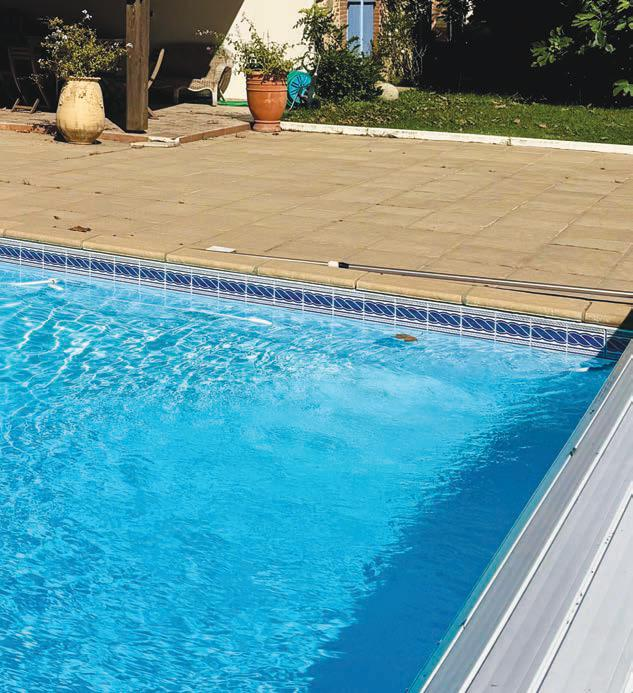
The safety device must meet current French standards and be in proper working order. An old alarm that no longer functions, or a damaged cover that does not lock securely, does not count. When viewing a house, ask when the system was installed, confirm that it meets regulations and request any supporting documentation.
If the system is outdated or non-functional, you will be responsible for upgrading it, so it’s always best to check.
Read more: The Laws of Pool Security in France and Swimming Pool Safety in France
Confirm the Pool Was Properly Declared
You should confirm that the pool was properly declared when built. Depending on size and type, pools in France require either prior declaration or planning permission. If the seller cannot confirm that it was correctly authorised, this may cause complications with the purchase. It is not common, but it does sometimes happen, particularly with older pool installations.
Read more: What Planning Permission Do We Need for Our Pool?
Don’t Forget Insurance and Liability
You should inform your insurer that the property has a swimming pool and confirm that both the pool and its equipment are covered against damage. It’s equally important to ensure you have adequate public liability cover, particularly if you plan to rent the property to paying guests.
How a Pool Affects Your Property Tax
In France, a permanent in-ground swimming pool is classed as an improvement to the property and is already taken into account when calculating the annual taxe foncière property tax. Therefore, if the pool has been correctly declared, it will be included in the seller’s current tax bill.
Read more: French Property Taxes: Taxe d’Habitation and Taxe Foncière
Assessing the Pool’s Condition
A swimming pool may look attractive during a viewing, but appearance alone tells you very little about its condition. Ask when it was constructed and what type it is. In France, most pools are either lined, tiled or prefabricated (coque).

If the pool is of a coque type (prefabricated), check that the water liner is level
With a liner pool, it’s not always possible to see what construction lies beneath until the liner itself needs replacing. A liner typically has a lifespan of about 10 to 15 years. The underlying structure, however, can last for many decades, particularly if built in reinforced concrete.

Covers should meet safety standards
With tiled pools, look for any loose or missing tiles and gently tap areas in the pool to check for hollow sounds. You may notice a white, powdery residue (efflorescence). This is not uncommon and is often cosmetic; however, if it’s widespread or persistent, it can indicate the movement of moisture through the structure. Likewise, tile or grout repairs are fairly common and usually straightforward, but may need a professional eye to confirm the pool remains watertight.
Prefabricated pools are typically made from polyester resin. Check for cracks – particularly around corners and steps – and blistering or bubbling on the surface, which can indicate osmosis caused by moisture beneath the finish. It’s also important to check the water line is level all around the pool, as this can signal the quality of the installation.
Read more: Choosing a Swimming Pool for Your French Home
Inspecting the Filtration System
Take a look at the filtration system for any visible signs of wear, leaks or temporary pipe repairs. These may indicate poor installation or inconsistent maintenance.
Ask how old the system is and whether any problems have arisen. Untidy pipework, improvised electrics or poorly finished surrounds can suggest the pool was not professionally installed, something to look out for in older self-build properties.
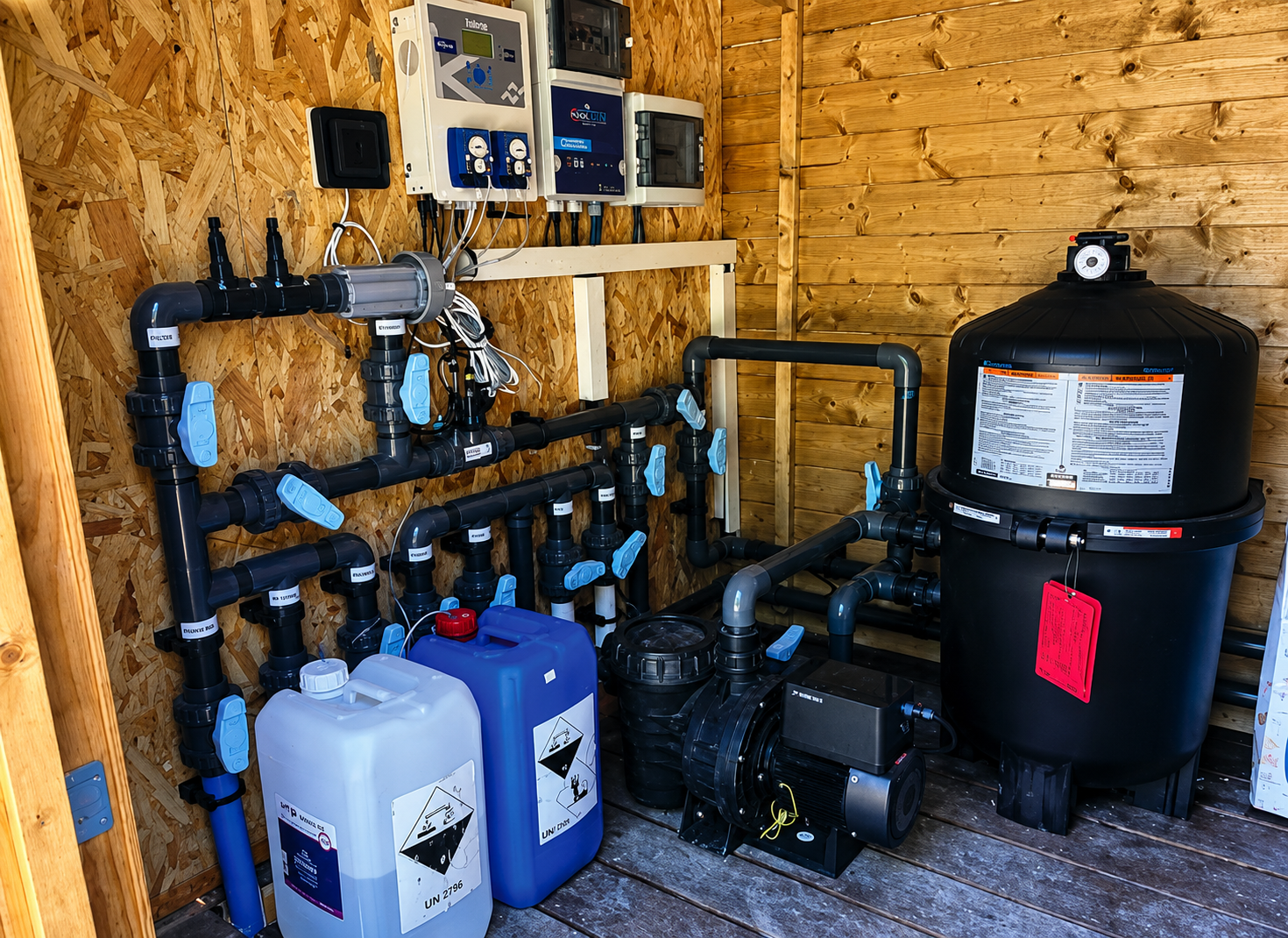
A new cartridge system with a variable speed pump is cost-effective
The filtration system should operate smoothly. Excessive noise or persistent leaks may require future expense.
What Green or Cloudy Water Really Means
Green or cloudy water is not usually a long-term problem. It may simply reflect seasonal maintenance or a short period of the property being empty. However, it can sometimes point to filtration issues or inconsistent upkeep. If a pool has a history of needing strong corrective treatments to recover from going green, this can place additional strain on pipework and pool coverings over time. While this is not uncommon and is often manageable, it’s worth asking how the pool has been maintained to get a clearer picture of its overall care.
If you’re unsure about the condition of the pool, arrange a visit from a specialist before exchange of contracts. An assessment can clarify the overall state of the installation and identify any work that’s required now or needs to be planned in for the future.
Understanding the Running Costs
Electricity is usually the biggest cost. Pumps must run daily during the season to maintain water quality. Older single-speed pumps consume significantly more energy than modern variable-speed models. In many cases, upgrading is straightforward and can reduce energy bills considerably.

Check the grout in tiled pools
Water treatment is usually either traditional chlorine products or a salt chlorination system. Where a salt system is already installed, annual running costs are often around €200 for the consumables, compared with approximately €500 per year for conventional chemical treatment.
It’s often assumed that pools need to be refilled regularly (it’s important to note that liner pools and prefabricated pools should never be emptied). However, aside from the initial fill, a pool generally only requires the occasional top-up to compensate for evaporation and routine maintenance.
Read more: What Do You Need to Know Before Owning a Swimming Pool in France?
Does the Pool Suit the Property?
Take a step back and ask yourself whether the pool truly complements the property. When it is well positioned and in proportion to the house and garden, it feels like it has always belonged there and can add real value. But if it is oversized or awkwardly placed, it can overwhelm a smaller plot and restrict how the space is used in the future.
Consider whether the pool is the right size for you and your lifestyle. Think about how often it will be used, by how many people and for what purpose. While a pool can always be altered by adding steps, for example, or even replaced in the future, it is far better to ensure it suits your needs from the outset.
Ultimately, a swimming pool is simply part of the home. When properly installed, well maintained and suited to the property, a pool brings enormous enjoyment and can enhance both the appeal and value of a house in France.
Most potential issues are identifiable and manageable with the right checks. Ask the right questions and your swimming pool can be exactly what it was meant to be: the backdrop to long summer lunches, happy house guests and the occasional overly competitive lilo race!
Red Flags to Watch For
Above-ground pool set in the ground: In some cases, an above-ground pool structure has been installed below ground level. These pools are not designed for permanent in-ground use and do not offer the same structural strength or longevity. Their lifespan is therefore more likely to be measured in years rather than decades. They’re often identifiable by a surrounding timber deck rather than traditional coping or paving, and the pipework is typically flexible, ribbed tubing rather than solid pressure pipes.
Water behind the liner: Visible water sitting between the liner and the pool wall usually indicates poor drainage around the outside of the structure. Groundwater can build up and create pressure behind the walls, forcing moisture between the structure and liner. This can cause bulging or wrinkling and, over time, may lead to structural stress. Drainage issues are often more complex to resolve than a simple liner replacement, so they should be investigated very carefully.
Skimmers and surrounding concrete: It’s also worth checking how the surrounding terrace has been constructed around the skimmers (filters in the pool walls). If concrete has been poured directly onto the skimmer pots without adequate expansion allowance, movement in the terrace over time can place stress on the skimmer housing. In some cases, this can pull the skimmer away from the pool wall, leading to cracks or leaks. This is not common in professionally installed pools, but it is something to be aware of with older installations or where the terrace has been added later.
Julia French runs Pristine Piscines in southwest France. Tel: 0033 (0)6 32 10 39 92 · pristinepiscines.fr
The unique mix of legal, financial and tax advice along with in-depth location guides, inspiring real life stories, the best properties on the market, entertaining regular pages and the latest property news and market reports makes French Property News magazine a must-buy publication for anyone serious about buying and owning a property in France.
From iconic perfumes to timeless leather goods, France is home to some of the world’s most desirable brands. While many of them are available internationally, shopping for them in France often means better prices, a wider selection, exclusive products, and—if you live outside the EU—the opportunity to claim a VAT refund.
Whether you’re looking for gifts or souvenirs you’ll actually use, these are the best French brands worth bringing home. And, with the Zapptax solution, you can make your shopping budget go even further.
1. French perfumes and fragrances
Luxury fragrance is one of France’s greatest specialties. Flagship boutiques often carry exclusive scents, larger collections and limited editions that never reach international retailers.
Diptyque
One of the most beloved Parisian perfume houses, famous for sophisticated fragrances and beautifully designed candles. Their Paris boutiques usually offer the widest choice.
Known for working with the world’s best perfumers rather than following fashion trends. A fantastic destination for niche fragrance lovers.
Officine Universelle Buly
Elegant packaging, customizable products and old-world Parisian charm make Buly one of the most unique shopping experiences in France.
With Zapptax, your purchases from multiple stores can be combined, making it easier to meet the VAT refund threshold.
2. French pharmacy skincare
French pharmacies are legendary among international travellers. Many cult skincare brands cost considerably less than in North America or Asia.
Caudalie
Famous for grape-based skincare developed in Bordeaux.
The iconic Sensibio H2O micellar water remains one of France’s best beauty bargains.
La Roche-Posay
Dermatologist-recommended skincare that’s often significantly cheaper in French pharmacies.
3. French leather goods and handbags
France is synonymous with leather craftsmanship. Beyond luxury houses like Louis Vuitton or Hermès, several contemporary brands offer exceptional quality at more accessible prices.
The famous Le Pliage bag remains one of the easiest and smartest purchases in France.
Polène
One of the most sought-after French handbag brands.
Buying directly from the Paris boutique avoids international shipping fees and gives access to the full collection.
Lancel
A heritage leather goods brand with elegant handbags and travel accessories.
Planning your shopping budget? The Zapptax VAT Calculator lets you estimate your VAT refund in just a few clicks.
4. Classic French fashion essentials
Some brands perfectly capture timeless French style.
Saint James
The authentic Breton sailor sweater.These iconic striped shirts have been made in Normandy for generations and last for years.
Another excellent Breton brand known for quality knitwear and marinières.
Petit Bateau
Perfect for premium basics, children’s clothing and timeless striped tops.
Can’t fit everything into your itinerary? Shop online from your favourite French brands and still benefit from a VAT refund with Zapptax.
5. French gourmet treats worth packing
Many French delicacies travel surprisingly well.
Pierre Hermé
Macarons may be the headline product, but chocolate bars, jams and biscuits make excellent gifts.
Professional-quality chocolate loved by pastry chefs worldwide. Perfect for anyone who enjoys baking.
Mariage Frères
France’s most famous luxury tea house offers elegant gift boxes that travel easily.
Claim your next VAT refund with Zapptax
The process is simple:
- request invoices in Zapptax’s name when shopping in France,
- upload it directly in the app,
- your tax-free forms are generated in the app at the end of your stay,
- validate them at customs when leaving the EU,
- receive your refund from Zapptax afterwards.
Unlike the traditional tax-free process, Zapptax lets you combine purchases from multiple stores, making it easier to reach the minimum spending threshold while avoiding paperwork in every boutique.
Before your next shopping trip, check that you’re eligible for a VAT refund and Download Zapptax to make the most of every purchase.



In 2017, the co-founders of ZappTax (both residents outside the EU and therefore eligible for VAT refund) devised an innovative system that overcomes almost all the problems of the traditional VAT refund system.
ZappTax’s mission is plain and simple:
Help international travellers to more easily obtain refunds of the value added tax (VAT) they pay on goods they purchase while travelling abroad. ‘More easily’ means a more convenient and streamlined refund process, higher and faster refunds… combined with 24/7 flexible and instant customer support during the entire refund process.
DOWNLOAD THE ZAPPTAX APP FROM THE APP STORE OR GOOGLE PLAY
France’s national holiday falls today, with closures, crowds and changes to some local celebrations as wildfire risk remains high. Travellers should also prepare for busy summer roads, EES border delays, Tour de France disruption and changes at French airports. Here are the France headlines you need to know this week.
France’s national holiday falls today
France’s Fête nationale falls today, Tuesday the 14th of July, meaning banks, schools, many offices and some businesses will be closed. Public transport generally continues to run, but services and local access may be affected by parades, ceremonies, road closures and security measures.
In Paris, the traditional Eiffel Tower fireworks display took place exceptionally on Monday the 13th of July this year, instead of the 14th, to allow the 14th to be marked by remembrance events for the 10th anniversary of the Nice attack. The military parade on the Champs-Élysées went ahead this morning, with large crowds and tight security in the capital.
Some firework displays cancelled due to wildfire risk & wildfire near Fontainebleau
Several communes have cancelled or adapted firework displays and public events because of drought conditions and heightened wildfire risk. Restrictions vary locally, so residents and visitors should check mairie or prefecture updates before travelling to an evening event.
Where celebrations do go ahead, expect road closures, parking restrictions, crowd-control measures and changes to public transport. Anyone staying in rural areas, campsites or near woodland should avoid private fireworks, barbecues, campfires, discarded cigarettes or any activity that could create sparks.
A major wildfire broke out in the Fontainebleau forest, south-east of Paris, prompting evacuations, road closures and rail disruption. The fire has burned a large area of forest, with hundreds of firefighters deployed and water-bombing aircraft used in the Greater Paris region. The blaze caused disruption on the A6 motorway and affected some train services from Paris. Residents and visitors near forested areas should follow local instructions, avoid restricted zones and check transport updates before travelling.
Summer travel disruption expected on roads and at borders
The summer holiday period is now well underway, with heavy traffic expected across July and August on routes towards the coast, the south of France, the Alps and major holiday destinations. Drivers heading to or through France should check live traffic updates before setting off, especially on Fridays and Saturdays.
Non-EU travellers, including British and American visitors, should also allow extra time at borders due to the EU’s Entry/Exit System. Dover has again been flagged as a possible pressure point, with concerns over delays during the peak summer getaway period.
Tour de France affected by heat and local restrictions
The Tour de France is continuing through July, bringing crowds, road closures and diversions along the route. Residents and visitors staying near a stage town should check mairie, prefecture and Tour de France updates before travelling, as closures can begin hours before the riders arrive.
This year’s race has also been affected by the extreme heat. Stage nine was shortened by 30km after a red heat alert in Corrèze, and riders have called for future scheduling changes to avoid racing during the hottest part of the day. Wildfire risk has also led to access restrictions for spectators in some areas.
Digital ID can now be used at French airports
Travellers with a France Identité digital ID can now use it at all French airports when boarding a flight or dropping off hold luggage. The feature has been available since the 24th of June and applies regardless of the flight destination.
However, it cannot be used in foreign airports or for border identity checks. Travellers still need to make sure they have the correct passport, residence permit or other travel documents required for their journey.
Navigo annual pass can now be added to some smartphones and watches
Île-de-France Mobilités annual pass holders can now validate their Navigo annual pass on certain smartphones and connected watches. The feature is initially available on Android devices, with iPhone access due to follow by September.
Users can choose whether to keep their physical pass or transfer it digitally, but they cannot use both at the same time. Anyone switching to digital should keep their physical pass safe, as it may be needed if they later decide to switch back.
European health insurance card reminder for residents travelling abroad
Residents insured through the French health system and travelling elsewhere in Europe this summer are reminded to take their carte européenne d’assurance maladie, or CEAM. The card helps cover necessary medical care during temporary stays in the EU, EEA, Switzerland and the UK.
Each person needs their own card, including children, and it is free and valid for two years. It should be requested at least 15 days before travel via an Ameli account, although a provisional certificate can be downloaded if the request is made too late.
New driver-assistance equipment mandatory in new cars
Since the 7th of July, all new vehicles registered and delivered in France must include additional driver-assistance and safety equipment under EU rules. The latest phase includes active driver-attention monitoring and improved automatic emergency braking that can detect pedestrians and cyclists. Current car owners do not need to upgrade existing vehicles. However, the rules may affect buyers ordering new cars, as some older models may stop being sold if they cannot meet the new requirements.
Want more help with your France property journey? Join Membership, search our Property Portal, subscribe to French Property News, and follow our YouTube channel for the latest advice and updates. Join us at the French Property Exhibition for expert advice and property inspiration.
Here’s the latest currency news from our partner Moneycorp, to help you find out what your money is worth.
Oil takes centre stage as geopolitical risks escalate
Market data is likely to take a back seat this week as political developments and the conflict involving Iran continue to influence broader market sentiment. Brent crude oil has risen again as fewer vessels pass through the Strait of Hormuz, disrupting supply flows. Brent crude is now trading above USD 80 per barrel and may continue to move higher as US-Iran strikes continue, following attacks on a number of vessels transiting the Strait.
Regional tensions are also intensifying. Iran retaliated against US strikes on military sites with attacks targeting Kuwait, Oman, Bahrain, Jordan and the UAE. This presents a more complex backdrop should neighbouring Gulf states become more actively involved in the conflict.
Sterling supported as rate hike expectations persist
The UK calendar remains particularly light during the first half of the week. Tomorrow evening, Bank of England Governor Andrew Bailey is due to speak.
Market expectations continue to suggest that one further 25bp rate hike remains possible later this year, a factor that has helped keep sterling supported. This comes as the UK is expected to see the appointment of another Prime Minister, most likely next week.
Inflation data and Warsh testimony in focus
Away from developments in the Middle East, Tuesday brings US Consumer Price Index (CPI) data. Inflation is forecast to slow from 4.2% to 3.8% year-on-year. While this would represent a moderation in inflationary pressures, the level would remain elevated relative to many developed economies and may still support the case for at least one further rate hike later this year.
Elsewhere, Federal Reserve Chair Kevin Warsh is scheduled to testify before Congress twice this week. He will first appear before the House Financial Services Committee on Tuesday, followed by the Senate Banking Committee on Wednesday.
Both appearances are likely to attract close market attention, with investors assessing his views on interest rates and the broader policy outlook. Any signals on the future direction of monetary policy could have a noticeable influence on US dollar performance.
Lagarde speech provides the euro’s main focal point
For the euro, Tuesday’s focus will be European Central Bank President Christine Lagarde’s speech.
Her comments on the monetary policy outlook could generate volatility in the single currency, particularly as this represents the only major scheduled event for the region this week. Meanwhile, EUR/GBP remains close to a 12-month low.
China slowdown and NZ recovery highlight global divergence
On Wednesday, Chinese GDP growth is forecast to slow from 5.0% to 4.5% year-on-year. Later in the day, the Bank of Canada’s interest rate decision is expected to leave rates unchanged at 2.25%.
The New Zealand dollar has also shown some signs of recovery. New Zealand’s services sector returned to expansion in June, with the index rising from 48.0 to 50.6, moving back above the key 50 level that separates contraction from growth. The improvement follows similar signs of strengthening within the country’s manufacturing sector.
Why Moneycorp?
With a Platinum Trusted Service Award 2020 from independent review site Feefo and 40 years of experience in the industry, FrenchEntrée has been recommending Moneycorp for more than 15 years. During this time they have helped thousands of client planning the best way to pay for their property as well as supporting them afterwards with any further payment from paying bills, mortgages to repatriating UK pension payments for those who have retired to France.
Furthermore, we have worked with the same person at Moneycorp for more than a decade! You might be familiar with her as she often writes for our French Property News magazine. She has 13 years’ experience in foreign exchange, and is a qualified European lawyer with experience in European transactions. Mar will be happy to answer any questions or enquiries to support you through these difficult times
Opening an account is really easy and free of cost. You can register online or over the phone in a couple of minutes and for FrenchEntrée readers there are no transfer fees in any payment.
Overlooking the Charente river, the historic hilltop city of Angoulême is ideal for exploring Nouvelle-Aquitaine, writes Josie Sharp
Aptly nicknamed the ‘balcony of the southwest’, the fortified hilltop town of Angoulême offers unbeatable views of the surrounding countryside. Capital of the Charente department, the town stands out for its medieval streets, famous comic festival and Unesco-listed old town.
The city makes a great base for exploring the Charente area. Cognac and its world-famous distilleries, the riverside town of Jarnac, and medieval Confolens are all within easy reach, and there are good connections to larger cities like Bordeaux and Poitiers.
The historic centre is an architectural treasure trove, with cobbled streets, elegant fountains and Renaissance and Neo-Classical buildings. The St-Pierre Cathedral, a Romanesque masterpiece, reflects the history of Angoulême stretching back centuries. In the heart of town, the streets are lined mostly with charming apartments, with some traditional multi-storey stone houses. A few timber-framed colombage homes survive, nestled along the narrow, winding lanes of Vieux Angoulême, hinting at the city’s medieval past.
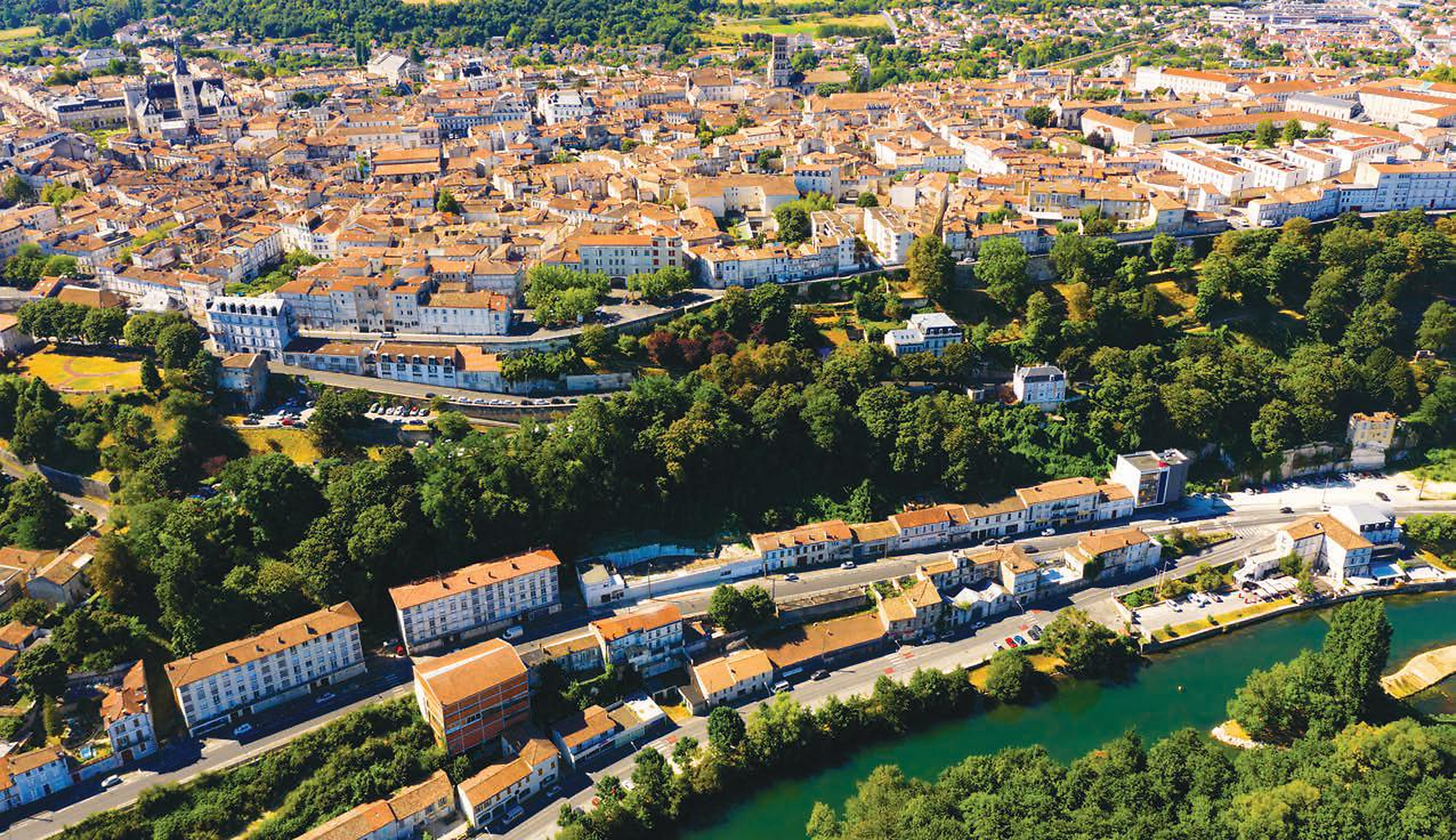
The city is France’s comic art capital, hosting an international festival each January. All year round, Angoulême celebrates banes dessinées through eye-catching street murals, speech-bubble signs and large trompe-l’oeil artworks. Beyond its artistic charm, Angoulême comes alive each September with the Circuit des Remparts, a thrilling classic car race that draws crowds from near and far, adding to the city’s lively calendar of events.
The centre-ville district, made up mostly of apartments, puts residents within walking distance of cafés, shops, nightlife and cultural attractions. For those seeking a practical, lively spot for commuting, La Gare is a great option, offering homes and apartments near the river and train station. Families are often drawn to the St-Cybard and St-Martial neighbourhoods, where quiet streets, green spaces and local schools support relaxed suburban living just a short distance from the city centre and its amenities.
The average square metre house price in Angoulême is €1,614, rising to €1,885 in the popular centre. This compares to €1,289 across the Charente department as a whole, and €1,750 in the wider Nouvelle-Aquitaine region.
Since January 1st, 2026, applicants for French citizenship and multi-year carte de séjour (residency cards) are required to take a new Examen Civique (Civics Test) to test their knowledge of French life, values, history, and politics. Let’s break down exactly what this entails, how much it costs, and who needs to take it.
What is the French Civics Exam or Examen Civique?
The new Civics Test, or Examen Civique, is part of a series of changes that were announced in 2025, designed to toughen up requirements for French residency and citizenship. It came into practice on January 1st, 2026, along with the new French language requirements.
The test is a written, multiple-choice exam with 40 questions covering various aspects of French life, culture, history, geography, and politics. It’s taken in French and is adapted to the language level required by the applicants – for example, an A2 level for a carte de séjour pluriannuelle applicant or B2 for a French citizenship applicant.
Read more about the New Language Requirements for Residency & Citizenship.
The exam is now mandatory for all applicants (aside from a few exemptions – see below), and a pass certificate must be presented as part of your dossier (application). To pass the test, you must receive a score of 80%, which means you’ll need to answer at least 32 out of 40 questions correctly.
Read the official government text on the French civics test here.
Who needs to take the French Civics Test?
The Civics Test is a requirement for several types of carte de séjour pluriannuelle (multi-year residency cards), the carte de résident (the renewable 10-year residency card), and French citizenship via naturalisation (both by declaration and decree). It is only required for first-time applications and therefore shouldn’t need to be retaken when it comes to renewing your card.
Who doesn’t need to take the French Civics Test?
There are a few exemptions, including:
- Applicants over 65 (for residency cards only)
- People with a disability or medical condition that prevents them from taking the test (a doctor’s statement will be required as proof)
- EU/EEA and Swiss citizens
- Certain types of cards (such as temporary worker cards)
- British residents protected by the Withdrawal Agreement, which includes anyone renewing a post-Brexit Withdrawal Agreement Residency Card
Anyone who already holds a card that is up for renewal won’t need to sit the test. However, if you apply for a different type of card – for example, you have a carte de séjour pluriannuelle and want to apply for a carte de résident – then you will need to pass the test.
For citizenship applications, there are no exemptions for age or status, although you may be exempt if you have a disability or medical condition that prevents you from taking the test. French citizenship applications made prior to December 31st, 2025, also won’t be required to sit the Civics Test.
If you’re applying for a French visa or a 1-year carte de séjour (either for the first time or for a 1-year renewal), then this doesn’t apply to you. However, you will be required to sit the exam if you apply for a carte de séjour pluriannuelle in the future.
How do I take the French Civics Test?
The Civics Test must be taken at an official test centre, located all around the country. Test centres are approved by either La Chambre de commerce et d’industrie de Paris (CCIP) (find your closest test centre here) or France Éducation International (FEI) (find your closest test centre here or sign up for the exam here).
You will need to register online, pay the exam fee, and book an appointment to take the test in person at your chosen test centre. The tests often book up quickly, so it’s wise to schedule your exam at least 4 to 6 weeks before your application deadline.
You will take the multiple-choice test on a provided computer or tablet, during which time you won’t be allowed access to your phone, written materials, or other electronic devices.You’ll have 45 minutes to answer all 40 questions. Make sure to account for additional time on the day, as most test centres will require you to arrive at least 15 minutes prior to the time of your exam.
You’ll find out straight away whether you passed or failed, and if you’re successful, your attestation (certificate) will usually be available within 12–48 hours.
How much does the Civics Test cost?
Fees may vary depending on the test centre, but taking the test typically costs €69. If you need to retake the test, this fee applies each time. The fees are usually paid to the test centre in advance.
How hard is the Civics Test?
While everyone’s experience of taking the Civics Test will be different, recent applicants mostly report passing on the first time, provided that they’ve taken the time to study (see the section below on preparing for the Civics Test). Preparation is key: the majority of the test focuses on factual knowledge that you are unlikely to know without thoroughly reading, memorizing, and practicing the study materials. In addition to that, the exam is conducted in written French and uses specific vocabulary that you may not have come across before if you haven’t previously studied French history, politics, or law.
The test itself comprises 40 questions: 28 of these test your factual knowledge on subjects including history, geography, and politics, and the remaining 12 questions are real-life scenarios in which you need to choose the “correct” action or reaction in accordance with French values. All questions are multiple choice, with 3 or 4 answers to choose from.
We recommend beginning to prepare for the exam 4 to 6 weeks in advance to give yourself plenty of time to study. Even if you’re a fast learner, we recommend going over the study materials a minimum of two weeks prior to the exam to ensure you have enough time to read everything and practice. In other words: don’t leave it until the last minute!
What happens if I fail the French Civics Test?
Hopefully you are successful on your first attempt, but there’s no need to worry if you fail the exam on the first go. Failed attempts aren’t recorded on your file and there’s no limit to the amount of times you can take the test. There’s also no waiting period before retaking it, so you can rebook immediately and give it another shot as soon as there’s a space. The only downside is that you will have to pay the exam fee again.
One exception to this rule in the rare instance that someone is caught cheating or impersonating someone else – attempted fraud results in a 2-year ban on retaking the exam, which could have serious implications if your residency card is up for renewal.
Preparing for the French Civics Test
Preparing for any exam can feel daunting, but the good news is that the French government has free study materials available to help you prepare. (You’ll also find plenty of paid sites online to help you study if you need more help, but note that you do not need to pay to access the official study materials!)
Most useful are the official lists of questions provided – these are the actual questions you will be asked during the “factual knowledge” portion of the exam, with questions selected at random from the list. Naturally, the answers aren’t provided, but if you are confident in answering all of these questions, you’ll be in good shape for the exam.
- Here are the official questions for the Civic Test – carte de séjour pluriannuelle (CSP)
- Here are the official questions for the Civic Test – carte de resident (CR)
- Here are the official questions for the Civic Test – Nationalité française
Other useful study materials include:
- The Livre du Citoyen – this Citizen’s Book is the official text provided for French Citizenship candidates and details the values of the French Republic, the basics of French politics and French institutions, key historic events and geographical facts, French cultural icons, and more. In other words, all the topics that your French Civics Test is likely to cover.
- The Charte des droits et devoirs du citoyen français (the charter of rules and responsibilities of French citizens) is another key text, especially for citizenship applicants.
- A free online quiz to help you prepare for the Civics Test.
FAQS: Quick answers to your questions
Which French Civics test do I need to take/what is the CSP and CR?
There are three different versions of the Civic Test available, which correspond to the type of status that you are applying for and, most importantly, the required French language level. You will either take the Civic Test for the carte de séjour pluriannuelle (CSP), which is at A2 level French, the carte de résident (CR), which is at B1 level French, or nationalité française (French Citizenship), which is at B2 level French. Make sure that you choose your study materials and practice papers accordingly.
How long is the Civics Test valid for?
Unlike French language tests, the civics test has no expiration date, so you can take it as far in advance of your application as you like. If you’re applying for French citizenship, this also means you can reuse it for subsequent applications if your initial application is adjourned.
However, you will need to pass a separate test when moving from one status to another to correspond with the higher required language level. For example, an A2-level civics test will not be valid for a French Citizenship application, so you’ll need to sit the B2-level test.
Does the Civics Test replace the naturalisation interview?
No, unfortunately, the civics test is in addition to the naturalisation interview. Candidates for French citizenship must first pass the civics test as part of the initial application process; later, if their dossier is approved, they will be invited for a separate entretien d’assimilation – an interview at the prefecture. During this interview, you’ll be asked about your personal situation, integration into France, and motivations for becoming French, as well as additional questions on French history, politics, geography, and culture. The good news is that these questions are based on the same material you will have studied for the Civics Test, so you should have a head start!
Have a question that we haven’t answered? Leave a comment below!
Next steps: applying for French citizenship or residency
The Civics Test is just one part of the application process for a carte de séjour pluriannuelle, a carte de résident, or French citizenship. You’ll also need to pass a language test, submit the required personal documents (often with certified translations), and pay the required fees (which have increased as of May, 2026).
Read our series of articles on applying for French Citizenship.
Find out how much the residency card and citizenship application fees are in 2026.
Bastille Day is approaching, with the national public holiday falling on Tuesday the 14th of July and Paris fireworks taking place a day earlier than usual this year. Summer school holidays have also begun, bringing heavier road traffic and warnings over EES border delays for non-EU travellers, while residents and second-home owners should keep an eye on water restrictions, wildfire alerts and heat-related disruption. Here are the France headlines you need to know this week.
Bastille Day falls on Tuesday the 14th of July
France’s next national public holiday is Fête nationale, or Bastille Day, on Tuesday the 14th of July. Banks, schools, many offices and some businesses will be closed, although arrangements can vary by sector and location. In Paris, the traditional Eiffel Tower fireworks will take place on Monday the 13th of July 2026, rather than the 14th. Visitors should expect large crowds, security measures, traffic restrictions and public transport changes around central Paris and the Champ-de-Mars area.
Summer holidays begin, with busy roads expected
School summer holidays began across mainland France on Saturday the 4th of July, marking the start of the main summer getaway period. The first weekend already brought difficult traffic conditions on several major routes, and drivers should expect further busy weekends throughout July and August. Holidaymakers driving to or through France are advised to leave early, avoid peak Saturday travel and check live traffic updates, which can make a significant difference.
Heat, water restrictions and wildfire alerts continue
Hot, dry weather continues to affect parts of France, increasing pressure on water supplies and raising the risk of wildfires. Water restrictions or drought warnings are now affecting many departments, with some communes at crise level, where all but essential water use is banned.
Wildfire risk also remains high in parts of the south, with major fires reported in several departments and restrictions affecting some outdoor activities and events. Anyone staying near woodland, scrubland, campsites or rural holiday homes should follow local prefecture advice and avoid barbecues, campfires, fireworks, discarded cigarettes or any work likely to create sparks.
EES border delays remain a concern for summer travellers
Travellers from outside the EU, including British and American visitors, should continue to allow extra time at borders because of the EU’s Entry/Exit System. Airlines and airport groups have warned that the biometric checks are causing queues at some European airports and ports during the peak summer travel period. The system records non-EU arrivals and departures from the Schengen Area and is used to monitor the 90-day rule. Travellers should make sure passports are valid, have the correct visa or residency documents where needed, and leave extra time for first-time biometric registration.
Paris Plages and Seine swimming areas reopen
Paris Plages and several supervised natural swimming areas have reopened for the summer, offering free urban beaches and open-air swimming spots in the capital. The sites are expected to run until the end of August, subject to water quality and weather conditions. Several of the swimming areas are on or near the Seine, following the major clean-up efforts linked to the Paris Olympics. Lifeguards and daily water checks are in place, but temporary closures may happen after storms or poor water-quality readings.
Income tax notices and refunds due later this month
Taxpayers in France should start receiving income tax notices later in July, with online filers expected to receive notices between the 24th and the 31st of July. Those who overpaid tax in 2025 may receive a refund during the same period. If there is still tax to pay, no immediate action is needed if bank details are up to date. Amounts of €300 or less are due to be taken in one payment on the 25th of September, while higher balances are due to be collected in four instalments from September to December.
Taxpayers who spot an error in their 2026 declaration will be able to use the online correction service from the beginning of August until the end of November.
Complementary health cover simplified for some residents
France’s Complémentaire santé solidaire, or C2S, is now being offered automatically to some additional low-income benefit recipients. The C2S helps reduce healthcare costs for people on low incomes by covering the complementary part of medical expenses not reimbursed by Assurance Maladie. Since the 1st of July, paid C2S can be proposed automatically, under conditions, to certain recipients of the allocation de solidarité spécifique and the allocation du contrat d’engagement jeune. Free C2S is already attributed automatically to RSA recipients unless they object.
Want more help with your France property journey? Join Membership, search our Property Portal, subscribe to French Property News, and follow our YouTube channel for the latest advice and updates. Join us at the French Property Exhibition for expert advice and property inspiration.
Here’s the latest currency news from our partner Moneycorp, to help you find out what your money is worth.
UK Politics remains the primary market driver
Markets continue to focus on the seemingly inevitable arrival of Andy Burnham in a couple of weeks’ time. As Burnham only recently returned to Parliament and, as a result, has not been involved in a recent general election campaign or published a manifesto, there is currently limited information available to provide a clearer understanding of his plans as incoming Prime Minister. This remains especially true given that he has delivered only one public speech and one radio interview since launching his leadership bid.
As such, the pound could remain volatile depending on how key policy issues appear likely to be addressed, such as defence spending plans.
Despite this uncertainty, the pound has remained strong against many counterparts. The fact that the BoE is still weighing up one 25bp interest rate hike later this year will likely have played a role in keeping sterling buoyant.
US focus shifts to the Fed as key data remains limited
The US celebrated its 250th anniversary over the weekend, with President Trump speaking in Washington.
The week ahead is quieter from a data perspective but still includes several releases of note. Later on Monday afternoon, Services PMI is expected to remain around 54, marking another positive month for activity in the services sector, with 50 representing the breakeven level.
Attention then turns to the FOMC meeting on Wednesday, where policymakers will discuss topics including the interest rate outlook and economic projections. Some within Federal Reserve Chair Warsh’s circle believe that one to two rate hikes remain possible this year. Any indication of a shift in that outlook would naturally influence the US dollar.
Eurozone inflation stability reduces pressure on the ECB
Eurozone retail sales figures were released this morning at 1.6%, in line with expectations, followed later this evening by comments from ECB President Lagarde.
Last week, the euro fell to a 12-month low against the pound as expectations of further ECB rate hikes later this year declined. Much of this reflects inflation across the Eurozone remaining close to the ECB’s 2% target, reducing the case for further policy tightening.
Germany, for instance, is expected to report unchanged CPI of 2.4% on Friday. Inflation would likely need to move higher for this outlook to be reconsidered, although that appears unlikely unless the conflict involving Iran were to reignite.
Why Moneycorp?
With a Platinum Trusted Service Award 2020 from independent review site Feefo and 40 years of experience in the industry, FrenchEntrée has been recommending Moneycorp for more than 15 years. During this time they have helped thousands of client planning the best way to pay for their property as well as supporting them afterwards with any further payment from paying bills, mortgages to repatriating UK pension payments for those who have retired to France.
Furthermore, we have worked with the same person at Moneycorp for more than a decade! You might be familiar with her as she often writes for our French Property News magazine. She has 13 years’ experience in foreign exchange, and is a qualified European lawyer with experience in European transactions. Mar will be happy to answer any questions or enquiries to support you through these difficult times
Opening an account is really easy and free of cost. You can register online or over the phone in a couple of minutes and for FrenchEntrée readers there are no transfer fees in any payment.
Adding a swimming pool to your French property is one of the most rewarding investments you can make. The warm summers, the lifestyle, the sheer pleasure of having your own slice of the Mediterranean in the garden, it all makes perfect sense. And the good news is that navigating the planning system is far more straightforward than many people fear, as long as you understand how it works from the start.
Above Ground or In Ground: The Size Rules Apply to Both
A common misconception is that above-ground pools sit completely outside the planning system. In fact, the same size thresholds apply to both above-ground and in-ground installations, with one important distinction – permanence.
If any pool, above ground or in ground, is installed for less than three months of the year and is genuinely temporary in nature, no planning permission is needed. If it will be in place for more than 3 months (whether it’s in use or not) it becomes considered as a permanent fixture. All other rules kick in regardless of whether it sits on top of the ground or below it.
For permanent pools under 10m² in surface area, no permission is required unless the property is within a protected zone. Between 10m² and 100m², a Déclaration Préalable de Travaux submitted to your local mairie is all that is needed. This is a straightforward form and most mairies process applications within one to two months. Pools exceeding 100m² require a full Permis de Construire, though at that scale you will almost certainly be working with a professional who will manage the submission as a matter of course.
Pump Rooms and Technical Spaces
A pool is nothing without its filtration and pump system, and France has sensibly integrated these into the overall planning framework. A dedicated pump room or technical shelter counts toward the total footprint of the project. Keeping it compact and well-designed not only satisfies planning requirements but also makes your pool area look far better. Many homeowners find that a neat, purpose-built pump enclosure adds real value to the finished installation.
Pool Terraces
Terracing around a pool is where a project really comes to life, and the planning rules here are practical. Smaller terracing elements that form part of the original pool declaration can often be included within the same submission. Larger terracing may need to be itemised separately, but submitting everything together as a coherent project is the standard approach, and most pool builders and architects are well practised at doing exactly that.
Working Near Listed Buildings: The ABF
If your property falls within 500 metres of a listed monument or protected site, the Architectes des Bâtiments de France will be consulted as part of your planning process. This sounds daunting, but in practice it simply means your project is reviewed with an eye toward visual harmony with the surrounding heritage. A well-designed pool with appropriate materials and sympathetic landscaping will almost always receive a positive response. The ABF are there to guide rather than obstruct, and engaging with them early in the process generally produces the best outcomes.
Flood Risk and Natural Hazard Zones
Many beautiful parts of France, including river valleys and low-lying rural areas, fall within zones covered by a Plan de Prévention des Risques. If your land is in one of these zones, your planning submission will need to demonstrate that the pool and its associated works do not increase flood risk. This typically involves showing how excavated material will be managed and confirming that water displaced during a flood event is properly accounted for. Pool builders with local experience handle this routinely, and approval in these zones is entirely achievable with the right approach.
Drainage and Water Management
France requires that pool backwash water and drainage are handled responsibly. In most cases this means connecting to an appropriate drainage system or soakaway, and ensuring that chlorinated water does not flow directly into natural watercourses. Your pool installer will design the drainage as part of the overall project, and including it clearly in your planning submission shows the mairie that the project has been properly thought through.
Pool Safety Regulations
France introduced mandatory pool safety legislation back in 2003, and it applies to all in-ground pools at residential properties. The law requires that every in-ground pool must be fitted with at least one of four approved safety systems: a perimeter alarm that detects when someone enters the pool area, a submerged alarm that triggers when something enters the water, a safety cover rated to support weight and resist submersion, or a rigid removable barrier around the pool.
These are not simply box-ticking exercises. Each approved system has to meet specific French standards and be certified accordingly, so it is worth checking that any equipment you buy carries the right certification before you commit to a purchase.
Above-ground pools with walls high enough to prevent unsupervised access by young children sit outside this particular requirement, but for the vast majority of residential installations the safety obligation is real and should be factored into the overall budget from day one. The good news is that quality safety systems are widely available, relatively affordable, and increasingly well-designed, with pool fencing in particular having improved enormously in recent years to the point where it genuinely enhances the look of a finished pool area rather than detracting from it.
With good preparation and the right professionals alongside you, getting permission for a pool in France is a genuinely positive process. The paperwork exists to make sure installations are safe and well considered, and the vast majority of applications are approved without difficulty. A little planning at the start means you can spend the summer doing what you actually came to France for, floating in your own pool with a cold drink in hand.
Want more help with your France property journey? Join Membership, search our Property Portal, subscribe to French Property News, and follow our YouTube channel for the latest advice and updates. Join us at the French Property Exhibition for expert advice and property inspiration.
A romantic waterside property in a tranquil spot is the dream for many househunters – Carolyn Reynier finds the best places to buy around three of France’s most beautiful lakes
For those who like small beaches and nautical activities galore, we’re looking at property in the picturesque villages and hamlets around three beautiful French lakes.
Firstly, the 1,300ha Lac de Pareloup on the Lévézou plateau in Aveyron (Occitanie) is the fifth largest artificial lake in France. The hills and lakes of the Lévézou – which are situated between the prefecture Rodez and subprefecture Millau – lie close to the Parc naturel régional des Grands Causses.
Next, in the verdant Pays Voironnais in Isère (Auvergne-Rhône-Alpes), the natural crystalline Lac de Paladru is surrounded by hills. Nearby medieval Voiron is one of three gateways into the 86,000ha Parc naturel régional de Chartreuse and several Alpine ski resorts.
Finally, the 35km-long emerald green Vouglans, France’s third largest artificial lake, is in the Pays des Lacs et Petite Montagne in Jura, Bourgogne-Franche-Comté.
LAC DE PARELOUP
I talk first to Marie Fabre at MCF Immobilier Conseils at Pont-de-Salars just north of Pareloup in Aveyron. The village straddles the small lakes of Bage and Pont-de-Salars, has shops, services and schools, and is a popular destination, with demand outstripping supply, she says. Old stone terraced village houses may have up to four bedrooms and a rear garden. Roofing is lauze (large heavy flat tiles) or slate to protect houses from inclement weather, notably snow. You’ll pay around €150,000 and can still find properties for renovation. Stone farmsteads and barns in and around the village have been, or can be, converted into dwellings. A barn for conversion may cost about €60,000-€70,000; a renovated one will sell for €160,000-€180,000. These Aveyron lakes are popular with tourists, so conversion to gîtes or other tourist accommodation is worth consideration. Heading south towards Pareloup, smaller Prades-Salars offers similar property but has no shops. Houses are larger so prices are generally on a par with Pont-de-Salars. Canet-de-Salars, three kilometres from the lake, doesn’t have any shops either. Salles-Curan at the southern end of Pareloup has two distinct sectors: on the lake, where houses sell for “exorbitant prices” says Marie, and in the village centre, which has similar prices to Canet and Pont-de-Salars but there are shops and services. On the lake, there are both old and more recent properties. No new construction is possible thanks to the Loi Littoral, which protects not only coastal areas but also large lakes. Lakeside properties – the expression you’ll hear is pieds dans l’eau – sell for €300,000-€700,000 and come with pontoons, which buyers use to moor their jet skis and boats, says Marie.
On the opposite bank have a look too, at Arvieu and its beach at Notre Dame d’Aurès. “All the activities you can do outdoors in nature you can do in the Pont-de-Salars sector,” she says.
“Aveyron lakes are popular with tourists, so conversion to gîtes is worth consideration”
LAC DE PALADRU
The Lac de Paladru, a private lake in Isère, is surrounded by five communes, says Virginie Dombes of Comptoir Immobiler de France. On the western side, Paladru and Le Pin now form Les Villages du Lac de Paladru, Montferrat lies to the northeast, next is Bilieu, with Charavines at the southern tip. The lake lies between the Lyon-Grenoble A48 and Lyon-Chambéry A43 motorways. “We’re really at the crossroads, easily accessible, yet we have the countryside and a certain much calmer way of life,” she adds.
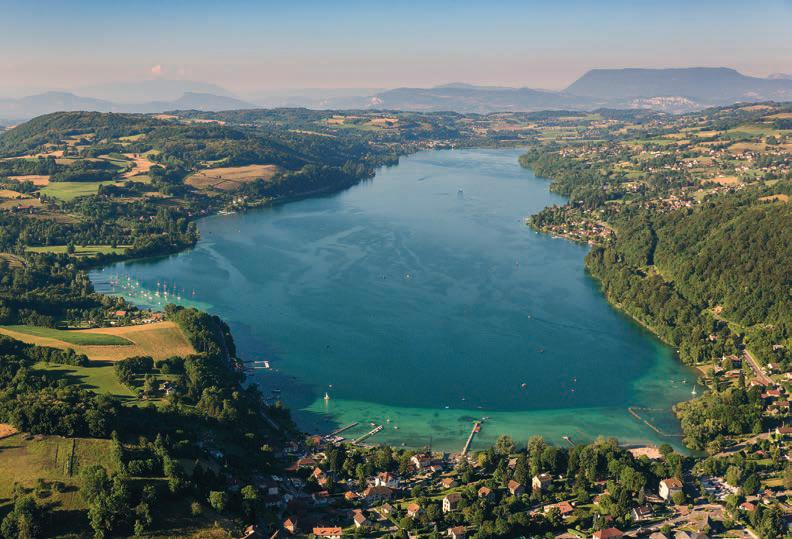
An aerial view of the Lac de Paladru, Isère
There’s a mix of larger family homes and second homes. Properties with lake views come at a price and rare pieds dans l’eau properties with a private beach come at an even higher one. Old properties are built in stone or with pisé (rammed earth), typical of the region. “Today, no building is permitted within 300m of the lake,” Virginie tells me. Prices for a small two-bedroom lakeside chalet may start at €180,000, rising to €1m and over for a substantial 200m2-300m2 family home with pontoon and lake access.
Those houses without lake views are still close to the water. Prices start at €120,000-€150,000 for a small house that requires work, rising to €600,000-€700,000 depending on the property type. “On average you can have something sympa to renovate or freshen up for €250,000 to €500,000,” says Virginie.
The layout of the communes is similar; they all have a few local shops (commerces de proximité), while Charavines and Montferrat also have pharmacies. Bilieu is a popular commune thanks to its sunny exposition and close proximity to motorway junctions.
Charavines is larger, more developed, and has a sunny public beach. It’s busy during the summer, so if you’re looking for peace and quiet, head for the other communes.
You can drive the 14km around the lake, and cycle or walk around three-quarters of it on a dedicated path. You still find properties for renovation or that just require a lick of paint to freshen them up. Virginie says demand for seasonal letting accommodation is on the increase, but although some properties are closed up during much of the year, around 70% of residents live here year round. “It’s not at all deserted the rest of the time.”
There are a few apartments (€80,000-€180,000); some residences have been built a stone’s throw from the lake and some apartments have a glimpse of the water (€230,000 for two bedrooms). Voiron has a “very pretty town centre and is relatively dynamic”. You’ll pay €30,000-€80,000 more for a town-centre apartment.
In the Chartreuse boutique, you can learn how the Carthusian monks make their famous yellow and green liqueurs from a secret recipe. As a teenager, I holidayed in Chambéry with the Sevez family, suppliers of my wine-shipping father’s Chambéry Gaudin vermouth. I have fond memories of skiing at St-Pierre-de-Chartreuse, close to the Grande Chartreuse monastery.
Virginie says the climate is good, not too hot, not too cold. “In 45 minutes, we’re in a ski resort, in two and a half hours we’re at the sea. And we’re close to the Italian border, too.”
LAC DE VOUGLANS
Finally, Lac de Vouglans in Jura is near the Swiss border. We’re looking at property around the northern end – ancient baronies and ruined strongholds testifying to turbulent times. I’ll leave you to discover the southern end for yourselves: it’s a long lake…
Electric mountain biking at Clairvaux-les-Lacs, Jura
On the western side, the original château at Orgelet was built in the 12th century. Major development took place more recently in the 1960s with the creation of an industrial zone and housing estates, says Thomas Lugand of IAD. The old two-storey houses were built in cut stone from local quarries, most of which no longer exist, so stone often came from dismantled châteaux. You’ll pay €200,000-€250,000 for one not needing work, and about €150,000 for one that does.
The sloping topography means that houses above the main road have a garage or similar on the ground floor, with the living area and access to the garden above; houses below the main road are set up inversely. “They were constructed in the old ramparts so made do with things as they were,”
Thomas says. You’ll find farmsteads and barns, renovated or ready for conversion, in the surrounding countryside where Simmental and Montbéliarde cows graze to produce Comté, one of my favourite cheeses – in fact, I’m nibbling a 30-month-aged Comté de Noël while writing these words. The last barn Thomas sold (for €35,000) was at Onoz south of Orgelet.
Heading north, La Tour-du-Meix is divided into two sectors. In the older upper St-Christophe quarter, near the château ruins, houses close to the Port du Meix (one of three ports on Vouglans) can have lake views and price tags of €400,000-€500,000. The village centre is located inthe lower quarter.
Largillay-Marsonnay has not profited from the expansion of tourism because it’s a little set back from the lake, although there is actually access to a beach. “Not a lot of people know that,” says Thomas. Prices are lower and yes, there is a ruined château. Pont-de-Poitte on the lake developed thanks to its proximity to Clairvaux and its Port de la Saisse, mainly used by fishermen.
Clairvaux-les-Lacs has two lakes – the Grand Lac and, well, the Petit Lac. The big one is the commune’s main tourist attraction; the small one is much less well-known to visitors. In the village centre there are stone houses on the former château ramparts. As a child, Thomas says, he visited the tunnels linking the houses so that during the medieval wars, residents could circulate underground to reach the ramparts to fight.
Prices are on a par with Orgelet. You’ll find more recent housing dating from the 1940s in Hautecour, an extension of Clairvaux. It’s often the modern properties that have lake views – and price tags of €400,000- €500,000 and higher. If Thomas had to classify the communes by house prices, he’d put Clairvaux first by far, then La Tour-du-Meix, Orgelet third and last Pont-de-Poitte.
This corner of Jura remains authentic, it’s not overdeveloped, explains Thomas. Yes, there are lots of folk during summer, but at Clairvaux you only have to go 500m and you’re surrounded by forest. “You can be in completely isolated sectors, where you meet few people, where telephones don’t necessarily work,” he says. “If you want to cut yourself off from the world, you can still manage to do that.” So if you do, you know where to go.
terredemeraudetourisme.com/lacs-jura/lac-de-vouglans
3 REASONS TO BUY HERE
These lovely lakes in Aveyron, Isère and Jura offer year-round or holiday living with good tourist accommodation potential
Waterfront homes, old stone village houses and modern properties, barns and farmsteads renovated or for conversion
Easy access to airports: Montpellier/Rodez for Aveyron; Grenoble/ Chambéry/Lyon for Isère; Lyon or Geneva for Jura
The unique mix of legal, financial and tax advice along with in-depth location guides, inspiring real life stories, the best properties on the market, entertaining regular pages and the latest property news and market reports makes French Property News magazine a must-buy publication for anyone serious about buying and owning a property in France.
France’s record-breaking June heatwave has brought water restrictions, wildfire warnings, storms and travel disruption, while the summer sales are set to be extended after high temperatures kept shoppers away. Property owners are also being reminded that today is the deadline to update their biens immobiliers declaration, and buyers can note new mortgage rate caps, flood-risk checks and a new coastal erosion tool. There are also updates on second-home tax audits, MaPrimeRénov’, inheritance rules and online shopping parcels. Here are the France headlines you need to know this week.
Record June heatwave brings water restrictions, storms and wildfire warnings
France has been dealing with one of its most intense June heatwaves on record, with temperatures exceeding 40C in several areas and widespread disruption to schools, transport, tourist sites and power production. The heat has now eased across much of the country, although the south-east has remained under close watch and temperatures are still above seasonal norms in many areas.
Water restrictions and vigilance warnings have also expanded sharply, with tap water restrictions or usage warnings in place across 79 departments Eleven departments now have at least one commune at crise level, where all but essential water use is banned. Residents and second-home owners should check the VigiEau website using their address, as rules vary by commune and sometimes by water source.
The hot, dry conditions have increased wildfire risk across parts of southern France, while the break in the heatwave brought violent storms to parts of the south-west, with hail, lightning, localised flooding and strong winds. Residents and visitors should continue to check local weather alerts, avoid activities that could spark fires, and contact insurers promptly if storm damage is discovered.
Summer sales extended after heatwave
France’s summer sales began on the 24th of June and were originally due to run until the 21st of July in most metropolitan departments. However, the government has announced that the sales period will be extended by one week, until the 28th of July, after the heatwave kept many shoppers away from stores.
Remote working on a visitor visa clarified, but questions remain
Remote workers hoping to live in France should note that France has not created a new digital nomad visa, despite recent discussion online. A response from the Ministry of the Interior to a parliamentary question has clarified that a third-country national who is not employed in France, and who is not working for a company based in France, may be considered “non-active” under French immigration rules if they are teleworking for a foreign employer.
However, the clarification does not remove all uncertainty. The visitor visa is still officially intended for people staying in France without carrying out a professional activity, and the response also refers to income being paid and taxed in the country of origin. This may be complicated for people living in France long term, as tax residence rules can still bring worldwide income within the French tax system. Anyone planning to work remotely from France should take advice before assuming that a visitor visa is suitable.
Property declaration deadline today
Property owners in France are reminded that today, the 30th of June, is the deadline to update their biens immobiliers declaration if there has been a change in the use or occupancy of their property.
This can include a main home becoming a second home, a property becoming vacant, a new tenant moving in, or certain changes to the property itself. If nothing has changed since the last declaration, owners generally do not need to do anything. A fine of €150 per property can apply.
French tax authorities given more time to correct second-home tax bills
French tax authorities now have more time to correct taxe d’habitation bills where a property’s status has been wrongly declared. The change relates in particular to second homes and vacant properties, where incorrect information can affect whether tax is due.
Previously, authorities had a shorter period to issue corrected bills where tax had been missed because of an error or omission. Under the new anti-fraud rules, this timeframe has been extended by two years. Property owners should check the biens immobiliers section of their French tax account to make sure their property status is accurate.
New mortgage rate caps from the 1st of July
Buyers taking out a French mortgage should note the new taux d’usure thresholds that apply from the 1st of July. The taux d’usure is the maximum all-in annual percentage rate that banks are allowed to charge, including interest, compulsory insurance and certain fees.
From July, the cap is 4.07% for fixed-rate mortgages under 10 years, 4.57% for fixed-rate loans of 10 to less than 20 years, and 5.29% for fixed-rate loans of 20 years or more. Variable-rate loans are capped at 5.28%, while bridging loans are capped at 6.39%. These thresholds are updated quarterly and can affect whether a mortgage application is accepted.
New coastal erosion tool for property owners and buyers
A new online tool has been launched to help people understand how climate change could affect France’s coastline. The application, Le littoral de ma commune, allows users to search for coastal communes and view information on shoreline retreat, land use, housing, protected areas and projected sea-level rise.
Service Public says nearly 20% of the French coastline is affected by coastal erosion, and around 5,200 homes could be affected by shoreline retreat by 2050. The tool is especially relevant for buyers looking at coastal property, as well as owners of homes near beaches, dunes or cliffs.
Buyers urged to check flood-risk zones before purchasing
Prospective buyers in France are being reminded to check flood risk carefully before making an offer, especially as extreme weather events become more frequent. Around 18 million people in France live in areas exposed to flood risk, while millions of homes are located in river or coastal flood zones.
One key document to check is the plan de prévention des risques d’inondation, or PPRI, which maps flood-risk areas and can impose restrictions on building, renovating or extending a property. Buyers can ask the local mairie for information or check the official GéoRisques website before reaching the notaire stage.
MaPrimeRénov’ funding set to focus on larger renovation projects
The list of single-project renovations eligible for MaPrimeRénov’ funding is set to be reduced, as the government looks to focus public funds on more comprehensive energy-renovation projects.
Several mono-geste works, such as attic insulation, window replacement, ventilation systems, solar water heaters and some wood or pellet stoves, are expected to lose eligibility when carried out alone. They may still be funded as part of a wider renovation project. Homeowners planning works should check current rules carefully before signing quotes or assuming grant support will be available.
Relief for Brits with English-law wills
British residents and second-home owners in France have welcomed clarification that wills choosing the law of England and Wales should not be affected by France’s 2021 forced-heirship provision.
The clarification follows a letter from France’s justice ministry to the European Commission, indicating that French notaires do not need to apply the compensatory levy mechanism where a will is governed by English law, because France considers English law to provide protection for children. The position may differ for some US-law wills, so owners with French assets should still review their estate planning with a specialist adviser.
France suspends €2 charge on low-value non-EU parcels
France is suspending its €2 charge on low-value parcels from outside the EU from the 1st of July, ahead of the rollout of a broader EU-level customs charge. The measure affects small e-commerce parcels, including those from non-EU online platforms.
The issue is particularly relevant for residents ordering goods from the UK, US or Asian online retailers. Further EU-level changes are expected later this year, meaning costs and customs handling for small parcels may continue to evolve.
Ultra-fast fashion law passed
French parliament has passed a law aimed at curbing ultra-fast fashion platforms such as Shein, Temu and AliExpress. The law targets companies with very high volumes of low-cost clothing and is designed to reduce waste, overconsumption and environmental damage.
The measures include penalties linked to products placed on the market and restrictions on advertising, including influencer promotions. The practical effect for shoppers will depend on how the rules are implemented, but the law forms part of a wider push to regulate low-cost online retail platforms in France and the EU.
New digital skills passport launched
A new Passeport de compétences has been launched to help people in France track and showcase their qualifications, training, experience and skills. The free digital tool is integrated with Mon Compte Formation and is available from the age of 15. It can bring together diplomas, certifications, work experience, publicly funded training and certain voluntary or civic activities. The aim is to help users create structured CVs, identify skills and support job-search or retraining plans.
Summer holiday traffic begins this weekend
The first major summer getaway weekend is approaching as French school holidays begin at the end of this week. Bison Futé expects traffic to build from Friday the 3rd of July and Saturday the 4th of July, especially on routes leaving major cities for holiday destinations.
Later weekends in July and August are expected to be even busier, with several red and black travel days forecast. Drivers heading to or through France should check the Bison Futé calendar, avoid peak departure times where possible and allow extra time for motorway journeys.
Want more help with your France property journey? Join Membership, search our Property Portal, subscribe to French Property News, and follow our YouTube channel for the latest advice and updates. Join us at the French Property Exhibition for expert advice and property inspiration.
Here’s the latest currency news from our partner Moneycorp, to help you find out what your money is worth.
US-Iran tensions escalate following Strait of Hormuz incidents
A further incident in which a vessel came under fire from Iranian forces has prompted an additional US military response. The US has carried out further strikes on Iranian military assets, weapons manufacturers and targeting systems, following a second vessel being hit by projectiles.
The Iranian authorities have stated that the initial attack was unauthorised, which, if accurate, would suggest limited operational control.
The USD has strengthened, although broader market reaction has remained
Burnham’s devolution proposals offer limited help UK growth
Andy Burnham remains favourite to succeed Keir Starmer, and both markets and media are assessing his potential policy agenda. At this stage, it remains unclear that these proposals would provide the conditions required for stronger near-term growth.
Over the weekend, Mr Burnham outlined plans centred on increased devolution and the creation of a “Number 10 of the North”. The proposals appear to imply additional administrative layers and spending rather than consolidation. In summary, they include granting greater tax and spending powers to regional mayoral authorities, relocating civil service roles, and offering targeted incentives for youth employment schemes.
How such measures would address elevated government expenditure and higher employment costs, following HM Treasury tax changes, remains unclear. Moreover, the proposals appear unlikely to materially influence consumer spending or business investment in the near term. Markets are therefore unlikely to place significant weight on these announcements for now, instead focusing on Mr Burnham’s forthcoming speech on the economy. Beyond this, the UK data calendar remains relatively light this week.
ECB divergence on inflation risks further EUR weakness
Concerns surrounding the ECB’s policy stance remain central to the outlook for the euro. This week’s provisional June CPI release is expected to show declines in both headline and core inflation; however, risks remain skewed towards a potential upside surprise in core.
Within the Governing Council, views remain clearly divided. Some policymakers are cautious about further rate increases given subdued economic performance, while others remain concerned about the risk of inflation expectations becoming embedded.
This divergence risks leaving policy unchanged while limiting the ECB’s ability to communicate a clear and consistent stance to markets. Such an outcome could undermine confidence and weigh further on the EUR, particularly against a firmer USD. That said, it remains unclear whether the US administration would tolerate sustained USD appreciation in the near term.
US payrolls in focus this week
The primary data release this week is the June US non-farm payrolls report (Thursday). Over the past three months, payroll growth has averaged 188k, a marked improvement from the preceding three months, which averaged -4k. These figures remain important alongside unemployment, hiring and layoffs data from other surveys.
Last week’s revision to Q1 GDP showed growth of 2.1% quarter-on-quarter annualised, although this was accompanied by weak consumption.
Consequently, even if payrolls and related indicators deliver stronger-than-expected outcomes, it is not clear this would be sufficient to sustain further USD strength. Risks may remain to the downside, with GBPUSD and EURUSD potentially making modest gains over the course of the week.
Canada’s World Cup progress may offer modest support to activity
Canada’s national team has reached a World Cup knockout victory for the first time, having also progressed beyond the group stage for the first time. Extended celebrations are likely to follow the win against South Africa.
There is a reasonable case that this could provide some support to activity. FIFA’s estimated $3.8bn economic uplift may not fully capture the impact of these historic milestones.
The CAD remains relatively weak against the USD but has moved away from recent multi-month lows. Tuesday’s April GDP data could provide a more constructive signal. A move of around 0.5% lower in USDCAD could be seen this week ahead of Thursday’s US payrolls release.
USDMXN has also retraced some recent gains despite renewed geopolitical tensions. Downside potential appears limited to less than 1%, while risks on the topside could extend to a move above MXN18.
Why Moneycorp?
With a Platinum Trusted Service Award 2020 from independent review site Feefo and 40 years of experience in the industry, FrenchEntrée has been recommending Moneycorp for more than 15 years. During this time they have helped thousands of client planning the best way to pay for their property as well as supporting them afterwards with any further payment from paying bills, mortgages to repatriating UK pension payments for those who have retired to France.
Furthermore, we have worked with the same person at Moneycorp for more than a decade! You might be familiar with her as she often writes for our French Property News magazine. She has 13 years’ experience in foreign exchange, and is a qualified European lawyer with experience in European transactions. Mar will be happy to answer any questions or enquiries to support you through these difficult times
Opening an account is really easy and free of cost. You can register online or over the phone in a couple of minutes and for FrenchEntrée readers there are no transfer fees in any payment.
Sarah Bright-Thomas on the small details that quietly decide whether a French property purchase runs smoothly, or doesn’t…
Most people buying property in France spend months on the enjoyable part. They research regions, scroll through listings at midnight, compare prices, view houses, and happily imagine long lunches in a garden that isn’t yet theirs. Far fewer spend even an afternoon thinking about legal risk, and who could blame them? It is rarely anyone’s idea of a holiday.
There is also a comforting assumption at work: if the sale is going through a French notaire, surely someone, somewhere, is checking that everything suits my particular circumstances. As a French lawyer who has spent rather more than 25 years guiding international buyers through these transactions, I can tell you that this is precisely where a good many expensive misunderstandings begin.
In my experience, the greatest risks in French property purchases are seldom dramatic. They are not scams, frauds or villains twirling moustaches. They are perfectly legitimate procedures, standard clauses and reasonable-sounding assumptions that simply do not match what the buyer actually intended. They are, in other words, the asterisks: the small footnotes that are easy to skim past at the start and become rather harder to ignore later.
When the small print meets real life
Consider a few of the situations I see regularly.
A couple buys together, assuming their home will pass neatly to their respective children from earlier marriages, only to find the ownership structure they signed up to does precisely the opposite. A purchase is financed in a way that seemed sensible over a kitchen-table conversation in the UK, but quietly creates complications on the French side. A buyer is certain that running a gîte, converting the barn or installing a pool will be straightforward, and discovers the relevant restrictions only after completion, when options have narrowed considerably.
None of this is necessarily anyone’s fault. The difficulty is simpler and more frustrating than fault: buyers often don’t know which questions they ought to be asking. And if you don’t know what to ask, your chances of being handed the answer you actually need are slim.
Preparation is the quiet hero
After two and a half decades of this work, I’ve noticed that the smoothest purchases tend to share one unglamorous quality: preparation. The buyers who sail through with the least stress are rarely the luckiest. They are the ones who spotted the risk points early, understood their options, and made informed decisions before committing themselves.
By contrast, a remarkable number of the delays, frustrations and unexpected bills that surface mid-transaction can be traced back to something that could have been flagged weeks or months earlier, for a fraction of the eventual cost and worry.

The cheering news is that these risks can usually be reduced, often dramatically. The trick is simply knowing where they tend to hide.
A guide built around the asterisks
That is why we put together the free Bright Guide to Risk Reduction in French Property Transactions. Rather than wading through legal theory, the guide walks through the buying process step by step and points out the moments where it pays to slow down, ask one more question, and take a little extra care.
To make those moments easy to spot, we’ve marked each one with a single, unsubtle symbol throughout: a whopping great asterisk. Each asterisk signals a stage where a bit more attention can head off a misunderstanding, avoid an unwelcome surprise and contribute to a calmer purchase overall. Whether you are still browsing, preparing to make an offer, or already deep in a transaction, it’s designed to help you move forward with rather more confidence.
Buying property in France should be exciting, and with any luck, it stays that way. The more asterisks you spot before you sign, the better your odds.
The Bright Guide to Risk Reduction in French Property Transactions is available to download free of charge at brightavocats.com/guide.